Wize University Chemistry Textbook > Kinetics
Pre-Equilibrium
Popular Courses
CHEM 1302A/B
Western University
General Chemistry
University Study Guides
CHEM 112
Queen's University
DAT
General Course
Chemistry
General Course
CHEM 1AA3
McMaster University
General Chemistry
University Study Guides
CHM135H1
University of Toronto
CHEM 102
University of Alberta
CHEM 123
University of British Columbia
CHEM 120
McGill University
APSC 132
Queen's University
CHEM 112B
Queen's University
CHEM 102
University of Victoria
CHEM 130
University of British Columbia
CHEM 1100
University of Manitoba
CHEM 1481
Texas A & M University
CHEM 122
Simon Fraser University
CHMA10H3
University of Toronto
SC/CHEM 1100 4.00
York University
0:00 / 0:00
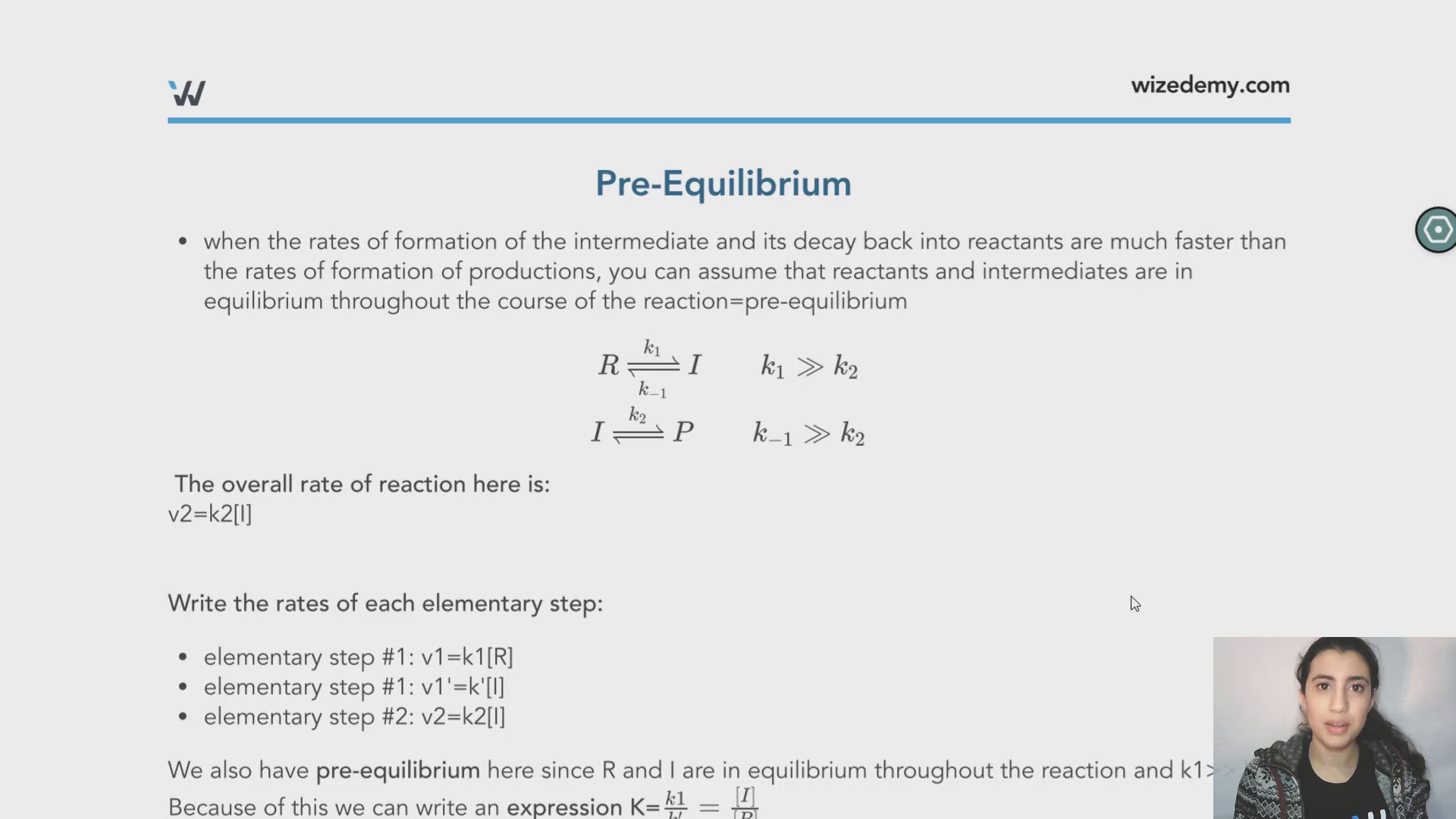
Pre-Equilibrium
- when the rates of formation of the intermediate and its decay back into reactants are much faster than the rates of formation of products, you can assume that reactants and intermediates are in equilibrium throughout the course of the reaction=pre-equilibrium
The overall rate of reaction here is:
v2=k2[I]
Write the rates of each elementary step:
- elementary step #1: v1=k1[R]
- elementary step #1: v1'=k'[I]
- elementary step #2: v2=k2[I]
We also have pre-equilibrium here since R and I are in equilibrium throughout the reaction and k1>> k2
Wize Concept
Since the reactants and intermediate are in equilibrium, recall that for equilibrium we know:
the rate of the forward reaction=rate of the backward reaction
In this case: k1[R]=k'[I]
Because of this we can write an expression K=
Now we can solve for our intermediate (I):
Now take the overall rate of reaction we have and plug in the expression for the intermediate:
v=v2=k2[I]
v=v2=k1k2[R]/k'
Could let K=k1k2/k' to simplify it:
v(overall)=K[R]
This was much faster than standard state approximation! We got the same answer by using pre-equilibrium and we were able to do this because there was an equilibrium between the reactants and intermediate!

Mark Yourself Question
- Grab a piece of paper and try this problem yourself.
- When you're done, check the "I have answered this question" box below.
- View the solution and report whether you got it right or wrong.
Write a rate law for the formation of NH3BH3 which involves only the concentration of reactants and rate constants.