Popular Courses
CHEM 1301A/B
Western University
General Chemistry
University Study Guides
CHEM 112
Queen's University
CHEM 121
University of British Columbia
DAT
General Course
Chemistry
General Course
General Chemistry
University Study Guides
CHEM 205
Concordia University
CHEM 121
Simon Fraser University
APSC 131
Queen's University
CHEM 1100
University of Manitoba
CHEM 1481
Texas A & M University
CEM 141
Michigan State University
CHMA10H3
University of Toronto
SC/CHEM 1100 4.00
York University
CHM 2045
University of Florida
CHEM 1001
Carleton University
CHEM 1035
Virginia Tech
CHEM 6A
University of California - San Diego
CHEM 111
University of British Columbia
0:00 / 0:00
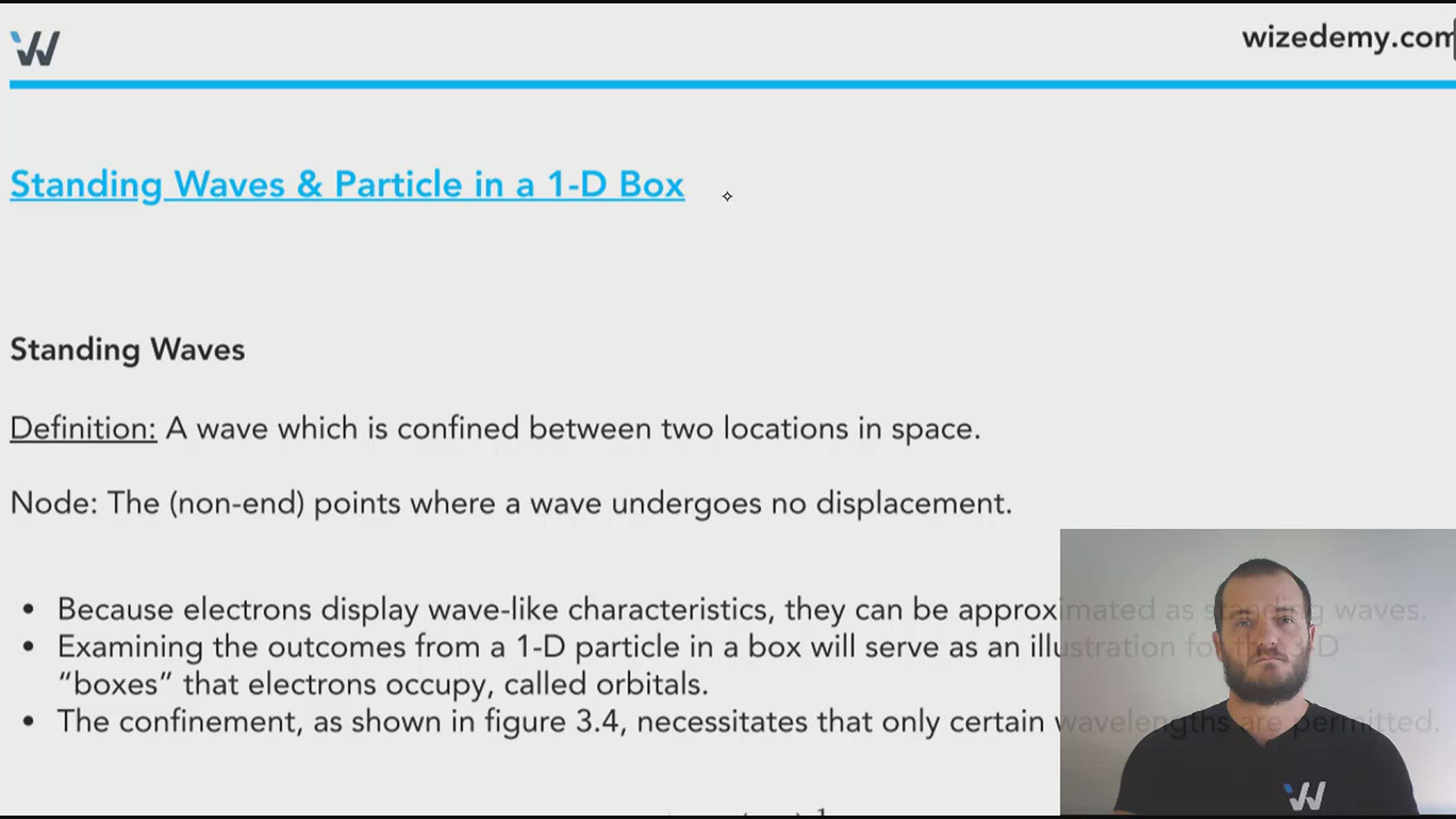
Standing Waves & Particle in a 1-D Box
Standing Waves
Definition: A wave which is confined between two locations in space.
Node: The (non-end) points where a wave undergoes no displacement.
- Because electrons display wave-like characteristics, they can be approximated as standing waves.
- Examining the outcomes from a 1-D particle in a box will serve as an illustration for the 3-D “boxes” that electrons occupy, called orbitals.
- The confinement, as shown in figure 3.4, necessitates that only certain wavelengths are permitted.
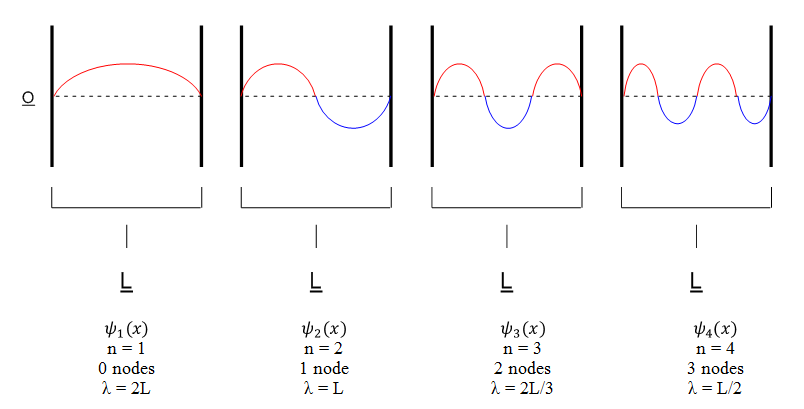
Wavefunctions
- The standing waves shown above can be described by mathematical functions, or, wavefunctions
- The sin wave provides the oscillation between positive and negative values
- L is the length of the box
- The !term is a normalization term and you are NOT required to understand what it does (for the purpose of this course).
- The probability of finding a particle at a given position is found by squaring the wavefunction and is denoted
Kinetic Energy and Quantization
- When we think about kinetic energy in the macroscopic world, it seems fairly intuitive that kinetic energy could be any value and varies linearly with velocity
- In the world of subatomic particles, the quantization of wavelength results in a quantization of other properties like kinetic energy
- Using the classical equation for kinetic energy and momentum, we can add in the equation of de Broglie as well as the wavelength of a particle in one-dimensional box.This allows us to express kinetic energy in terms of n and L as shown below:
- n represents which wavefunction we are looking at (n=1,2,3,4...)
- m is the mass of the particle, typically an electron.
- L is the length of the box
- Note that this is the equation for kinetic energy of a particle in a 1-D box
What is the wavelength of a n = 4 standing wave confined to a 210nm length?
0:00 / 0:00
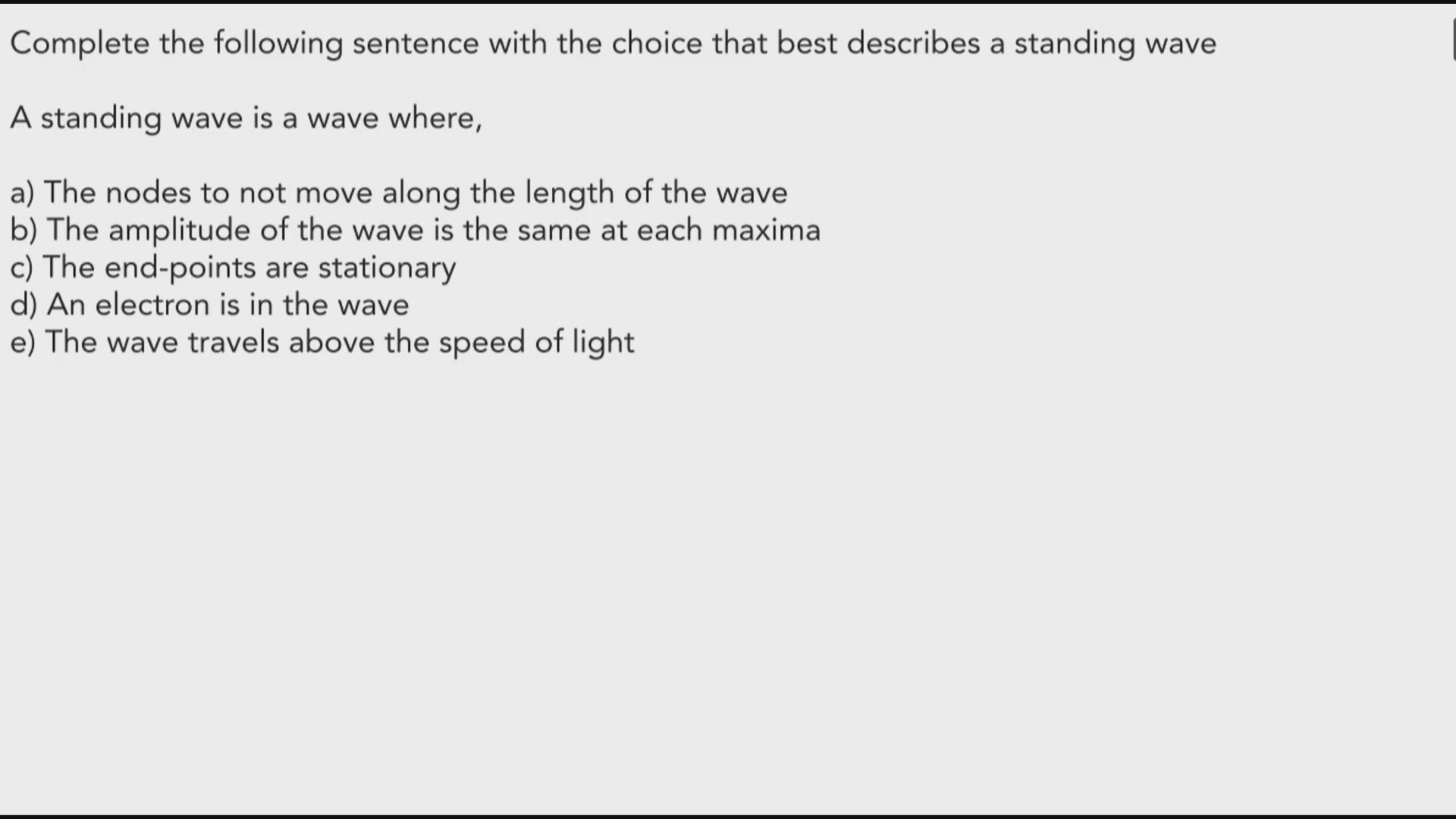
Complete the following sentence with the choice that best describes a standing wave
A standing wave is a wave where,
a) The nodes to not move along the length of the wave
b) The amplitude of the wave is the same at each maxima
c) The end-points are stationary
d) An electron is in the wave
e) The wave travels above the speed of light
A standing wave is defined as a wave with fixed endpoints, C. A and B are correct but they do not define a standing wave. D and E make no sense.
C
0:00 / 0:00
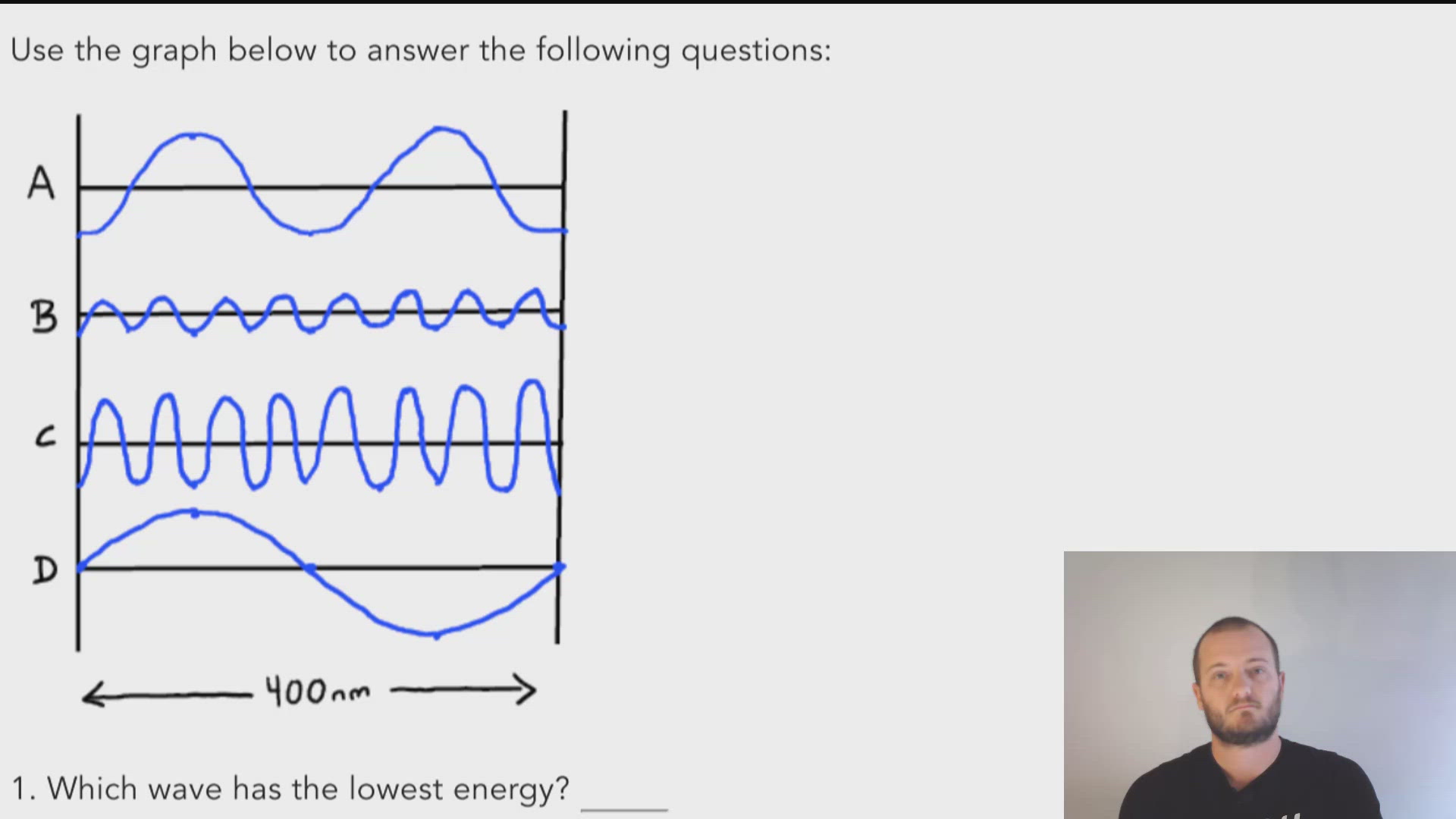
Use the graph below to answer the following questions:
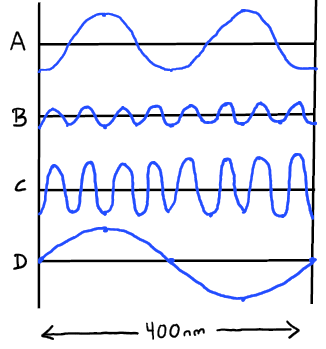
1. Which wave has the lowest energy?
D
Solution:
Energy is inversely proportional to wavelength, longest wavelength is D (400 nm)
2. What is the wavelength of wave A?
200 nm
Solution:
Wave A does two complete cycles over 400 nm so, 400nm / 2 = 200m
3. If wave B represents a photon from the UV region, what region of the electromagnetic spectrum would you find wave C?
UV
Solution:
B and C have the same frequency (and wavelength) so they are from the same region
4. Which wave has the lowest amplitude?
B
Solution:
The smallest vertical distance is covered by wave B. ie. it's the shortest wave