Wize University Chemistry Textbook > Lewis Structures & Resonance Structures
Lewis Structures of Acids and Salts
0:00 / 0:00
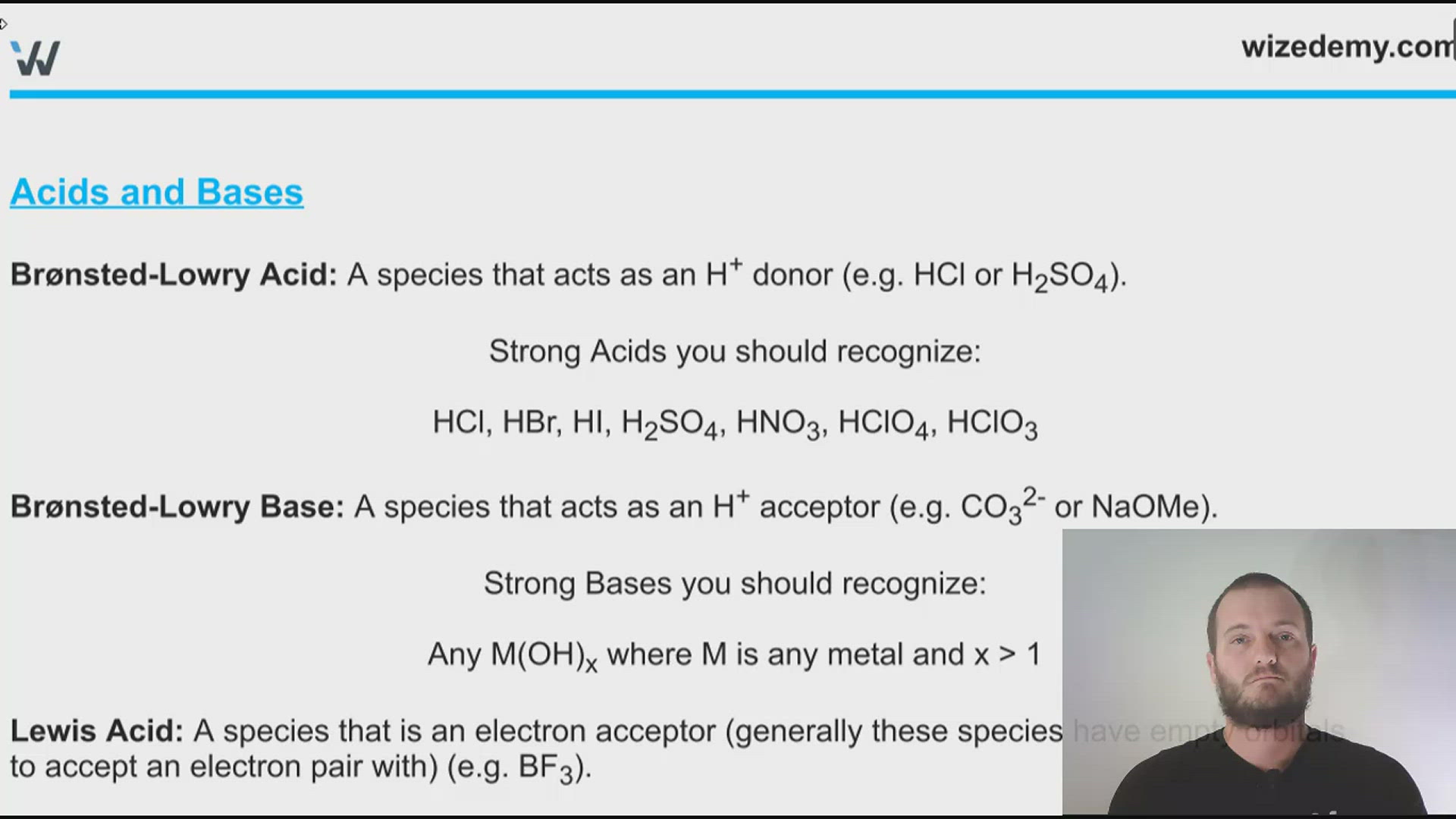
Acids and Bases
Brønsted-Lowry Acid: A species that acts as an H+ donor (e.g. HCl or H2SO4).
Strong Acids you should recognize:
HCl, HBr, HI, H2SO4, HNO3, HClO4, HClO3
Brønsted-Lowry Base: A species that acts as an H+ acceptor (e.g. CO32- or NaOMe).
Strong Bases you should recognize:
Any M(OH)x where M is any metal and x > 1
Lewis Acid: A species that is an electron acceptor (generally these species have empty orbitals
to accept an electron pair with) (e.g. BF3).
Lewis Base: A species that is an electron donor (generally these species have lone pairs to donate to another species) (e.g. NMe3).
Lewis Structures of Oxoacids
An oxoacid is an acid which contains at least one H-O bond and at least one other element. Common examples include H3PO4, H2SO3, and many of the strong acids listed above.
To draw the Lewis structure of an oxoacid follow these steps:
- Remove the hydrogen atoms as "H+" atoms
- Draw the Lewis structure of the resulting anion as normal (eg. PO43-, SO32-)
- Reattach the "H+" ions to the negatively charge oxygen atoms

0:00 / 0:00
Lewis Structures of Acids and Salts
- Using normal rules and steps of Lewis structures do not always apply for acids and salts. Take for example HNO3 and NaNO3:

0:00 / 0:00
Draw the Lewis structure for sulfuric acid, H2SO4


Mark Yourself Question
- Grab a piece of paper and try this problem yourself.
- When you're done, check the "I have answered this question" box below.
- View the solution and report whether you got it right or wrong.
Draw the correct lewis structure of chloric acid and draw all resonance structures.