Wize University Chemistry Textbook > Introduction to Organic Chemistry
Unrelated Compounds or Isomers?
Popular Courses
General Chemistry
University Study Guides
Chemistry
General Course
General Chemistry
University Study Guides
APSC 132
Queen's University
CHEM 112B
Queen's University
CHEM 130
University of British Columbia
CHEM 1100
University of Manitoba
CHEM 1481
Texas A & M University
CHMA10H3
University of Toronto
SC/CHEM 1100 4.00
York University
CHM 2045
University of Florida
CHEM 1001
Carleton University
CHEM 111
University of British Columbia
CHEM 112
University of Saskatchewan
CHEM 1P91
Brock University
CHMA11H3
University of Toronto
CHEM 1110
University of Manitoba
CHM 1301
University of Ottawa
CHEM 1300
University of Manitoba
CHEM 119
Texas A&M University
0:00 / 0:00
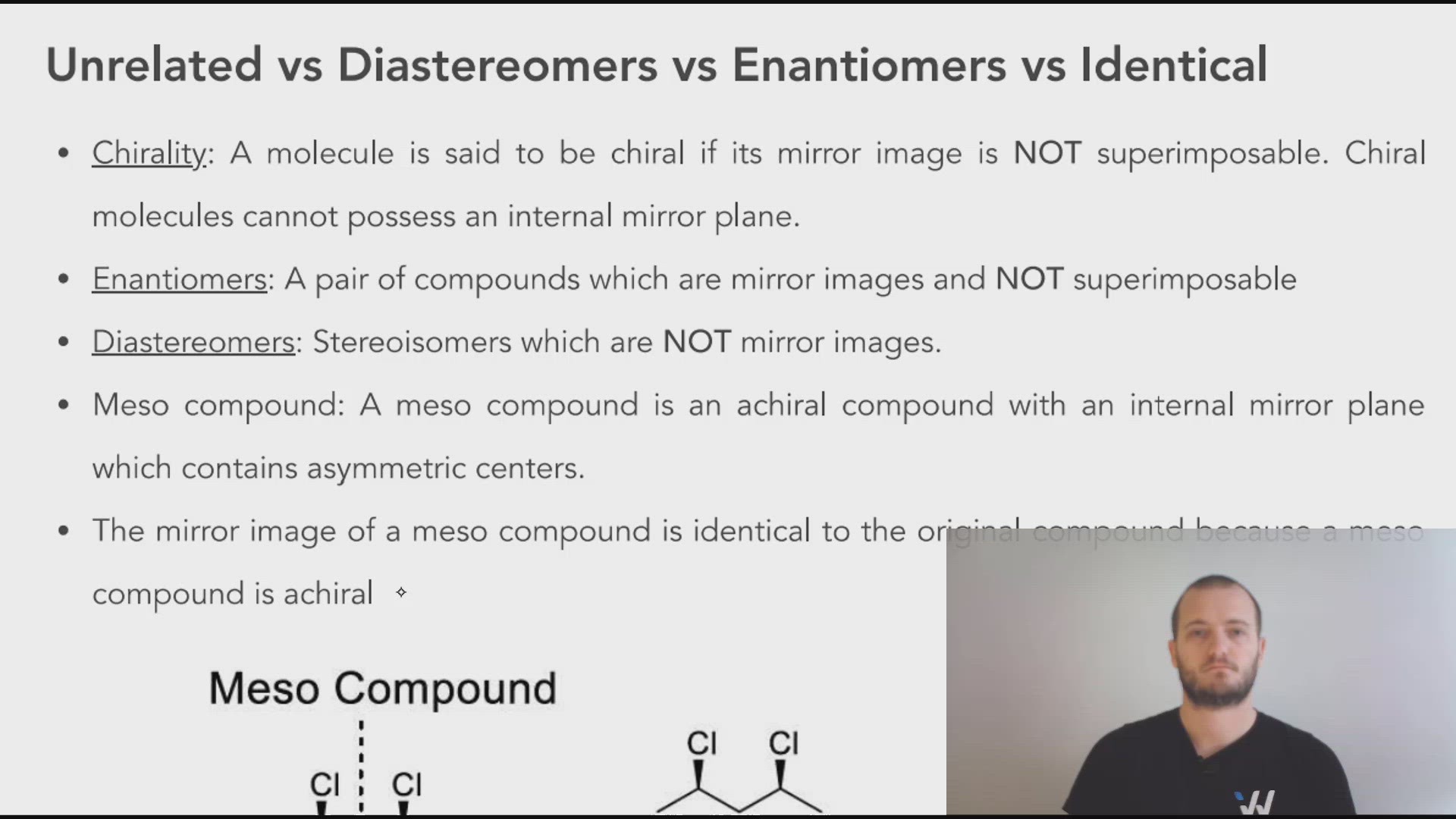
Unrelated vs Diastereomers vs Enantiomers vs Identical
- Chirality: A molecule is said to be chiral if its mirror image is NOT superimposable.
- Chiral molecules have chiral centres but cannot possess an internal mirror plane.
- Enantiomers: A pair of compounds which are mirror images and NOT superimposable
- Diastereomers: Stereoisomers which are NOT mirror images.
- Meso compound: A meso compound is an achiral compound with an internal mirror plane which contains chiral centers.
- The mirror image of a meso compound is identical to the original compound because a meso compound is achiral

Notice that if we take a chiral molecule with two chiral centers and change one of the centers we create a diastereomer but if we change all the chiral centers we create an enantiomer.

Enantiomers vs Diastereomers
Steps for Identifying Chirality in Molecules
- Do the molecules have the same bond connectivity?
- If no, they are unrelated compounds
- If yes, move on to step 2
- Are the compounds superimposable?
- If yes, they are identical
- If no, the molecules are stereoisomers (D or E)
- Are the compounds mirror images?
- If no, the compounds are diastereomers
- If yes, the compounds are enantiomers
Practice: Unrelated vs Identical vs Diastereomers vs Enantiomers
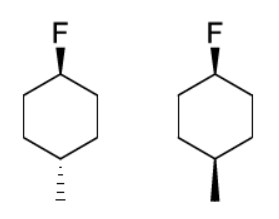
Are the compounds enantiomers, diastereomers, identical or unrelated?
Which of the following describes the 2 compounds?