Popular Courses
ECON 203
Concordia University
ECON 203
Concordia University
Macroeconomics
University Study Guides
AP Macroeconomics Exam Prep Course
AP Exam Prep
ECONOMIC 1022A/B
Western University
Macroeconomics
General Course
ECON 102
University of British Columbia
ECON*1100
University of Guelph
Macroeconomics
University Study Guides
ECON 203
University of Calgary
ECON 102
University of Alberta
ECO102H1
University of Toronto
ECO 1102
University of Ottawa
ECON 209
McGill University
ECON 1BB3
McMaster University
COMM 171
Queen's University
ECON 112
Queen's University
AP/ECON 1010 3.00
York University
ECON 295
McGill University
ECON 110
Queen's University
0:00 / 0:00
Loanable Funds
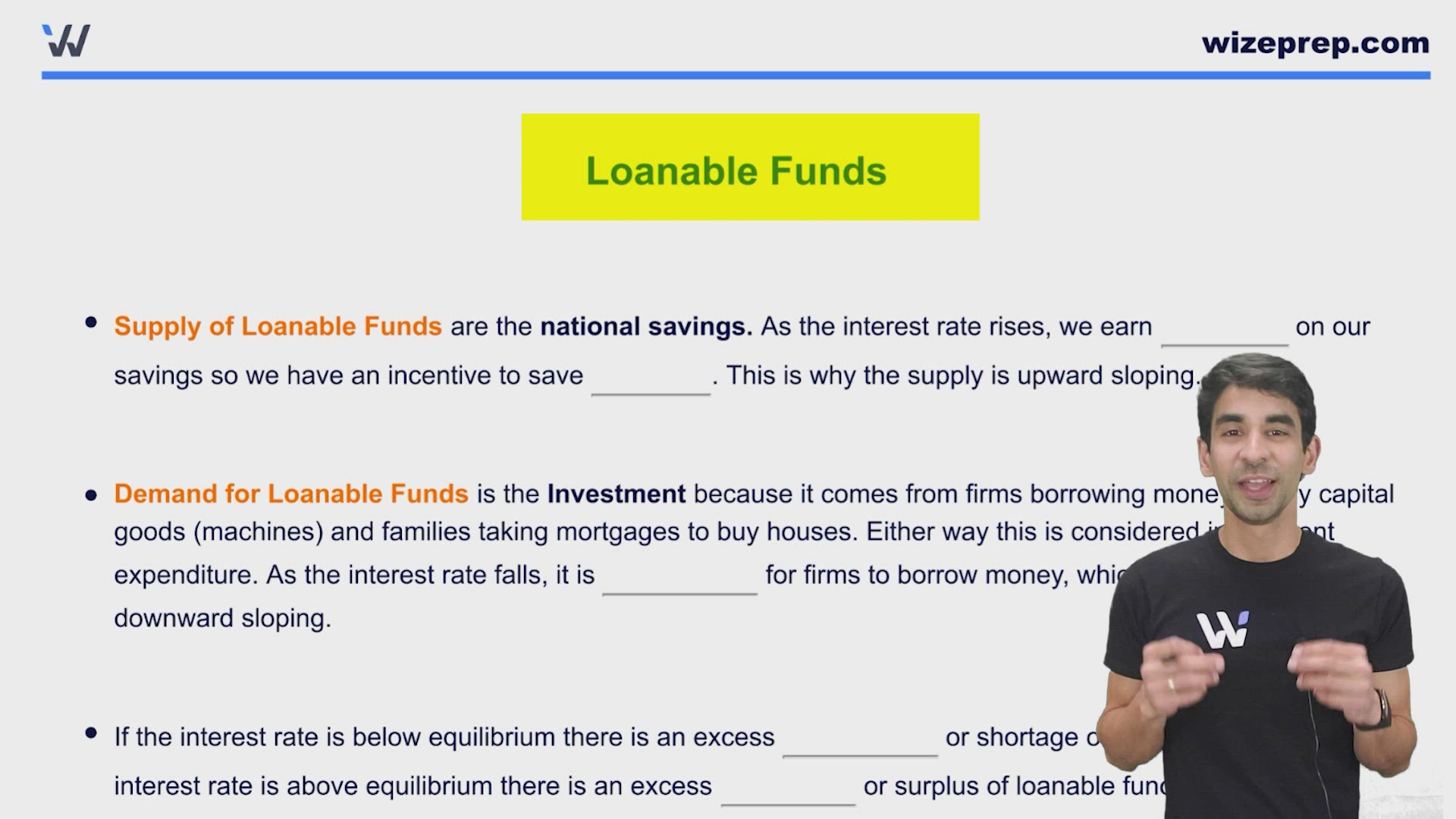
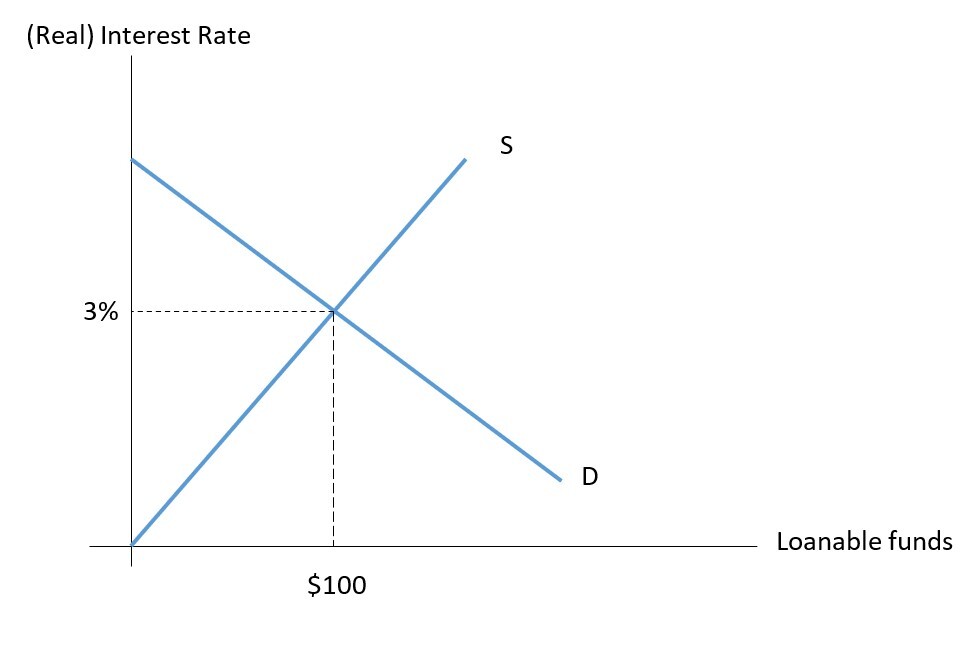
- Supply of Loanable Funds are the national savings. As the interest rate rises, we earnmoreon our savings so we have an incentive to savemore. This is why the supply is upward sloping.
- Demand for Loanable Funds is the Investment because it comes from firms borrowing money to buy capital goods (machines) and families taking mortgages to buy houses. Either way this is considered investment expenditure. As the interest rate falls, it ischeaperfor firms to borrow money, which is why the demand is downward sloping.
- If the interest rate is below equilibrium there is an excessdemandor shortage of loanable funds and when interest rate is above equilibrium there is an excesssupplyor surplus of loanable funds.

Factors That Affect Supply
- Government budget surpluses / deficits - There can be crowding out caused by government deficits which leads to supply of loanable funds shifting to theleftcausing interest rates toriseand Investment todecrease.
- Tax incentives for saving more - If there are more incentives like a tax-free savings account then national savings willincreasemeaning shift to therightwhich would cause equilibrium interest rate todecrease
Factors That Affect Demand
- Tax credit for Investment - If the government gives a tax break for firms spending more on Investment expenditure, the demand for loans willincreasemeaning shift to therightand this will cause equilibrium interest rate toincrease
- Vicious circle - the cycle that results when deficits reduce the supply of loanable funds, increase interest rates, discourage investment, and result in slower economic growth; slower growth leads to lower tax revenue and higher spending on income- support programs, and the result can be even higher budget deficits
- Virtuous circle - the cycle that results when surpluses increase the supply of loanable funds, reduce interest rates, stimulate investment, and result in faster economic growth; faster growth leads to higher tax revenue and lower spending on income- support programs, and the result can be even higher budget surpluses
- Government Net Debt - the difference between the value of government financial liabilities and financial assets. The government can borrow from other countries, the central bank, the World Bank and commercial banks.

0:00 / 0:00
Example: Loanable Funds
If there is a surplus of loanable funds then:
a. supply of loanable funds will shift right and demand will shift left
b. supply of loanable funds will shift left and demand will shift right
c. neither curve shifts, but the quantity supplied of loanable funds increases and the quantity demanded decreases as the interest rate rises to equilibrium
d. neither curve shifts, but the quantity supplied of loanable funds decreases and the quantity demanded increases as the interest rate falls to equilibrium
D.
Surplus means that there's excess supply which means the interest rate is above equilibrium (try drawing the graph). This means interest rates will eventually fall back to equilibrium. As you move down along the supply curve, the quantity supplied is decreasing. As you move down along the demand curve, the quantity demanded is increasing
Practice: Loanable Funds
If the current interest rate in the market for loanable funds is below equilibrium:
Practice: Supply and Demand for Loans
What would happen in the market for loanable funds if the government decreased the tax rate on interest income?
Practice: Government Budget and Loans
An increase in the budget deficit
Practice: Budget Deficit and Loans
An increase in the budget deficit would cause a
Practice: Factors That Affect Supply and Demand for Loans
Suppose the government were to replace the income tax with a consumption tax. This would make the interest rate: