Create a free account to get started

Unlock full course notes by signing up

  • Video lessons taught by top educators
  • Practice questions with guided solutions
  • Written review notes for reference
  • Expert answers anytime from course tutors

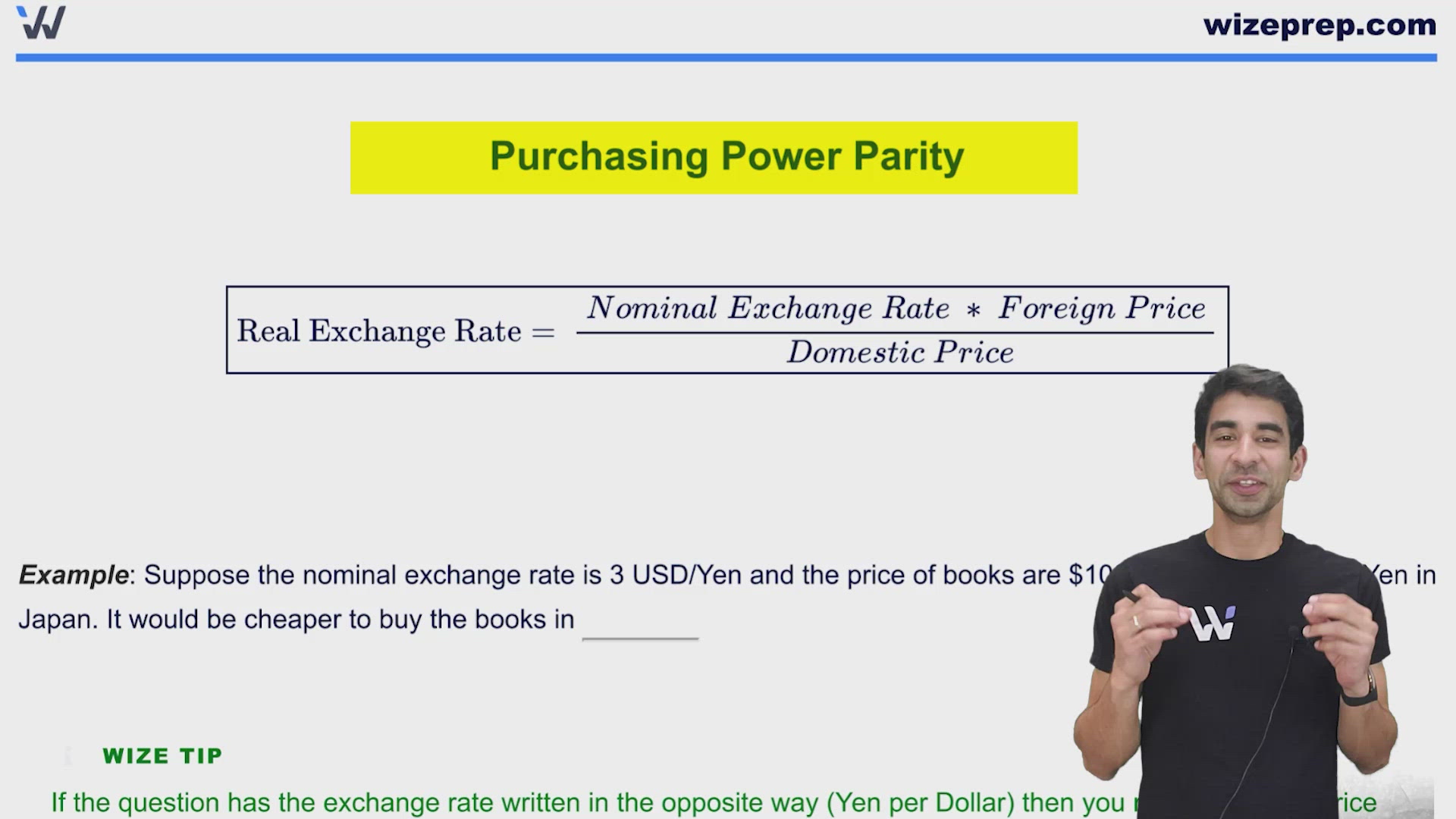
Purchasing Power Parity


Real Exchange Rate=  Nominal Exchange Rate ∗ Foreign Price  Domestic Price\boxed{\text{Real\ Exchange Rate} =\ \frac{\ Nominal\ Exchange\ Rate\ *\ Foreign\ Price\ }{\ Domestic\ Price} }


Example: Suppose the nominal exchange rate is 3 USD/Yen and the price of books are $100 in the USA and 40 Yen in Japan. It would be cheaper to buy the books in ________


  • Purchasing power parity (PPP) - when the real exchange rate = 1. It only applies to tradable goods like books, clothes, shoes (but does not apply to golf lessons, for example). In the example above, according to purchasing power parity the nominal exchange rate would eventually be ________ USD/Yen.


  • Small open economy - an economy that trades goods and services with other economies and, by itself, has a negligible effect on world prices and interest rates.

  • Perfect capital mobility - full access to world financial markets.


  • Interest rate parity - a theory where the real interest rate on comparable financial assets should be the same in all countries. It does not always occur if assets have different risk and taxes.


interest on domestic asset = interest on foreign asset + percentage ∆ in expected exchange rate \boxed{\text{interest on domestic asset = interest on foreign asset + percentage ∆ in expected exchange rate }}


Create a free account to get started

Unlock full course notes by signing up

  • Video lessons taught by top educators
  • Practice questions with guided solutions
  • Written review notes for reference
  • Expert answers anytime from course tutors

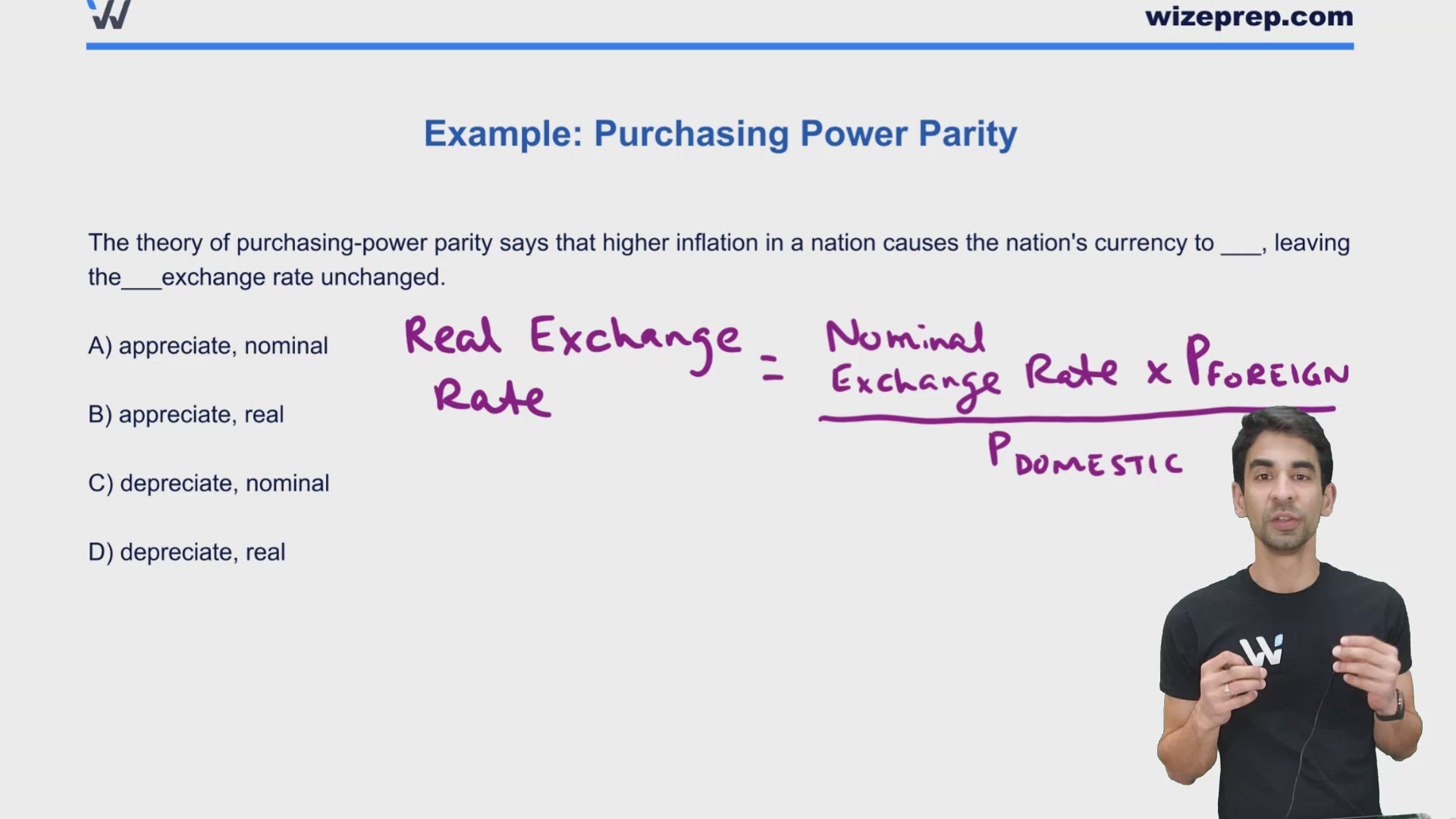
Example: Purchasing Power Parity


The theory of purchasing-power parity says that higher inflation in a nation causes the nation's cur­rency to ___, leaving the___exchange rate unchanged.


A) appreciate, nominal

B) appreciate, real

C) depreciate, nominal

D) depreciate, real


D.

Higher inflation means other countries will not buy from your country so your currency will depreciate. However, according to purchasing power parity, the real exchange rate will still be equal to 1.


Practice: Purchasing Power Parity


If a cup of coffee costs 2 euros in Paris and $6 in Toronto and purchasing-power parity holds, what is the exchange rate?


Choose an answer

Create a free account to get started

Unlock full course notes by signing up

  • Video lessons taught by top educators
  • Practice questions with guided solutions
  • Written review notes for reference
  • Expert answers anytime from course tutors

Practice: Exchange Rate

If a nation's currency doubles in value on foreign exchange markets, the currency is said to___, reflecting a change in the ___ exchange rate.

Choose an answer

Create a free account to get started

Unlock full course notes by signing up

  • Video lessons taught by top educators
  • Practice questions with guided solutions
  • Written review notes for reference
  • Expert answers anytime from course tutors