Wize University Microeconomics Textbook > Elasticity
Point Price Elasticity of Demand
Popular Courses
ECON 201
Concordia University
ECONOMIC 1021A/B
Western University
Microeconomics
University Study Guides
ECON 201
University of Calgary
ECON 101
University of British Columbia
ECON 1B03
McMaster University
ECON*1050
University of Guelph
ECON 101
University of Alberta
Microeconomics
General Course
ECO101H1
University of Toronto
Microeconomics
University Study Guides
ECON 208
McGill University
ECON 101
University of Waterloo
ECON 110A
Queen's University
ECN 104
Toronto Metropolitan University
ECO 1104
University of Ottawa
EC120
Wilfrid Laurier University
AP/ECON 1000 3.00
York University
ECON 103
University of Victoria
ECON 1101
Dalhousie University

0:00 / 0:00
Price Elasticity of Demand
Inelastic
- Means you are insensitive to the price
- If price rises, the quantity demanded will fall by only a little bit. Example: Medicine
Elastic
- Means you are sensitive to the price
- If price rises, the quantity demanded will fall by a lot. Example: Pepsi
Point Price Elasticity of Demand
- For products that have inelastic demand, the absolute value of Price Elasticity of Demand (Ed) will belessthan 1 Example: If the price of medicine increases by 50% and the quantity demanded falls by 10% (notice percentage change in quantity is smaller than percentage change in price), then what would be the price elasticity of demand?
Elasticity of demand = -10% / 50% = -0.2
The absolute value of -0.2 is 0.2 which is less than 1 (meaning inelastic).
- For products that have elastic demand, the absolute value of Ed will begreaterthan 1 Example: If the price of Pepsi increases by 5% and the quantity demanded falls by 50% (notice percentage change in quantity is larger than percentage change in price), then what would be the price elasticity of demand?
Elasticity of demand = -50% / 5% = -10
The absolute value of -10 is 10 which is greater than 1 (meaning elastic).
- For products that have unit elastic demand, the absolute value of Ed will beequalto 1 Example: If the price of oranges increases by 5% and the quantity demanded falls by 5% (notice percentage change in quantity is equal to percentage change in price), then what would be the price elasticity of demand?
Elasticity of demand = -5% / 5% = -1
The absolute value of -1 is 1 which is unit elastic (in the real world there's no example of products with unit elastic demand, it's just a concept.
For products with different types of demand, the absolute value of the Price Elasticity of Demand will have different values:
Percentage Change
In the examples above the percentage changes were given. If they give you just a change (without percentages) you can use the following formula to convert to percentages:
Example: If the quantity changes from 40 to 50 units what is the percentage change?
Percentage change = (50 - 40) / 40 * 100 = 25%
0:00 / 0:00
Example: Point Elasticity with Numbers and Equations
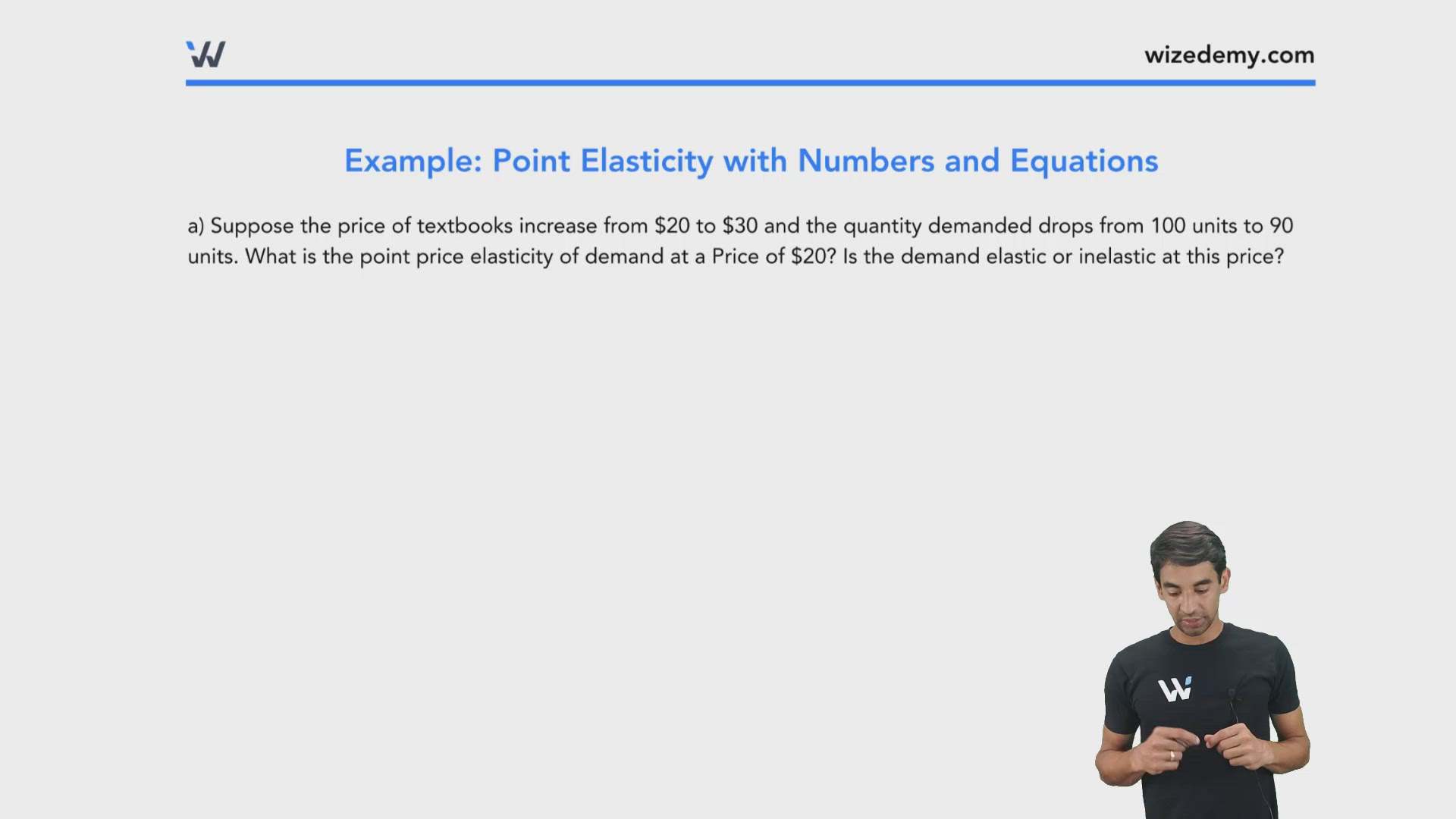
a) Suppose the price of textbooks increase from $20 to $30 and the quantity demanded drops from 100 units to 90 units. What is the point price elasticity of demand at a Price of $20? Is the demand elastic or inelastic at this price?
Point price elasticity of demand (point Ed) =
% Change in P =
% Change in Q =
Point Ed =
Point Ed = -0.2 which is inelastic (absolute value is less than 1)
b) If the demand equation is P = 70 – 2Q, what is the price elasticity of demand at a price of $40?
First lets plug in price of 40 in the demand equation to get the quantity:
40 = 70 - 2Q
2Q = 30
Q = 15
Since they only gave you one price, you can just make up any number for a second price and plug in to the demand so that you can get the corresponding quantities (you can always do this). For example let's plug the second price as $50:
50 = 70 - 2Q
2Q = 20
Q = 10
Now we have 2 prices and 2 quantities so we can find the percentage changes:
% Change in P =
% Change in Q =
Point price elasticity of demand (point Ed) =
Point Ed =
Point Ed = -1.33 which is elastic (absolute value is greater than 1)