Wize University Microeconomics Textbook > Elasticity
Price Elasticity of Supply
Popular Courses
ECON 201
Concordia University
ECONOMIC 1021A/B
Western University
Microeconomics
University Study Guides
ECON 201
University of Calgary
ECON 101
University of British Columbia
ECON 1B03
McMaster University
ECON*1050
University of Guelph
ECON 101
University of Alberta
Microeconomics
General Course
ECO101H1
University of Toronto
Microeconomics
University Study Guides
ECON 208
McGill University
ECON 101
University of Waterloo
ECON 110A
Queen's University
ECN 104
Toronto Metropolitan University
ECO 1104
University of Ottawa
EC120
Wilfrid Laurier University
AP/ECON 1000 3.00
York University
ECON 103
University of Victoria
ECON 1101
Dalhousie University

0:00 / 0:00
Elasticity of Supply
Elasticity of supply has the same rules as elasticity of demand, but it's from the firm's perspective rather than the consumer.
Things to Remember About Elasticity of Supply (Es)
- Elasticity of supply is always positive
- Inelastic - elasticity is between 0 and 1
- Elastic - elasticity is greater than 1
- Unit elastic - elasticity is = 1
Factors that Affect Price Elasticity of Supply
1. Access and Availability of Substitutes for its Resources
The more substitutes that a firm has in resources (workers and machines) the more
elastic
the supply
Example: if workers can easily be replaced by machines, then the supply will be more elastic because the firm can produce more products quite easily.
2. Time horizon
- In the long run the supply iselastic
- In the short run the supply isinelastic
Example: If you are a farmer that grows apples, you will not be able to increase your apple production much next week (short run) so your supply is inelastic. But one year in the future (long run) you can increase apple production a lot (because you have time to plant more trees) so your supply is elastic.
Perfectly Elastic and Inelastic Supply

- Perfectly inelastic supply - when the price changes, the quantity supplied does not change at all Example: Seats in a movie theater. You cannot add or remove seats from the theater.
- Perfectly elastic supply - when the price changes, the quantity supplied changes by an infinite amount. Example: Pencils. If the price of pencils increase, the company that makes them can increase production very easily
Different Elasticities Along the Supply Curve
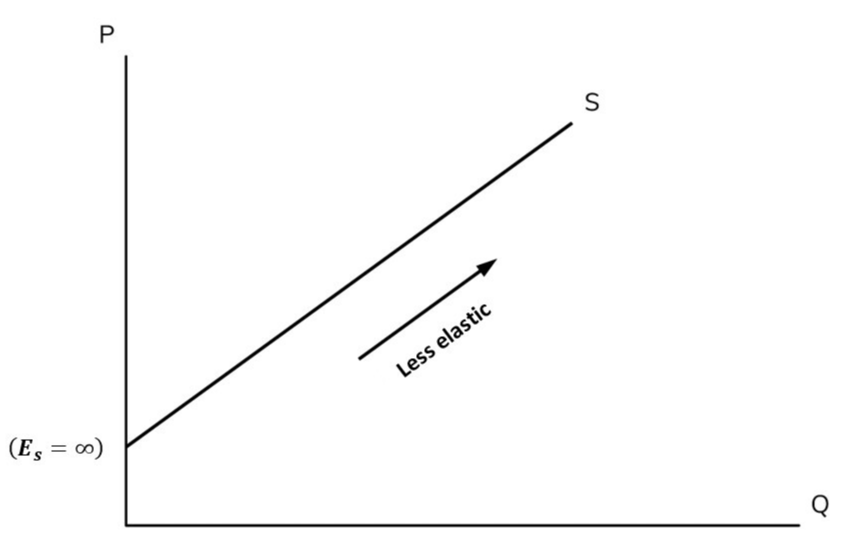
- On the left side of the supply curve (at lower quantities) the supply is more elastic because when the firm is making a low quantity it is easy for them to increase production. Example: If your firm is making 1 shoe and you want to double production to 2 shoes, it will be quite easy (you can use the same worker or machine to make the extra shoe).
- On the right side of the supply curve (at higher quantities) the supply is less elastic because when the firm is making a high quantity it is harder for them to increase production. Example: If your firm is making 1000 shoes and you want to double production to 2000 shoes, it will be quite difficult (you might need to get more machines and workers which can take a long time).
Unit Elastic Supply

When the supply curve starts at the origin (the bottom left corner) the elasticity of supply comes out to be 1 (unit elastic) no matter what two points you take on the supply curve.
Example:
In the diagram above, from point A to B the price doubles from $1 to $2 (which means increase of 100%) and the quantity supplied also doubles from 2 units to 4 units (which is increase of 100%) so:
From point B to C the price increases from $2 to $3 (which means increase of 50%) and the quantity supplied increases from 4 units to 6 units (which is also increase of 50%) so:
0:00 / 0:00
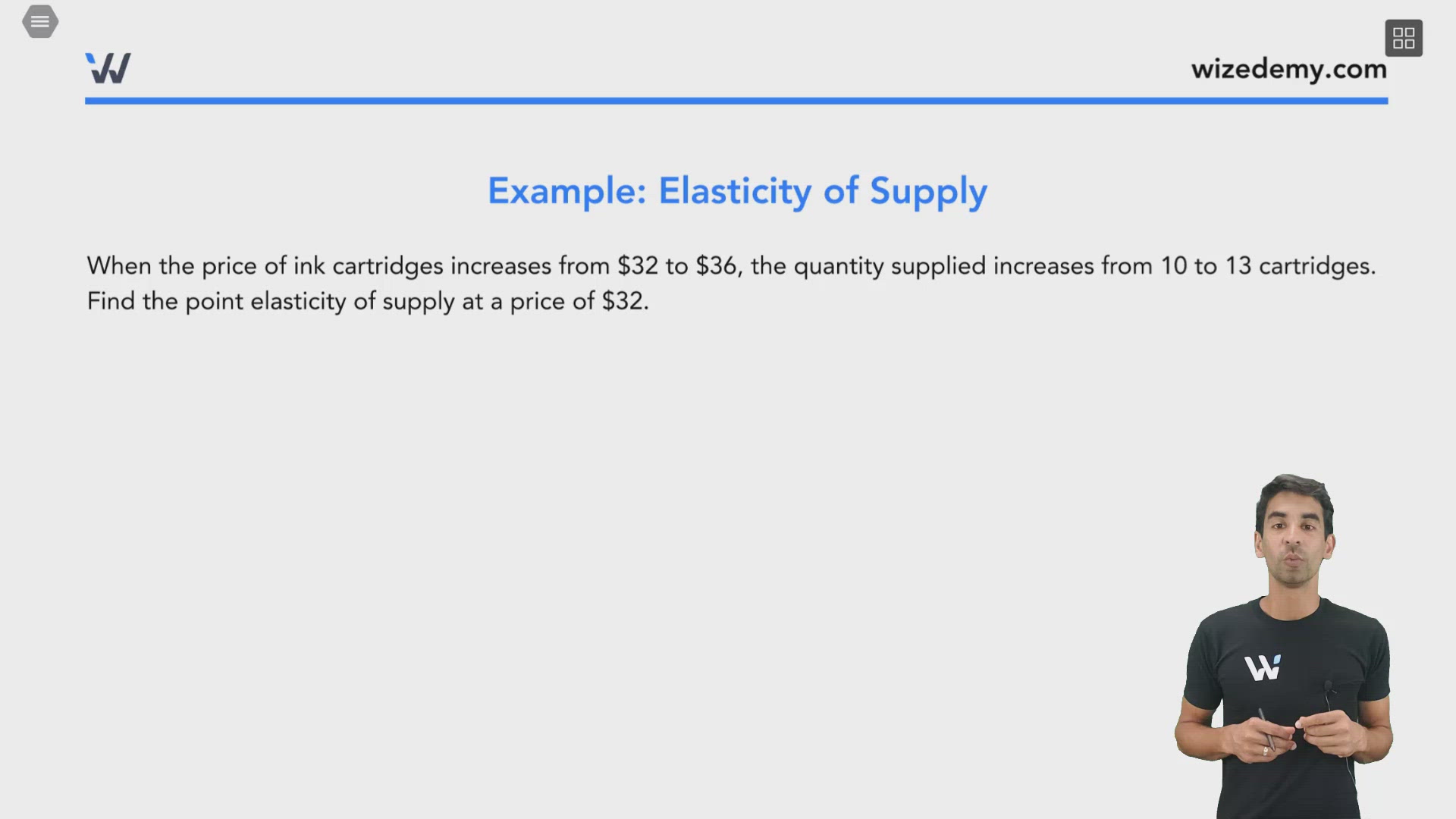
Example: Elasticity of Supply
When the price of ink cartridges increases from $32 to $36, the quantity supplied increases from 10 to 13 cartridges. Find the point elasticity of supply at a price of $32.
This means supply is elastic at this price because the elasticity is great than 1.