Wize University Microeconomics Textbook > Production and Costs
Fixed Costs and Variable Costs
Popular Courses
ECON 201
Concordia University
ECONOMIC 1021A/B
Western University
Microeconomics
University Study Guides
ECON 201
University of Calgary
ECON 101
University of British Columbia
ECON 1B03
McMaster University
ECON*1050
University of Guelph
ECON 101
University of Alberta
Microeconomics
General Course
ECO101H1
University of Toronto
Microeconomics
University Study Guides
ECON 208
McGill University
ECON 101
University of Waterloo
ECON 110A
Queen's University
ECN 104
Toronto Metropolitan University
ECO 1104
University of Ottawa
EC120
Wilfrid Laurier University
AP/ECON 1000 3.00
York University
ECON 103
University of Victoria
ECON 1101
Dalhousie University
0:00 / 0:00
Fixed Costs and Variable Costs
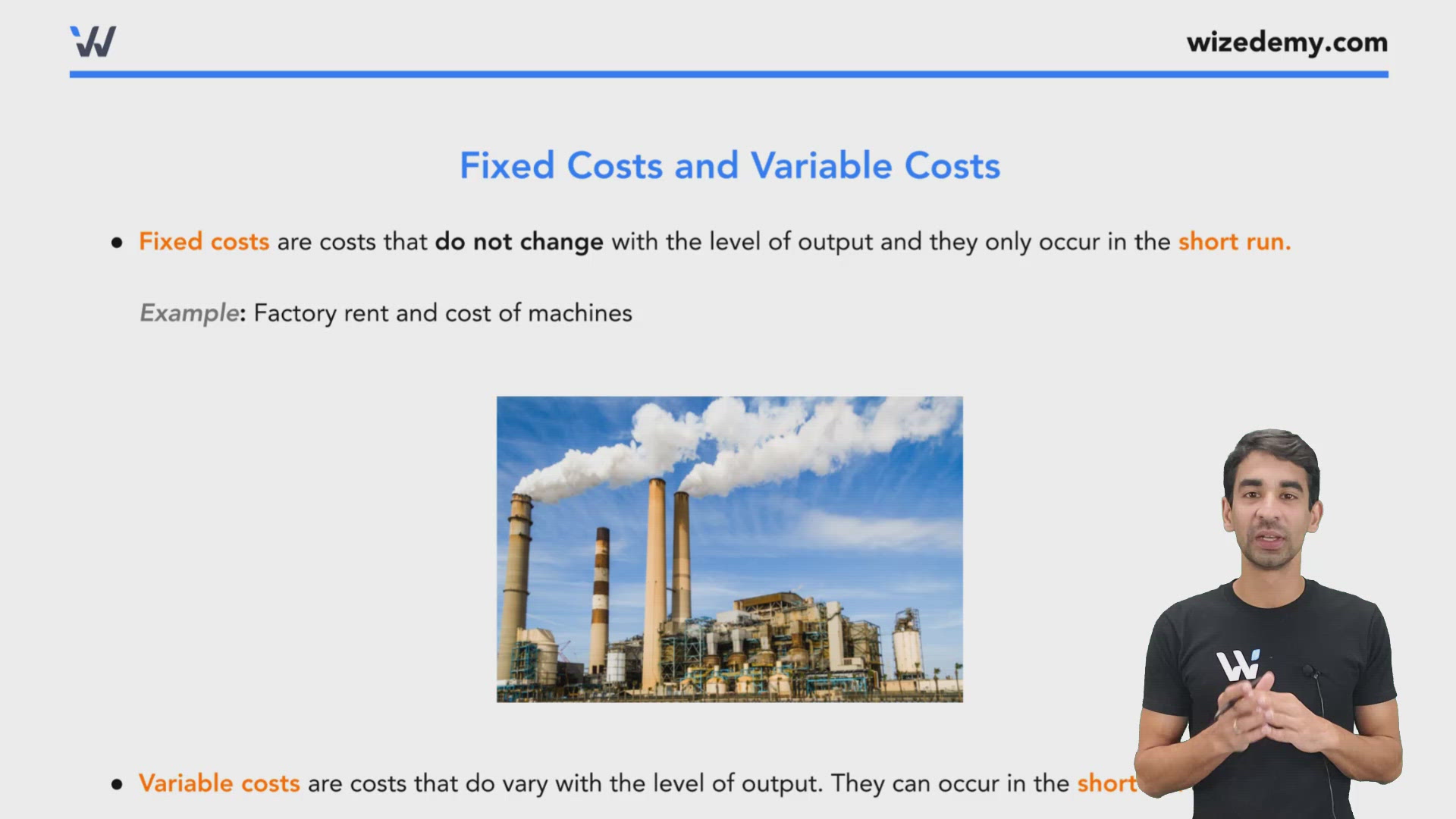
- Fixed costs are costs that do not change with the level of output and they only occur in the short run. Example: Factory rent and cost of machines

- Variable costs are costs that do vary with the level of output. They can occur in the short run and long run. Example: Wages paid to workers and cost of raw materials

- Marginal cost is the additional cost of producing one more unit.
Wize Tip
For the averages always divide the total by quantity (Q).
Wize Tip
Marginal always has change in the formula.
Relationship Between Marginal Product and Marginal Cost
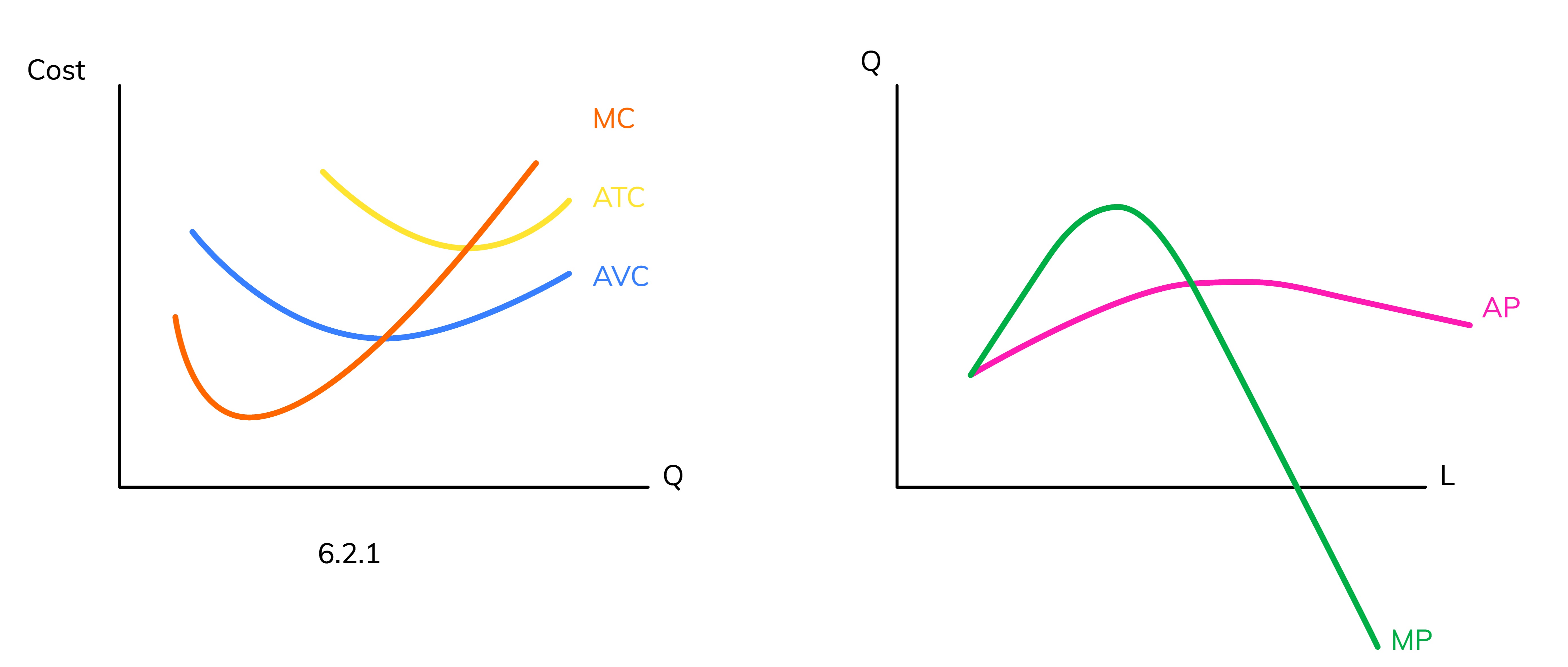
- When marginal product (MP) is increasing, the marginal cost (MC) isdecreasing. This is because as each additional worker becomes more productive (which is a good thing), the additional cost of each extra unit goes down.
- When MP is decreasing, the MC isincreasing. This is because as each additional worker becomes less productive (which is a bad thing), so the additional cost of each extra unit goes down
- MP is at its maximum when MC is at itsminimum
Relationship Between Average Product and Average Variable Cost
- When average product (AP) is increasing, the average variable cost (AVC) isdecreasing. This is because as the average worker gets more productive (which is a good thing), the average variable cost will go down.
- When average product (AP) is decreasing, the average variable cost (AVC) isincreasing. This is because as the average worker gets less productive (which is a bad thing), the average variable cost will go up.
- AP is at its maximum when AVC is at itsminimum
Relationship Between Marginal Cost and Average Variable Cost
- When MC < AVC, it pulls the AVCdownso AVC isdecreasing. This is on theleftside of the graph
- When MC > AVC, it pulls the AVCupso AVC isincreasing. This is on therightside of the graph
- MC = AVC when AVC is at itsminimum
Relationship Between Marginal Cost and Average Total Cost
- When MC < ATC, it pulls the ATCdownso ATC isdecreasing. This is on theleftside of the graph
- When MC > ATC, it pulls the ATCupso ATC isincreasing. This is on therightside of the graph
- MC = ATC when ATC is at itsminimum
Average Fixed Cost
- The only thing you need to know about average fixed costs (AFC) is that it is always decreasing.
- This is because of the formula above. As the output (quantity) increases and we divide the fixed costs by a bigger and bigger number, the AFC falls.

0:00 / 0:00
Example: Fixed and Variable Costs
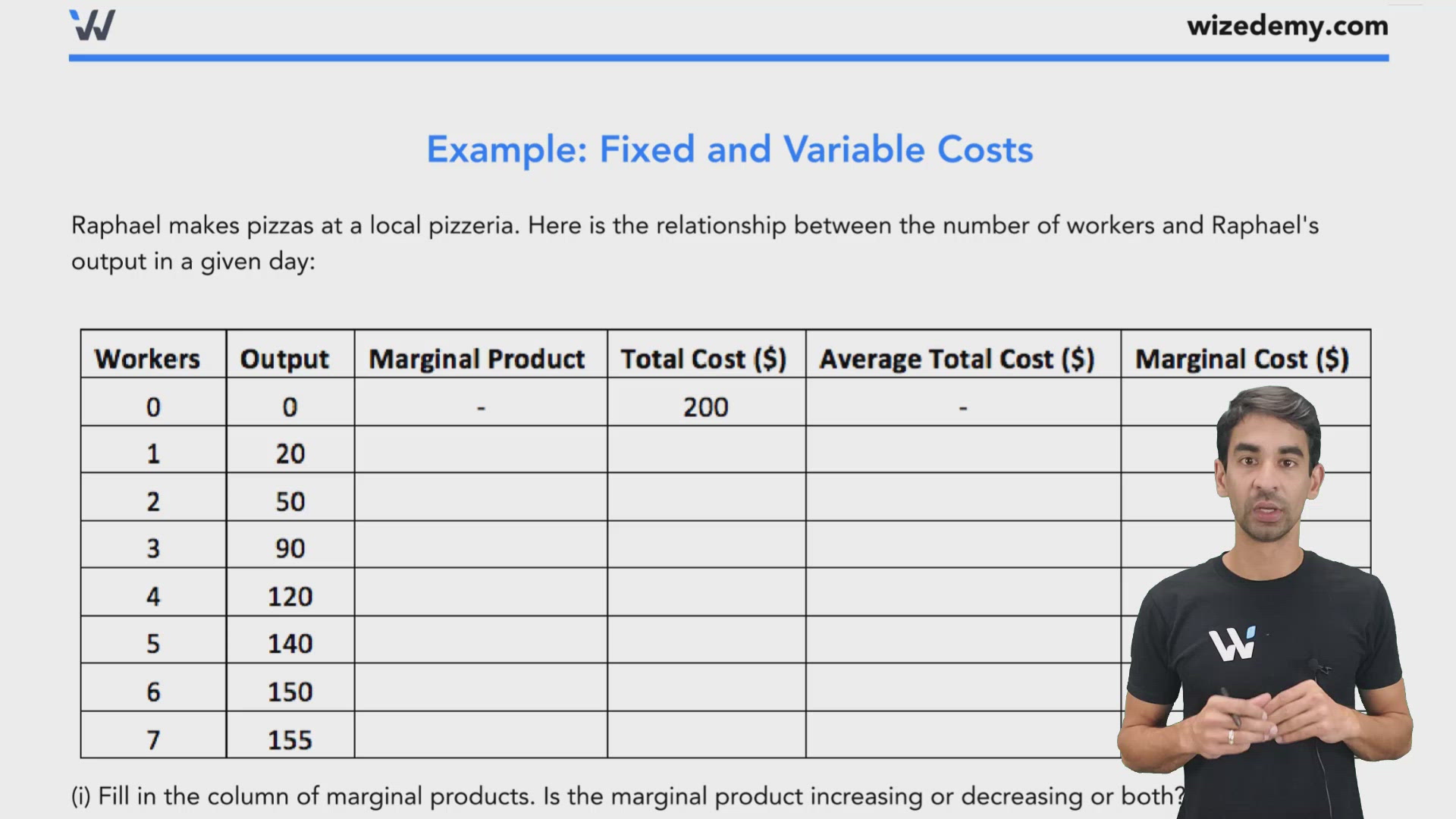
Raphael makes pizzas at a local pizzeria. Here is the relationship between the number of workers and Raphael's output in a given day:
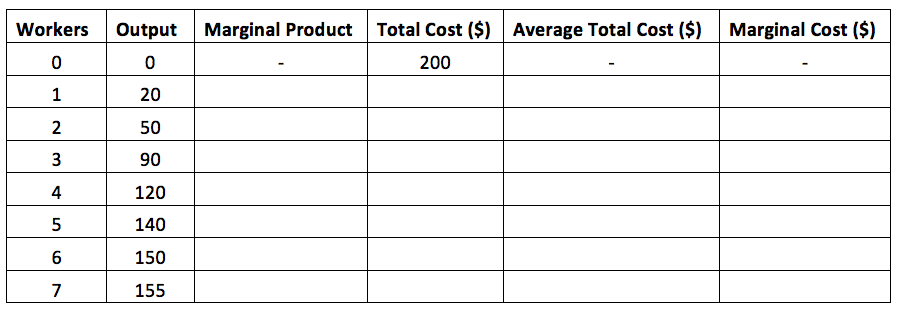
(i) Fill in the column of marginal products. Is the marginal product increasing or decreasing or both? Which law explains the decrease in marginal product?

Find the marginal product in each row using the formula . Marginal product is both increasing and then decreasing. Law of diminishing returns explain the eventual fall in MP.
(ii) A worker costs $100. Use this information to fill in the column for total cost. Fill in the column for average total cost (ATC) rounding any decimal to the nearest tenth.
The total cost is $200 in the first row where output is 0 so that must be the fixed cost (for things like rent). Add $100 for each additional worker in each row.
(iii) Now fill in the column for marginal cost rounding any decimal to the nearest tenth.
Find marginal cost in each row using the formula
(iv) Compare the column for marginal product and for marginal cost. Comment on the relationship linking these two variables. Why does the MC eventually rise?
MP and MC are inversely related. When MP is increasing. MC is decreasing and vice versa. MC eventually rises because MP eventually falls (law of diminishing returns).
(v) Is there a relationship between the marginal cost and the average cost? If yes, use the relationship to explain why the ATC curve is U-shaped.
Yes. When MC < ATC , ATC is decreasing (on the left side)
When MC > ATC, ATC is increasing (on the right side)
Therefore ATC is U-shaped
Practice: Fixed and Variable Costs
Raphael owns an Italian restaurant. The production function relating the number of meals served per day (Q) and the number of employees hired per day (L) is shown in the table. The marginal cost of serving a meal is lowest when Raphael increases the number of meals served per day from ___. The average variable cost of serving a meal is lowest when Raphael serves __ meals per day.