Wize University Microeconomics Textbook > Theory of Consumer Choice
Optimal Bundle (Utility Maximization)
Popular Courses
ECON 201
Concordia University
ECONOMIC 1021A/B
Western University
Microeconomics
University Study Guides
ECON 1B03
McMaster University
ECON*1050
University of Guelph
ECON 101
University of Alberta
Microeconomics
General Course
ECO101H1
University of Toronto
Microeconomics
University Study Guides
ECON 101
University of Waterloo
ECON 110A
Queen's University
ECN 104
Toronto Metropolitan University
ECO 1104
University of Ottawa
AP/ECON 1000 3.00
York University
ECON 1101
Dalhousie University
ECON 111
Queen's University
ECON 103
Simon Fraser University
ECON-1100
University of Windsor
MET EC 101
Boston University
ECON-B 251
Indiana University - Bloomington
0:00 / 0:00
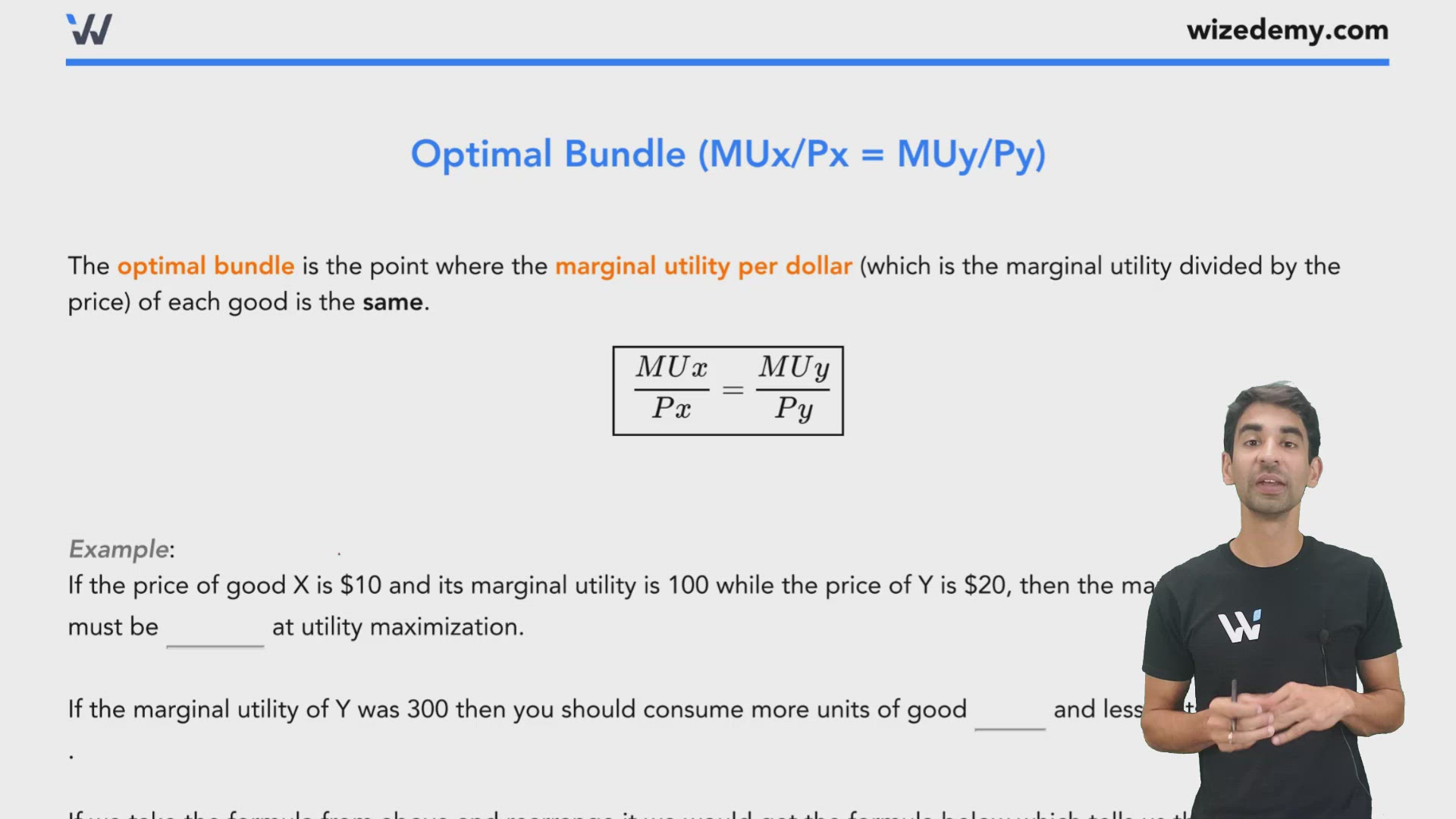
Optimal Bundle (MUx/Px = MUy/Py)
The optimal bundle is also called utility maximization and it is the point where the marginal utility per dollar (which is the marginal utility divided by the price) of each good is the same.
Example:
If the price of good X is $10 and its marginal utility is 100 while the price of Y is $20, then the marginal utility of Y must be
200
at utility maximization.
If the marginal utility of Y was 300 then you should consume more units of good Y
and less units of good X
.If we take the formula from above and rearrange it we would get the formula below which tells us the exact same thing.

0:00 / 0:00
Example: Optimal Bundle (MUx/Px = MUy/Py)
The price of apples is $1.50 and the price of peaches are $2.50. Mark gets a marginal utility of 30 from his last apple and a marginal utility of 40 from his last peach consumed. Based on this information, how should he change his consumption of the two fruits?
A) consume more peaches
B) consume more apples
C) do not change consumption as he is at his optimal consumption bundle
D) cannot be determined
B.
MUa/Pa = 30/1.5 = 20
MUp/Pp = 40/2.5 = 16
Since 20 > 16 he should always get more of the bigger number so consume more apples. It's giving him more happiness per dollar.

0:00 / 0:00
Optimal Bundle (Indifference Curve and Budget Constraint)
The optimal bundle is also called the utility maximization point or the consumer equilibrium. This is a combination of two goods that provides you a given utility at the lowest possible budget. You can also think of it as a combination that gives you the maximum utility given your budget.

- In the diagram above points A and B give thesamelevel of utility (because they are on the same indifference curve).
- However, point B is on ahigherbudget.
- This means point A is the best point to be at so it is the optimal bundle.
- At point A the indifference curve is tangent to the budget line which means their slopes are the same. The slope of the indifference curve is called the MRS (Marginal Rate of Substitution) and the slope of the budget line is -Px/Py.

0:00 / 0:00
Example: Optimal Bundle (Indifference Curve and Budget Constraint)
Brenda is currently consuming 5 milkshakes and 3 sandwiches a week. The price of each milkshake is $4 and sandwiches are $10. If milkshakes are plotted on the X axis and sandwiches on the Y axis, what would be her MRS (Marginal Rate of Substitution) at utility maximization?
A) -2.5
B) -0.4
C) -0.6
D) -3.3
B
At utility maximization the MRS = -Px/Py = -4/10 = -0.4