Popular Courses
Microeconomics
University Study Guides
Microeconomics
General Course
Microeconomics
University Study Guides
ECO 1104
University of Ottawa
EC120
Wilfrid Laurier University
ECON 1101
Dalhousie University
ECON 103
Simon Fraser University
ECON-1100
University of Windsor
MET EC 101
Boston University
ECON-B 251
Indiana University - Bloomington
ECN 101
Toronto Metropolitan University
ECON 102
University of Illinois at Urbana - Champaign
ECON 1010
University of Manitoba
ECON 1001
Carleton University
ECON 1101
University of Minnesota
ECON 101
University of Delaware
ECON 101
University of Wisconsin - Madison
ECON 1P91
Brock University
ECON 102
Pennsylvania State University
ECON 1
University of California - San Diego
0:00 / 0:00
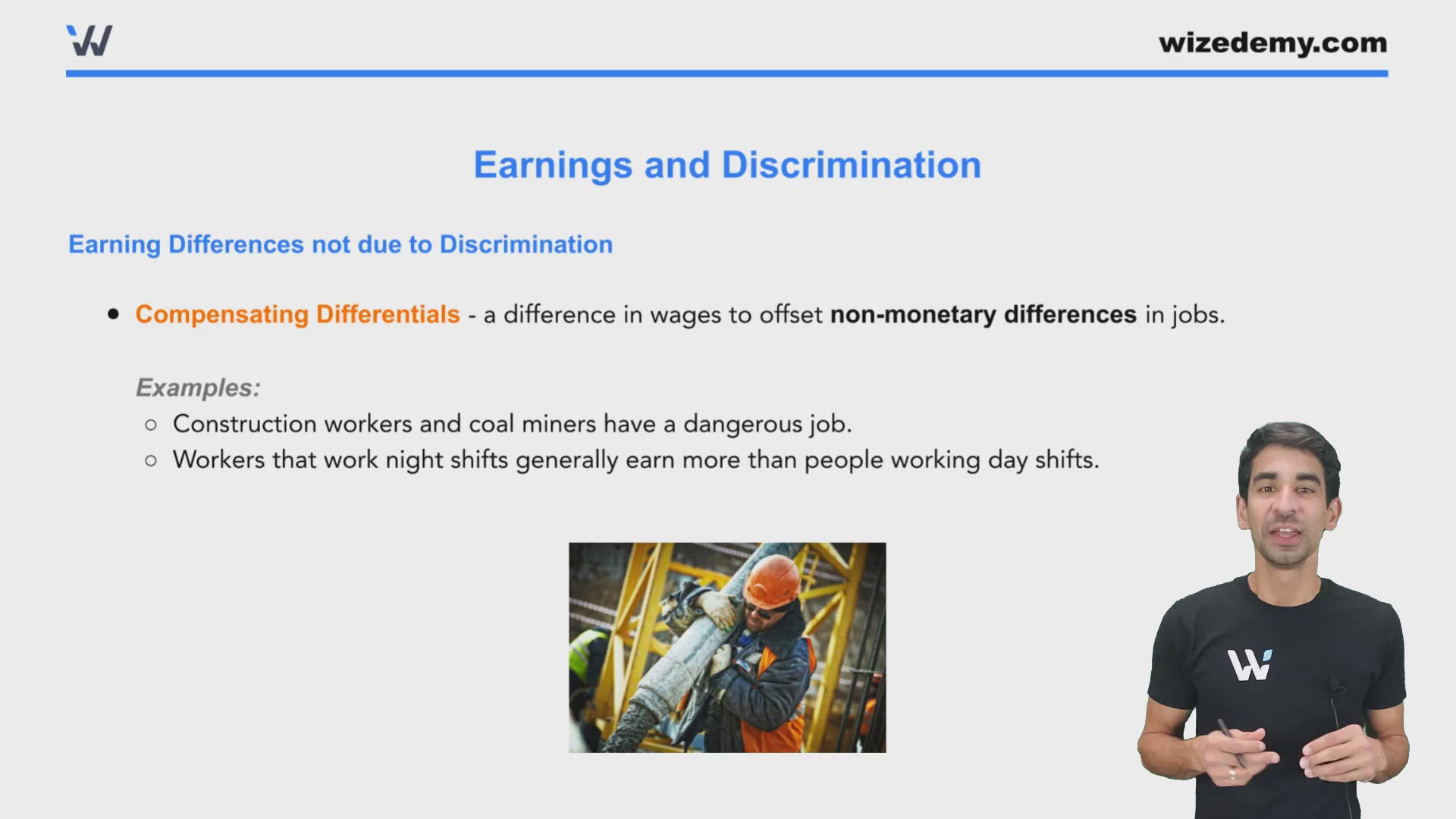
Earnings and Discrimination
Earning Differences not due to Discrimination
- Compensating Differentials - a difference in wages to offset non-monetary differences in jobs. Examples:
- Construction workers and coal miners have a dangerous job.
- Workers that work night shifts generally earn more than people working day shifts.

- Human Capital - investments in people, mainly education and on-the-job training. It leads tohighermarginal product of labor andincreasesthe demand for labor.
- Ability, Effort and Chance - This can apply to people with a particular skill set. Examples
- Athletes with higher natural abilities earn more (this is not compensating differential).
- Some athletes earn more because they work harder (effort).
- Chance plays a role in that an athlete could get injured and earn less because of that injury.
- Chance also plays a role if an athlete may have gotten drafted by a team that gelled together very well with their style of play, and that could increase their pay down the road.

- Signaling - education is often used as a signal to firms that the individual has a higher ability, even if the education doesn't make them better qualified for that specific job. This theory says that more people getting educated does not necessarily make them more productive so it would havenoeffect on demand for labor and wages (opposite of human capital).
- Superstar Phenomenon - this applies to certain people that are extremely talented and able to supply everyone in the market at a low cost. Example: a lot of movie companies want to make movies with Leonardo Dicaprio.
- Everyone wants to enjoy the product supplied by the best producer.
- The good has to be produced with a technology that allows the best producer to supply everyone in the market at a low cost.
- This is not possible with plumbers because the best plumber cannot supply everyone in the market with their service.
- Efficiency Wages - Above equilibrium wages paid by firms to increase workers' productivity. Above equilibrium wages can also be due to unions bargaining for higher wages and due to minimum wage laws.
Discrimination
- Discrimination - offering different opportunities to similar individuals who differ only by race, ethnic group, sex, age, or other personal characteristics. Examples:
- On average, African American men earn 21% less than white men. This can be traced to the quality of education (human capital) in certain neighborhoods.
- Women are more likely to take time off work after having a child compared to men. There's also compensating differentials, for example, women are less likely to be truck drivers which might pay a higher wage.
- Discrimination by Employers - this generally tends to disappear over time because the firms that don't discriminate will be able to hire certain workers at a lower cost and replace the companies that discriminate. Example: if a restaurant only hires blonde waiters, its supply of labor will shift left and this will cause the wage to rise. The supply of waiters at other restaurants will shift right and the wage rates at those restaurants will decrease.
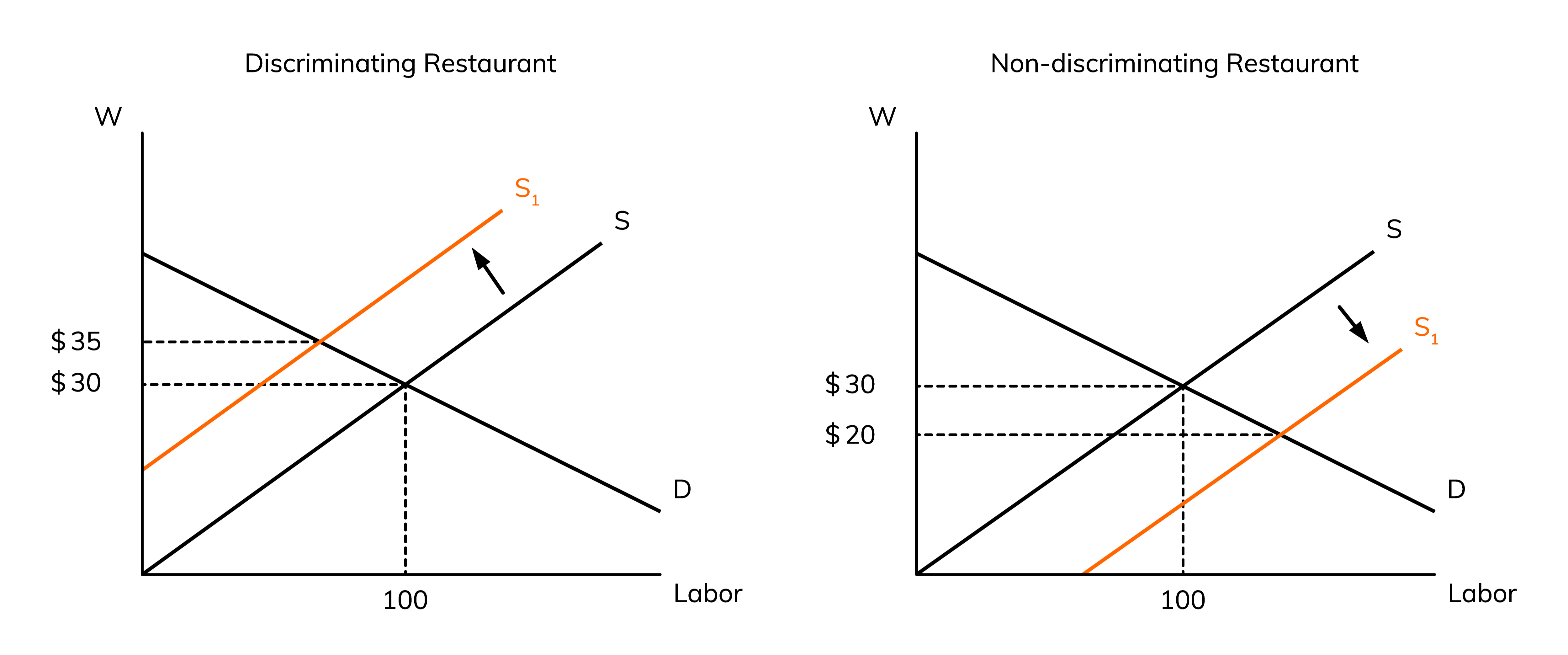
- Discrimination by Customers and Government - this generally does not disappear over time. Example: if some customers prefer blonde waiters then the discrimination will not disappear.
- Some restaurants will have blonde waiters that will generally have higher prices and other restaurants may have more brunette waiters with lower prices.
- Similarly, if the government says brunette waiters can wash dishes, but can't be waiters, the discrimination would continue.
0:00 / 0:00
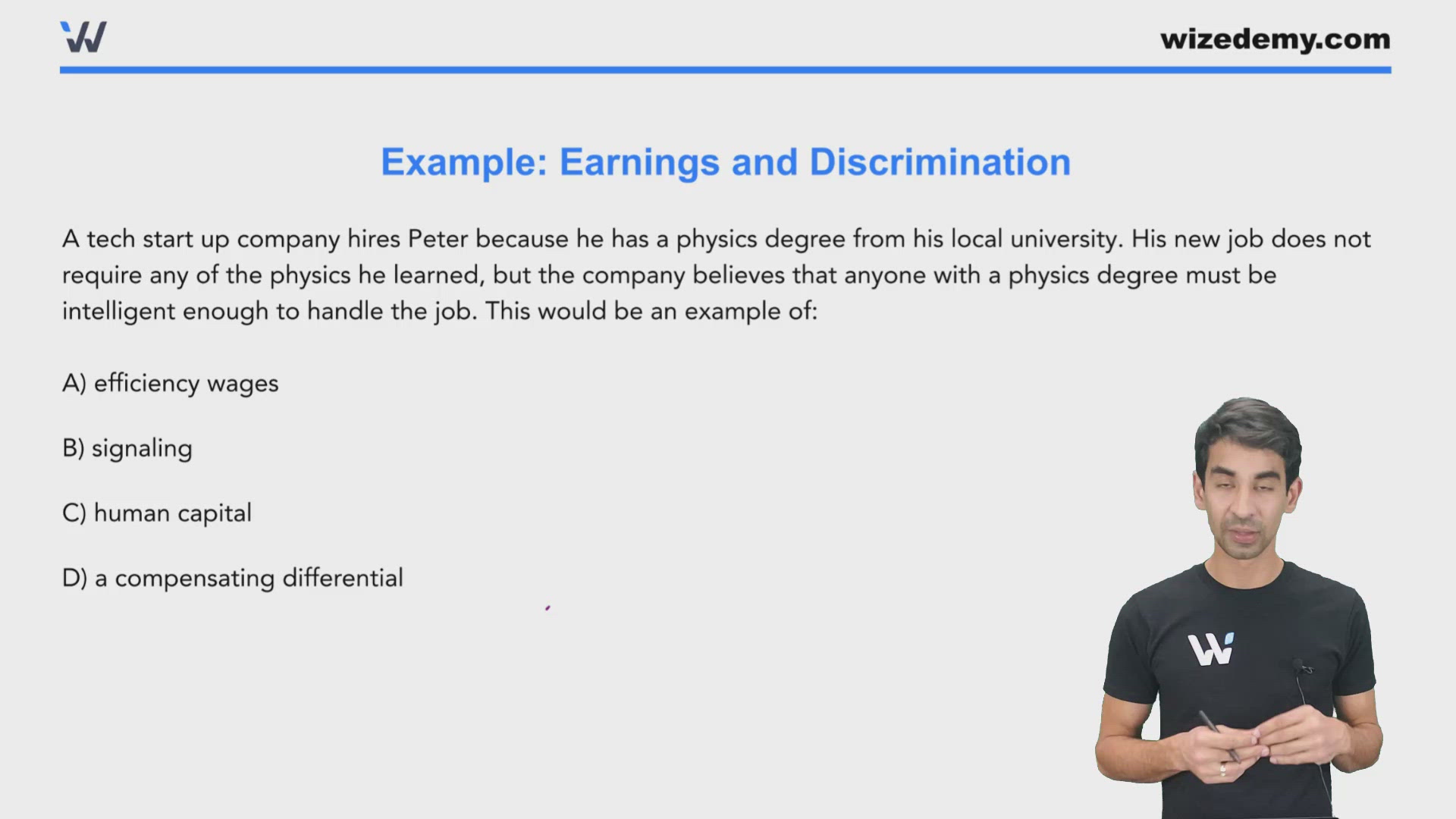
Example: Earnings and Discrimination
A tech start up company hires Peter because he has a physics degree from his local university. His new job does not require any of the physics he learned, but the company believes that anyone with a physics degree must be intelligent enough to handle the job. This would be an example of:
A) efficiency wages
B) signaling
C) human capital
D) a compensating differential
B
signaling is when you indicate to employers that you are capable of learning, even if the skills you studied don't help you for the job.
Practice: Earnings and Discrimination
Jenny runs a boutique clothing store. She pays her workers 50% more than what similar clothing stores pay, even though she could pay less and still get all the workers she wants. She feels higher wages make her labor work harder and be more loyal. This is an example of
Practice: Earnings and Discrimination
Barbara and Bob work at a small town restaurant. Barbara greets customers at the door and makes less money than Bob, who mops the floors and cleans the outside of all the windows during the winter. This is an example of: