Popular Courses
ECON 201
Concordia University
ECONOMIC 1021A/B
Western University
Microeconomics
University Study Guides
ECON 201
University of Calgary
ECON 101
University of British Columbia
ECON 1B03
McMaster University
ECON*1050
University of Guelph
ECON 101
University of Alberta
Microeconomics
General Course
ECO101H1
University of Toronto
Microeconomics
University Study Guides
ECON 208
McGill University
ECON 101
University of Waterloo
ECN 104
Toronto Metropolitan University
ECON 110A
Queen's University
ECO 1104
University of Ottawa
EC120
Wilfrid Laurier University
AP/ECON 1000 3.00
York University
ECON 103
University of Victoria
ECON 1101
Dalhousie University

0:00 / 0:00
Quota
A production quota is when the government tells the firm they can not sell more than a certain quantity of a good.
Example: The government can put a quota on the number of fishing licenses allowed (to protect the fish).

- Quotas should always be on theleftof the equilibrium quantity.
- In the diagram above the price paid by consumers and received by producers with the quota would be$12
- It doesn't matter where the output of 15 hits the supply curve because if the sellers know that consumers are willing to pay $12 (because that's where it hits demand) then that's the price they will charge.
- Quotas always lead tohigherprices andloweroutput.
0:00 / 0:00
Example: Quota
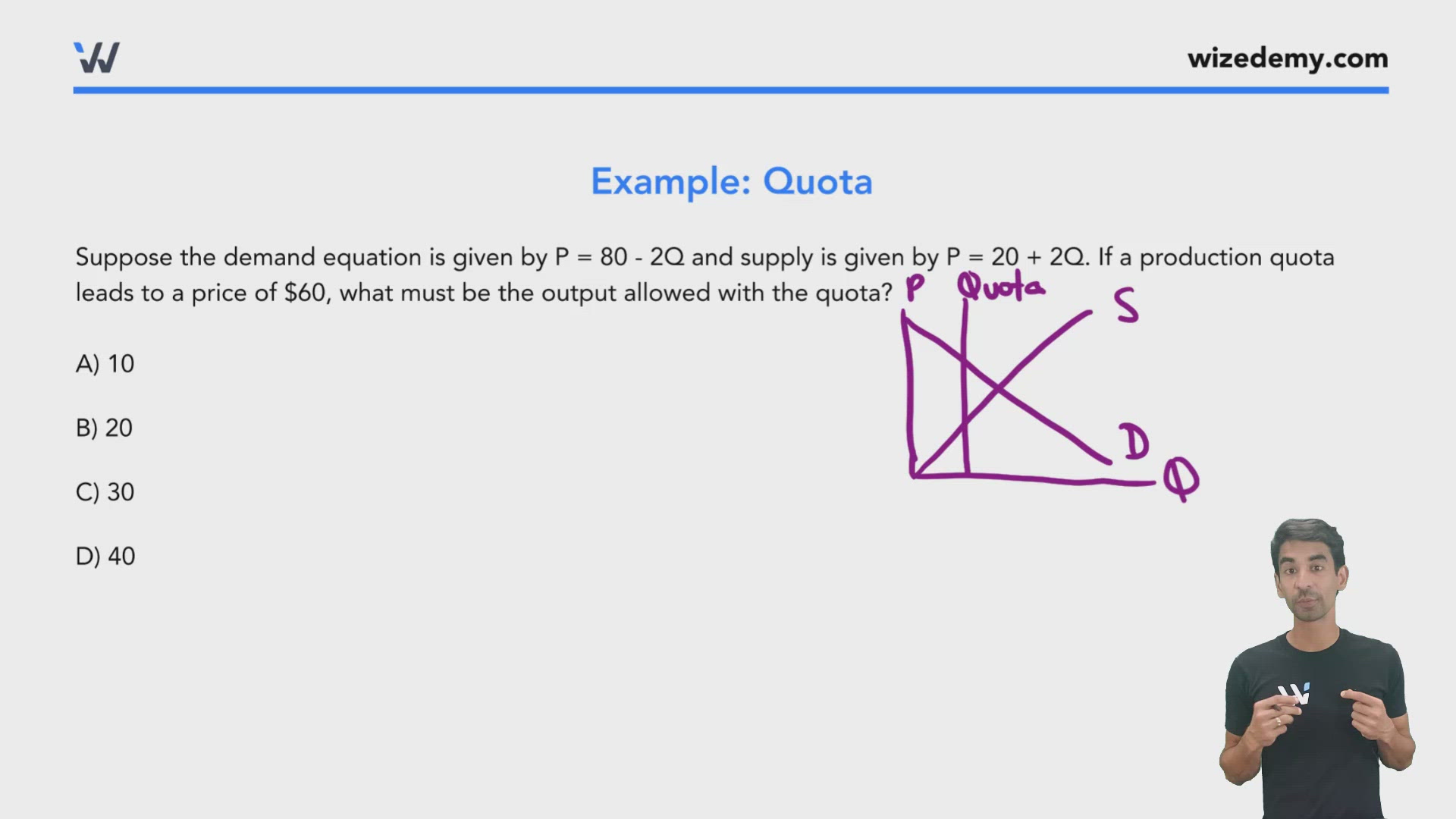
Suppose the demand equation is given by P = 80 - 2Q and supply is given by P = 20 + 2Q. If a production quota leads to a price of $60, what must be the output allowed with the quota?
A) 10
B) 20
C) 30
D) 40
A.
With a quota the price is always where the quota hits the demand curve. We have to plug in 60 as the price in the demand equation:
60 = 80 - 2Q
2Q = 20
Q = 10
Practice: Quota
A production quota that is placed at an output level that is higher than the equilibrium output will: