Popular Courses
ECON 201
Concordia University
Microeconomics
University Study Guides
Microeconomics
General Course
Microeconomics
University Study Guides
EC120
Wilfrid Laurier University
ECON 111
Queen's University
ECON 103
Simon Fraser University
ECON-1100
University of Windsor
MET EC 101
Boston University
ECON-B 251
Indiana University - Bloomington
ECN 101
Toronto Metropolitan University
ECON 1010
University of Manitoba
ECON 102
University of Illinois at Urbana - Champaign
ECON 1001
Carleton University
ECON 101
University of Delaware
ECON 1101
University of Minnesota
ECON 101
University of Wisconsin - Madison
ECON 1P91
Brock University
ECON 102
Pennsylvania State University
ECON 1
University of California - San Diego
0:00 / 0:00
Present Value
If you are expecting to receive some money in the future, the present value tells us how much that money is worth today.
Example: If you get $200 in ten years that is not the same thing as getting $200 today because if you had that money today you could invest it in the market and turn it in to a higher value in the future.
Where:
i = interest rate
n = years (or time periods)
If you are going to receive $100 in three years and the interest rate is 7% what would be the present value?
Present Value =
This means getting $100 in three years is the same thing as getting $81.63 today because if you had $81.63 today you could invest it in the market at 7% and turn it in to $100 in 3 years.
If you are expecting to receive some money in the future, the present value tells us how much that money is worth today. Example: If you get $200 in ten years that is not the same thing as getting $200 today because if you had that money today you could invest it in the market and turn it in to a higher value in the future.
0:00 / 0:00
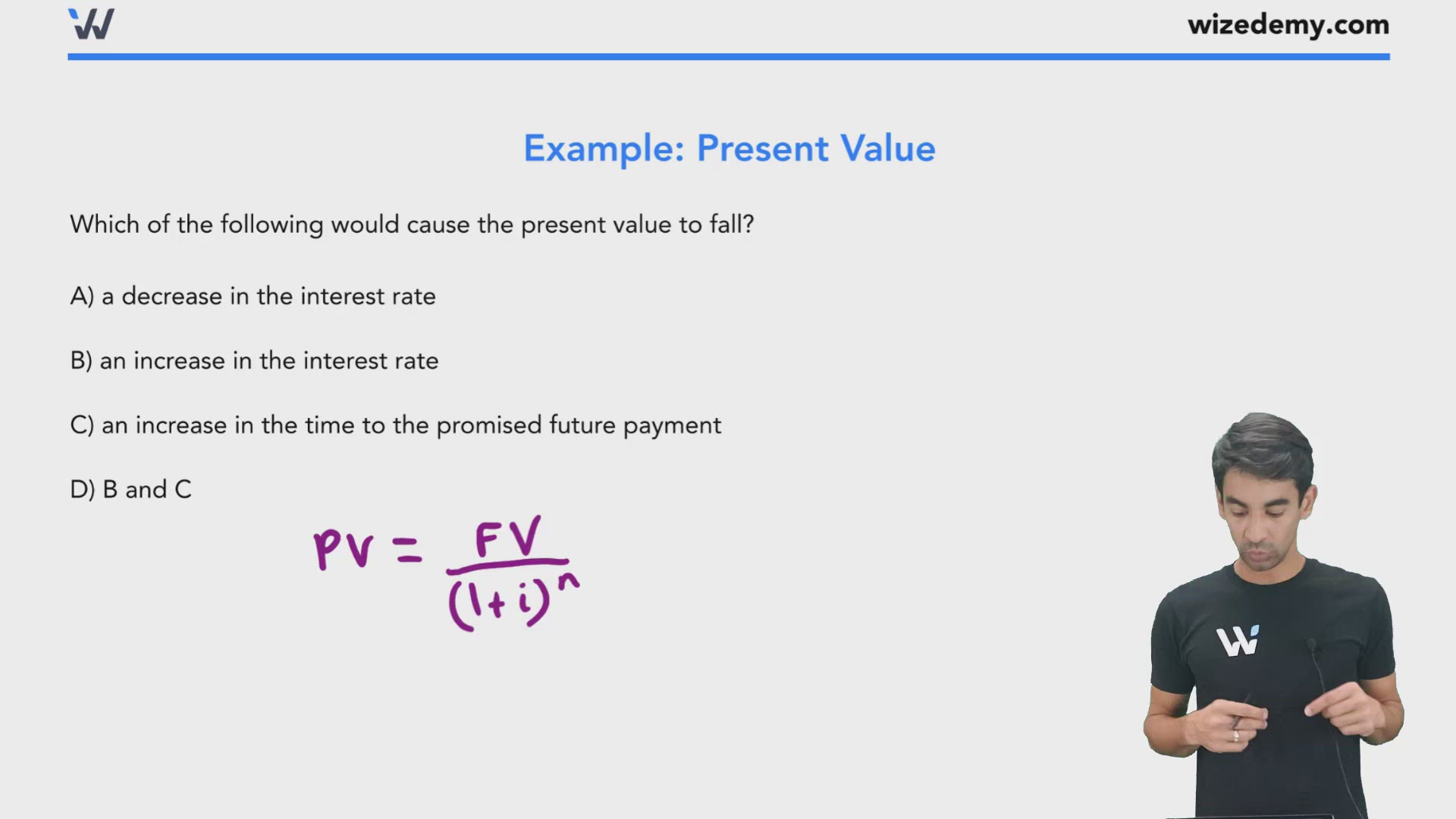
Example: Present Value
Which of the following would cause the present value to fall?
A) a decrease in the interest rate
B) an increase in the interest rate
C) an increase in the time to the promised future payment
D) B and C
D
Interest rate is in the denominator of the formula and whenever the denominator gets bigger the present value will get smaller. Time to promised future payment means the letter n in the formula and since it's in the denominator again if it gets bigger it will mean the present value will get smaller.
Practice: Present Value
You have just won the lottery and you have two options:
Option 1: Receive $150,000 in five years
Option 2: Receive $120,000 today.
If the current interest rate (yield) is 6%, which option should you take?