Wize University Statics Textbook (Master) > Force System Resultants (Moment, Couple, Dist. Load)
Moment (of a Force) About a Point
Moments About a Point - Scalar Formulation (for 2D)
Example 1 - Part 1 (M= r x F): Moment About a Point (2D)
Example 1 - Part 2 (M= Fd): Moment About a Point (2D)
Example 2: Moment About a Point (2D) - M = Fd
Example: Computing Moments About a Point
Example: Computing Moments About a Point Example
Example: Computing Moments About a Point
Practice: Moments About a Point (2D)
Practice: Moments About a Point (2D)
Moments About a Point - Practice Questions (2D)
Quiz: Moments About a Point - Practice Questions (2D)
Moments About a Point - Vector formulation (for 3D)
Example 1: Moment About a Point (3D)
Practice: Moments About a Point (3D)
Practice: Moments About a Point (3D)
Moments About a Point - Practice Questions (3D)
Quiz: Moments About a Point - Practice Questions (3D)
Popular Courses
ENGG 130
University of Alberta
CIV100H1
University of Toronto
PCS 211
Toronto Metropolitan University
ENGG 202
University of Calgary
ENGSCI 1022A/B/Y
Western University
ENGR 242
Concordia University
ENGR 141
University of Victoria
CE 221
Michigan State University
GENG-1110
University of Windsor
ESM 2104
Virginia Tech
APS160H1
University of Toronto
0:00 / 0:00
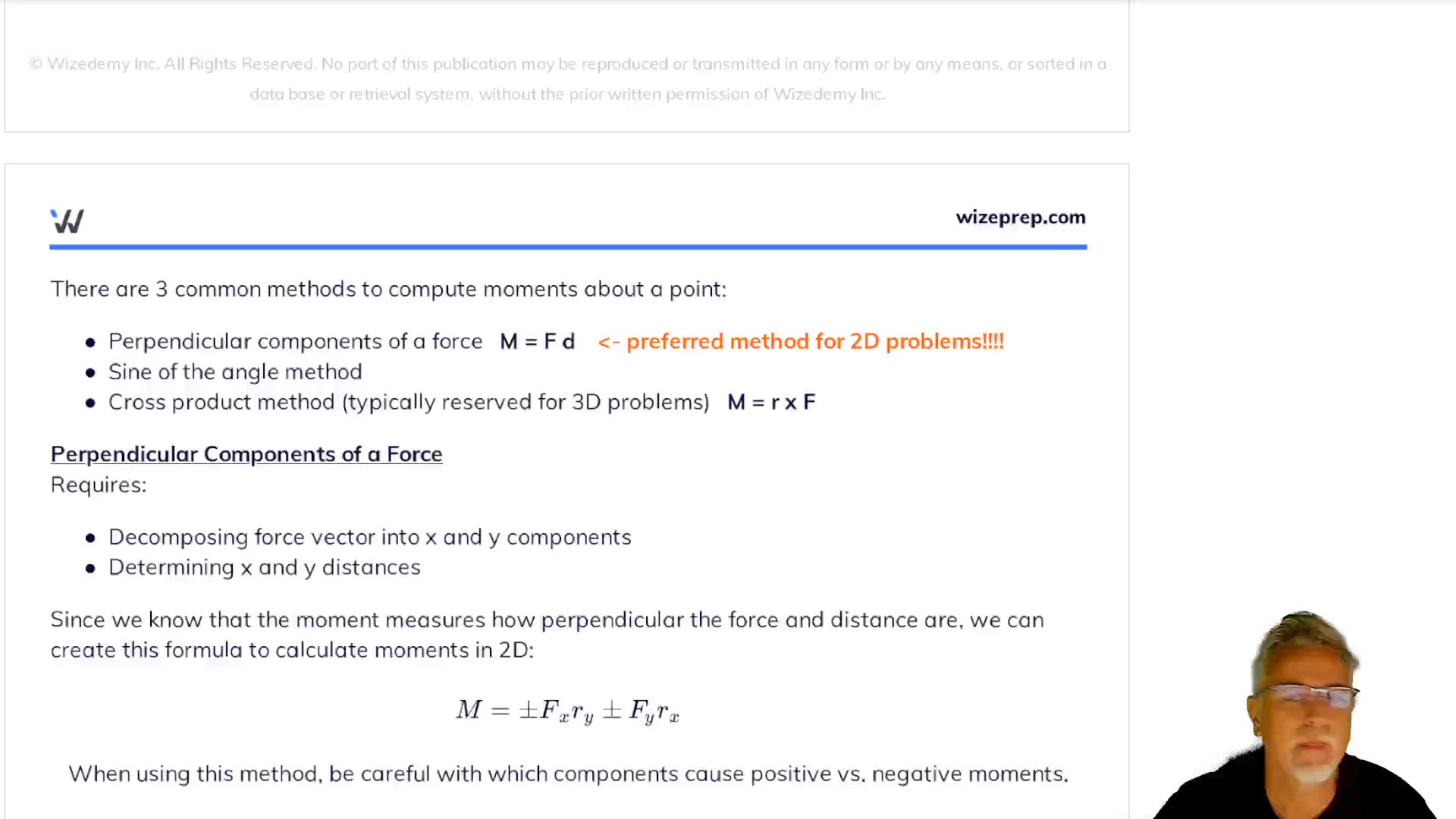
There are 3 common methods to compute moments about a point:
- Perpendicular components of a force M = F d <- preferred method for 2D problems!!!!
- Sine of the angle method
- Cross product method (typically reserved for 3D problems) M = r x F
Perpendicular Components of a Force
Requires:
- Decomposing force vector into x and y components
- Determining x and y distances
Since we know that the moment measures how perpendicular the force and distance are, we can create this formula to calculate moments in 2D:
When using this method, be careful with which components cause positive vs. negative moments.
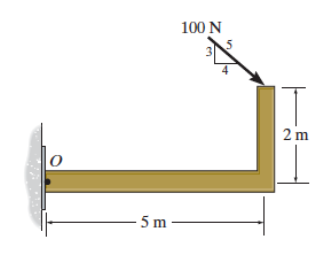
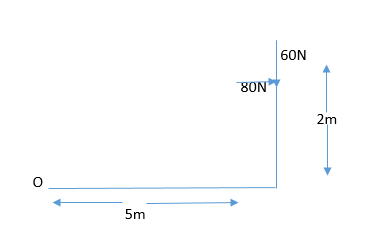
Example: Determine the moment about point O
Sine of the Angle Method
I personally find this method to be more difficult, especially when the angle isn't obvious or easy to calculate.
My suggestion? USE THE FIRST METHOD for 2D problems!!!
Requires:
- Magnitude of the force
- Magnitude of the distance
- The angle between the two vectors
We can use another definition of the cross product:
Where the computation is very straight forward if we know the angle of the geometry. This method is rarely used because the angle is usually not provided, but it is good to know because it is the fastest.
Example: Determine the moment about point O
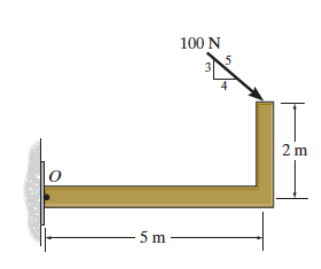
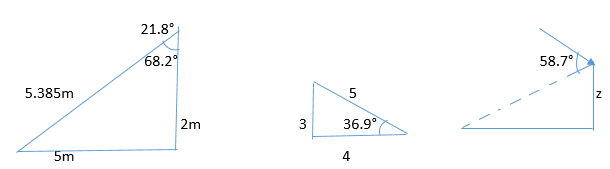
Cross Product Method*
*Again, we normally only use this for 3D problems, but the example below shows that it still works in 2D
Requires:
- Force vector in Cartesian vector form
- Distance vector in Cartesian vector form
- Computation of a determinant
This method requires the computation of the cross product, which can take some time and requires some math. Therefore, we usually don’t use this for 2D cases. In 3D, this method is recommended because no visualization is necessary, and the math takes care of everything.
Cross Product Example: Determine the moment about point O
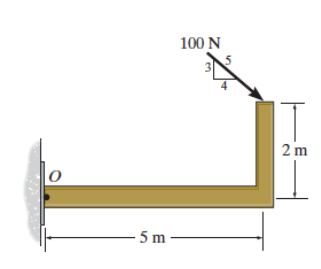
or
0:00 / 0:00
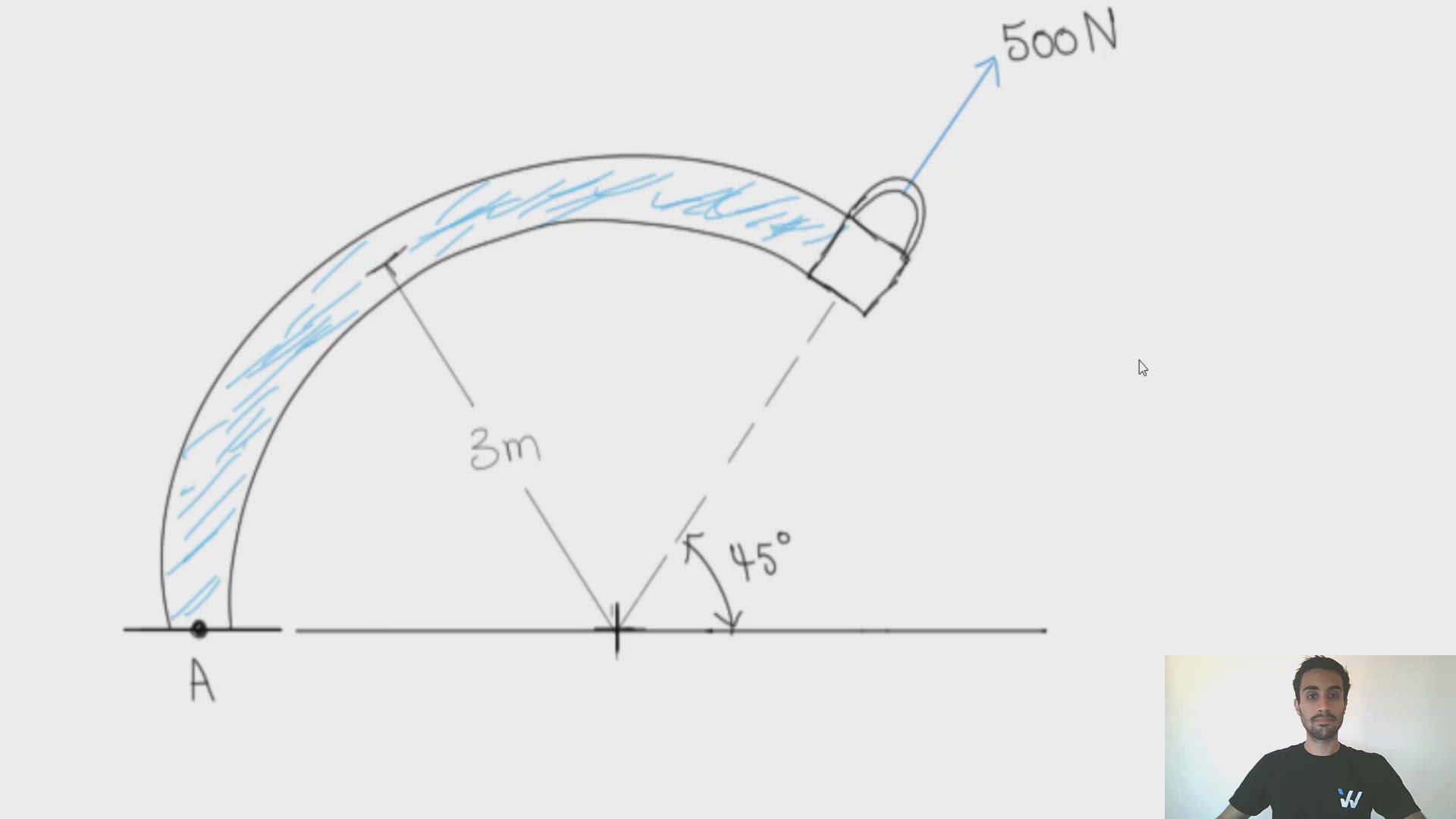
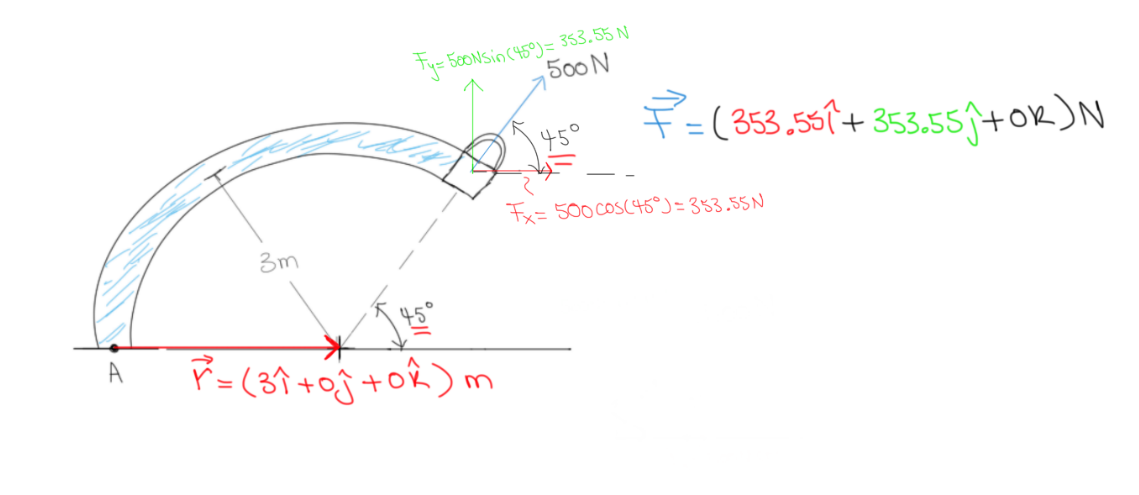
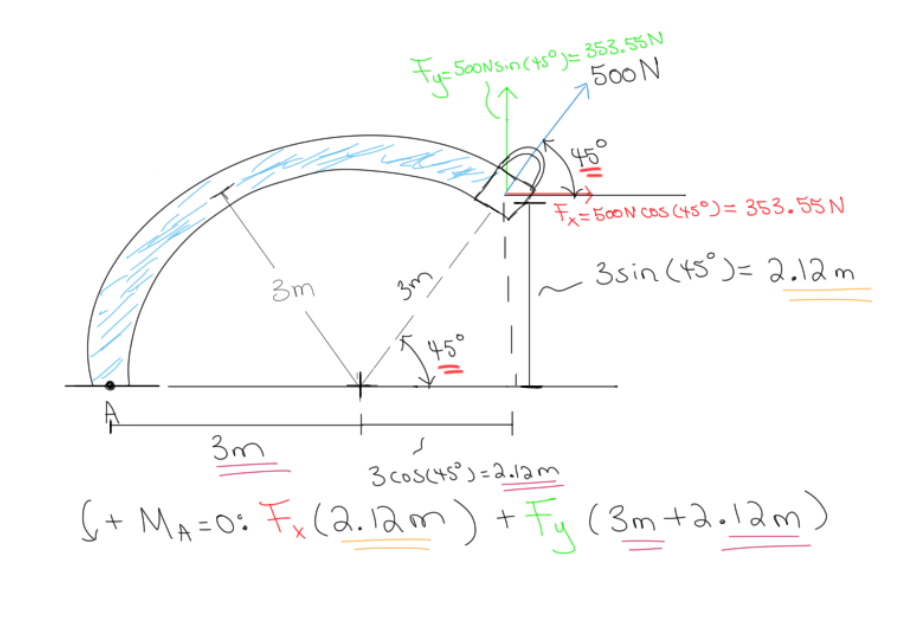
Determine the moment about A using,
1) M = r x F
2) M = Fd
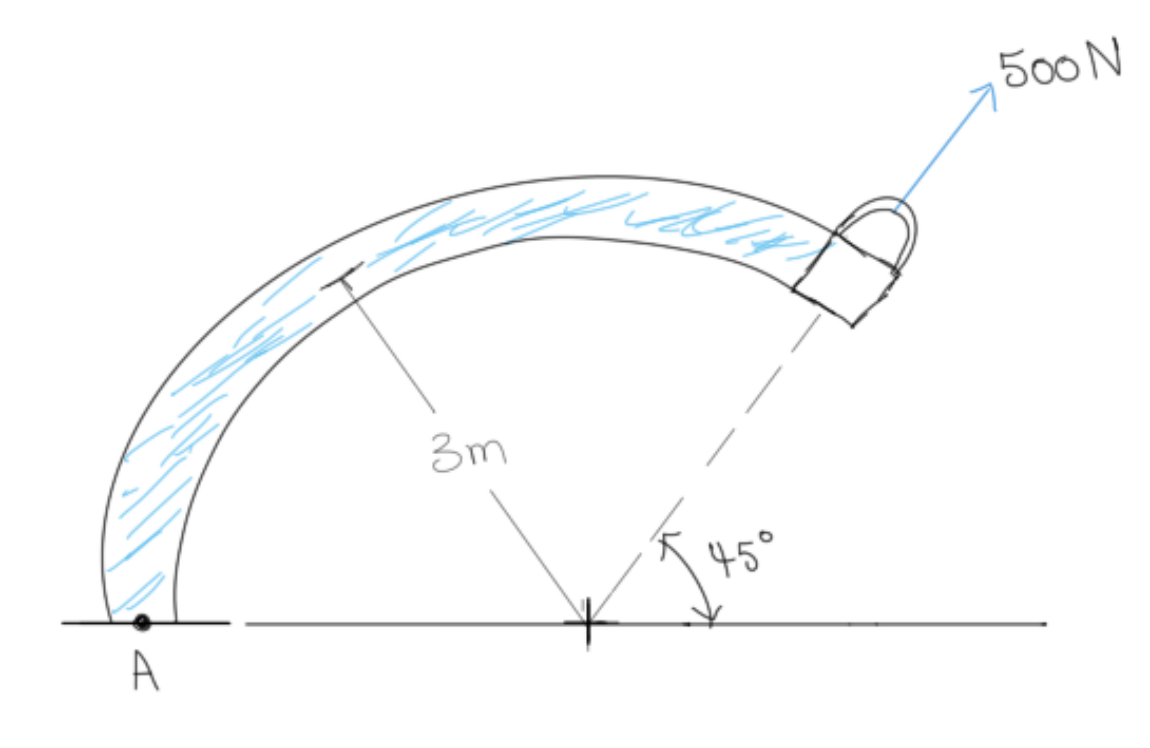
Solution:
Using 1) M = r x F,
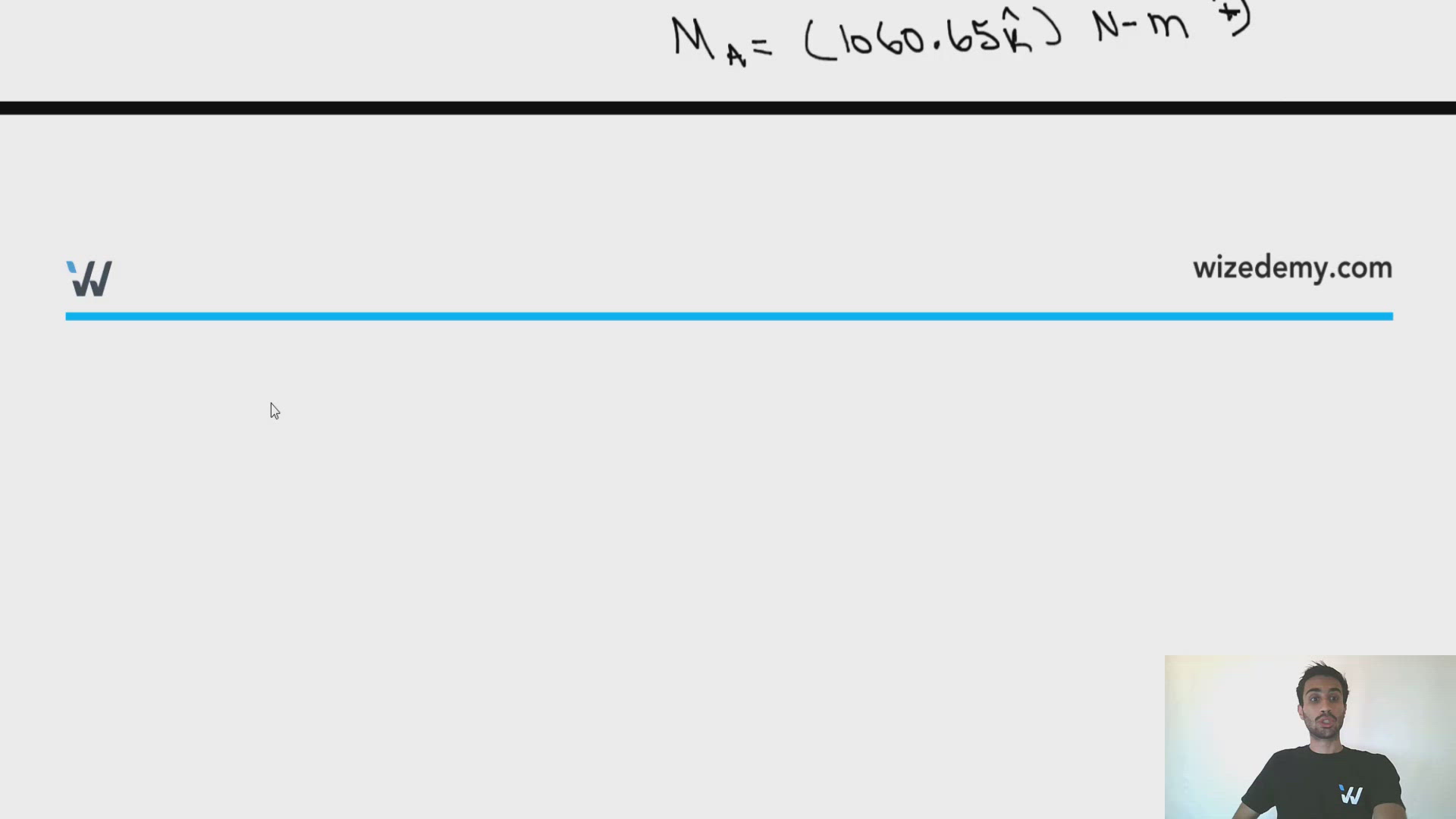
Using 2) M = Fd,
0:00 / 0:00
Determine the moment about A using,
1) M = r x F
2) M = Fd
Solution:
Using 1) M = r x F,
Using 2) M = Fd,
0:00 / 0:00
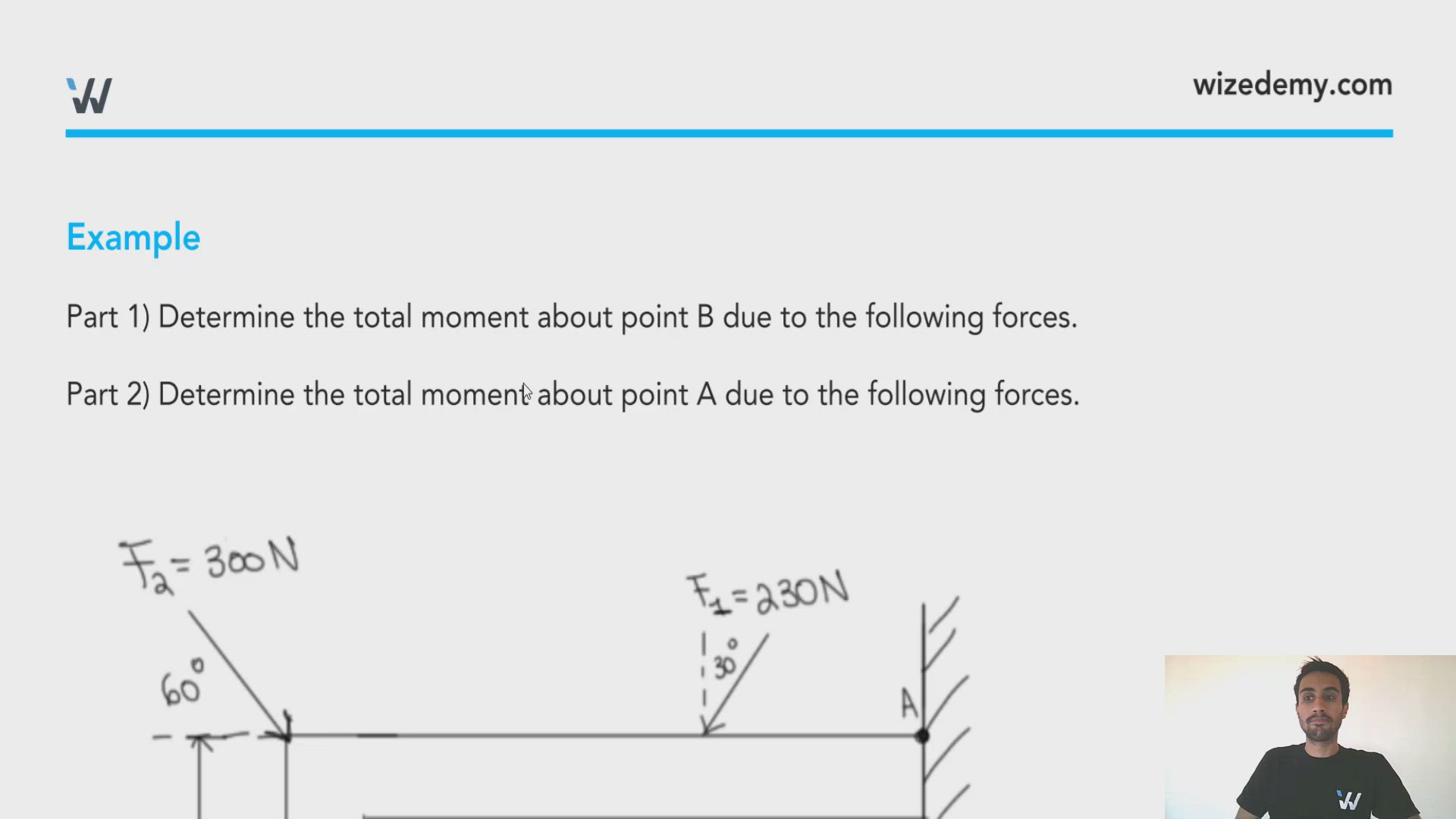
Example
Part 1) Determine the total moment about point B due to the following forces.
Part 2) Determine the total moment about point A due to the following forces.
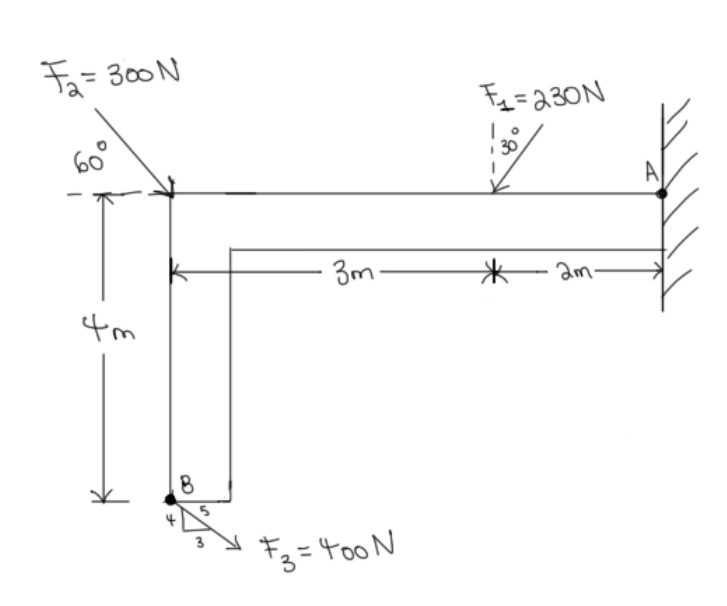
Solution:
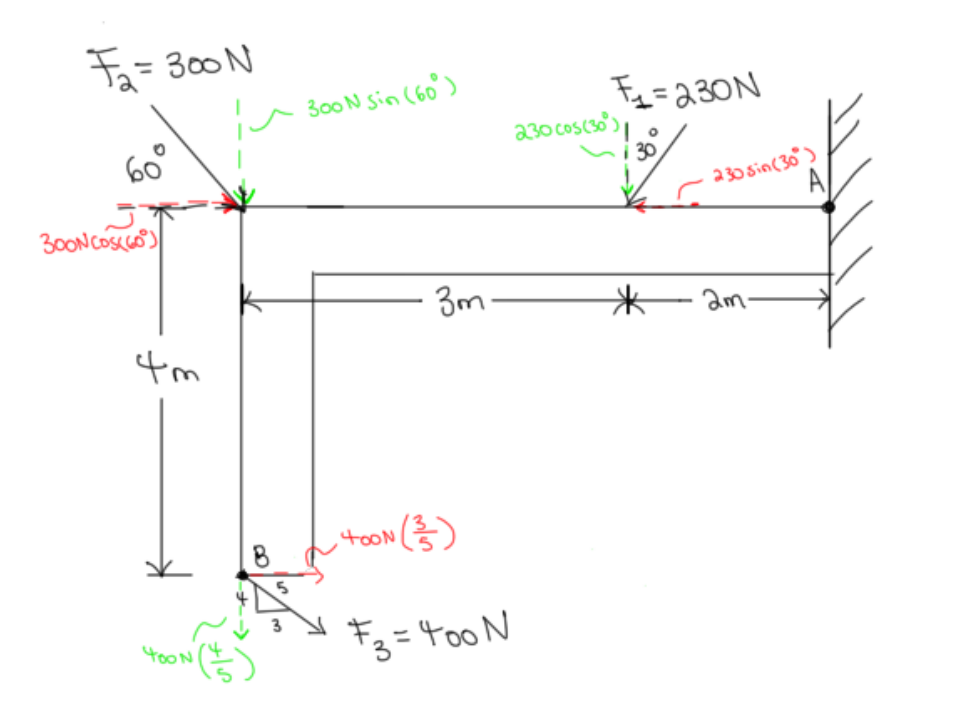
Determine the moment about point O
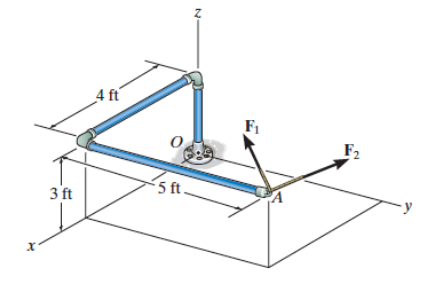
GIVEN:
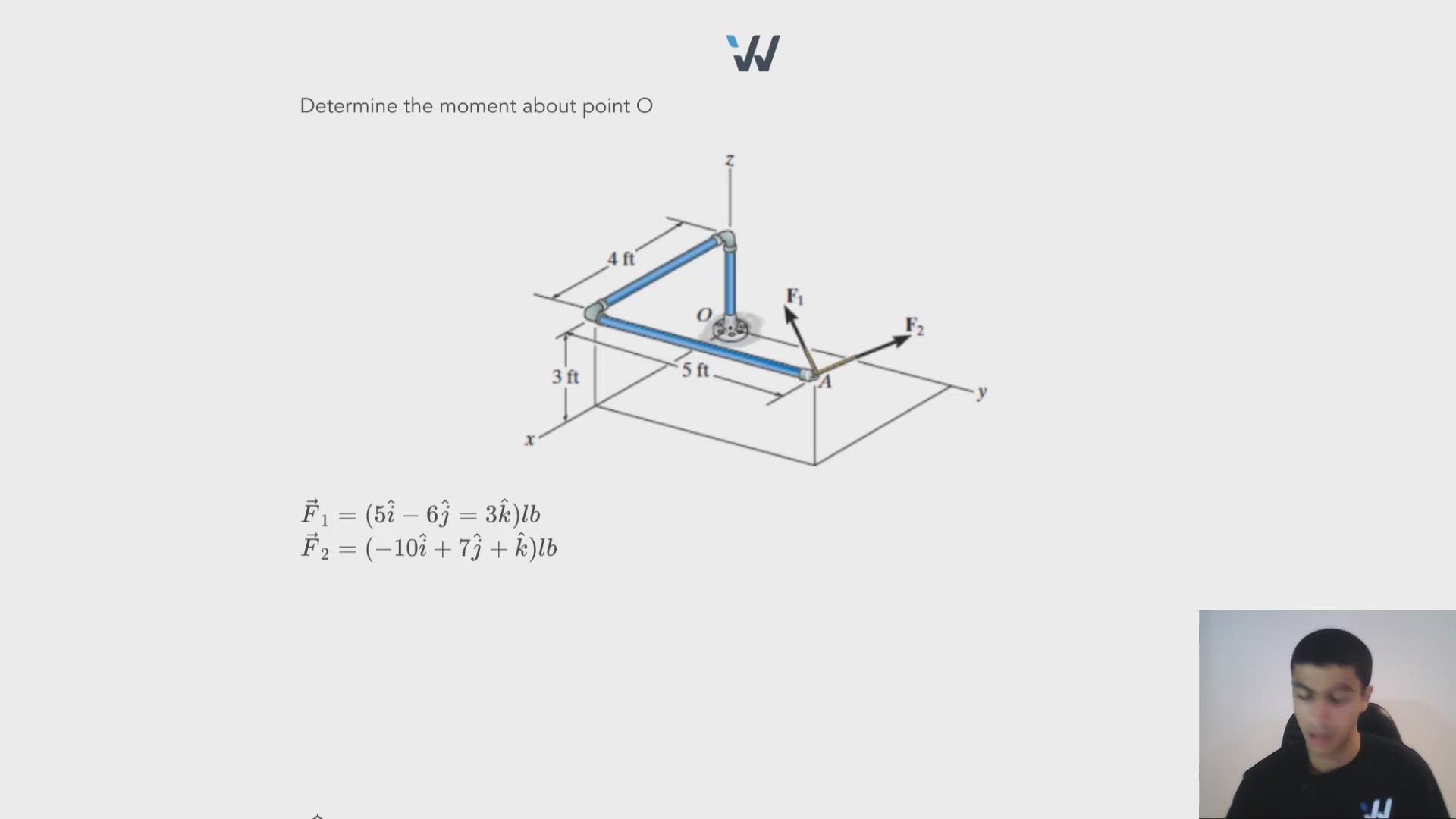
0:00 / 0:00
Determine the moment about point O
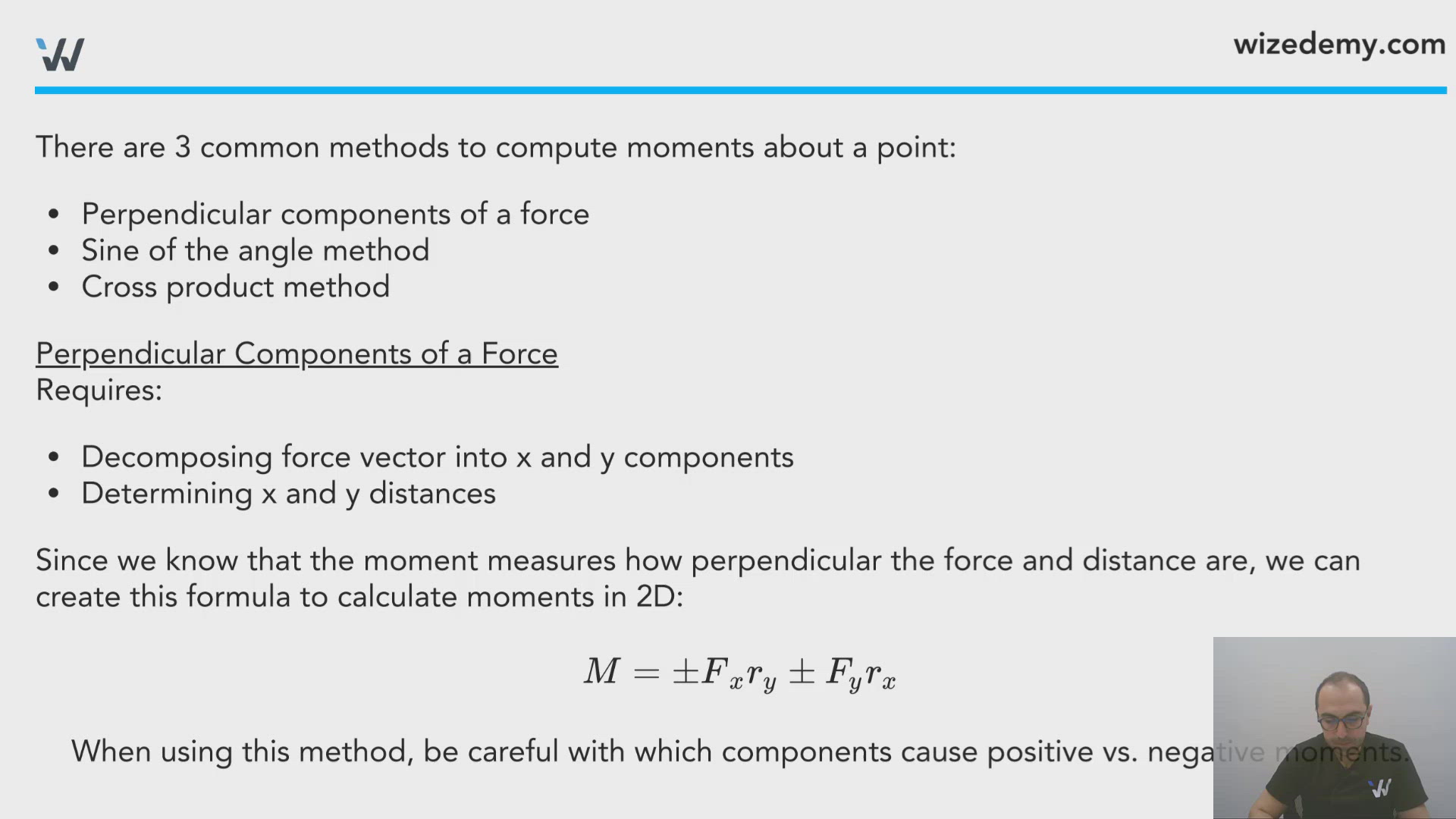
0:00 / 0:00
There are 3 common methods to compute moments about a point:
- Perpendicular components of a force
- Sine of the angle method
- Cross product method
Perpendicular Components of a Force
Requires:
- Decomposing force vector into x and y components
- Determining x and y distances
Since we know that the moment measures how perpendicular the force and distance are, we can create this formula to calculate moments in 2D:
When using this method, be careful with which components cause positive vs. negative moments.
Example
Determine the moment about point O
Sine of the Angle Method
Requires:
- Magnitude of the force
- Magnitude of the distance
- The angle between the two vectors
We can use another definition of the cross product:
Where the computation is very straight forward if we know the angle of the geometry. This method is rarely used because the angle is usually not provided, but it is good to know because it is the fastest.
Example
Determine the moment about point O
Cross Product Method
Requires:
- Force vector in Cartesian vector form
- Distance vector in Cartesian vector form
- Computation of a determinant
This method requires the computation of the cross product, which can take some time and requires some math. Therefore, we usually don’t use this for 2D cases. In 3D, this method is recommended because no visualization is necessary, and the math takes care of everything.
Cross Product Example
Determine the moment about point O
or
1) Calculate the moment that the force causes about point D:
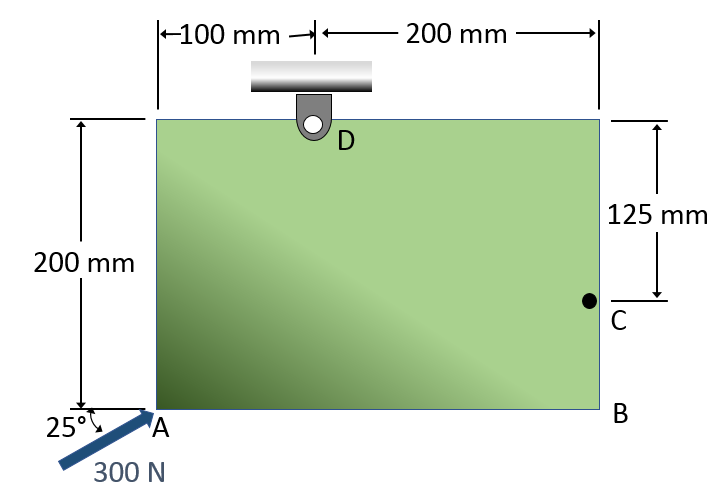
2) Calculate the moment generated about point A
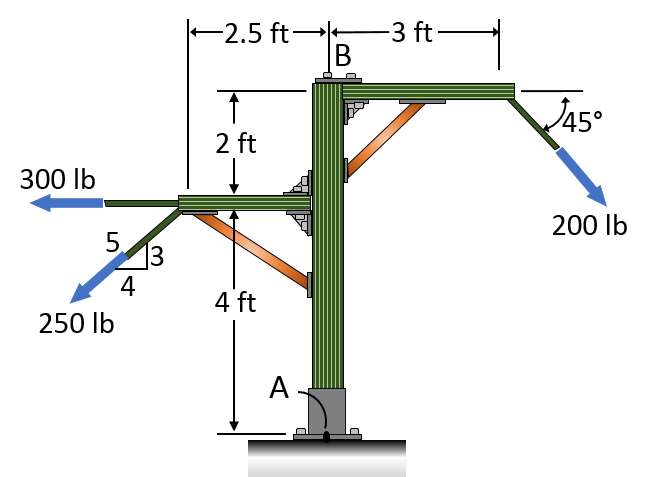
1) Calculate the moment that the force causes about point D:
2) Calculate the moment generated about point A

Mark Yourself Question
- Grab a piece of paper and try this problem yourself.
- When you're done, check the "I have answered this question" box below.
- View the solution and report whether you got it right or wrong.
1) Calculate the moment that the force causes about point D:
2) Calculate the moment generated about point A
Quiz: Moments About a Point - Practice Questions (2D)
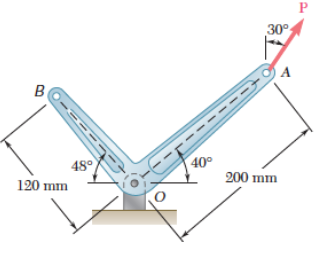
Determine the moment that the Force P causes about O. Take P = 100N.
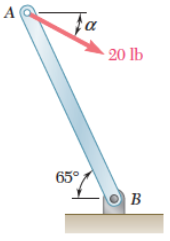
The length of rod AB is 2ft. Determine the angle α so that the applied force causes a moment of 20 lb-ft about Point B.
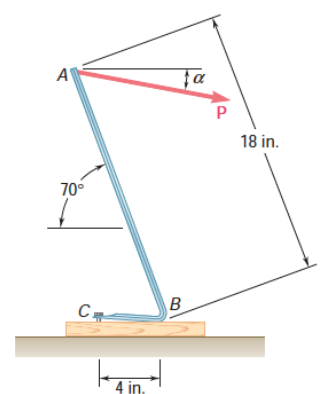
Determine the moment that P = 15 lbs, causes about point C. Take α = 10o
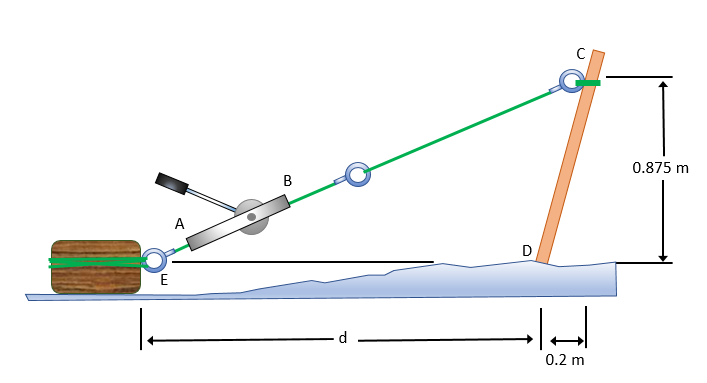
Determine the value of d, if a moment of 960Nm about D is needed, and if AB can exert a maximum force of 2400N.
Moments About a Point (3D problems)
- Moments about a point are defined as:
- This is a vector equation!
- We will go through how you can calculate a cross-product, but the key is that the order of operations matters
- The line of action is the line that the force is applied to and passes through r is always measured from the point to the line of action of the FORCE – it doesn’t matter where on the line of action
- The force must be represented in Cartesian vector format in order to compute the cross product
- You may think of the cross product as a test of “perpendicularity”, which is maximized if the two vectors are perpendicular, and minimized if they’re parallel
- In other words, a maximum moment is obtained by keeping the force perpendicular to the distance
0:00 / 0:00
Example
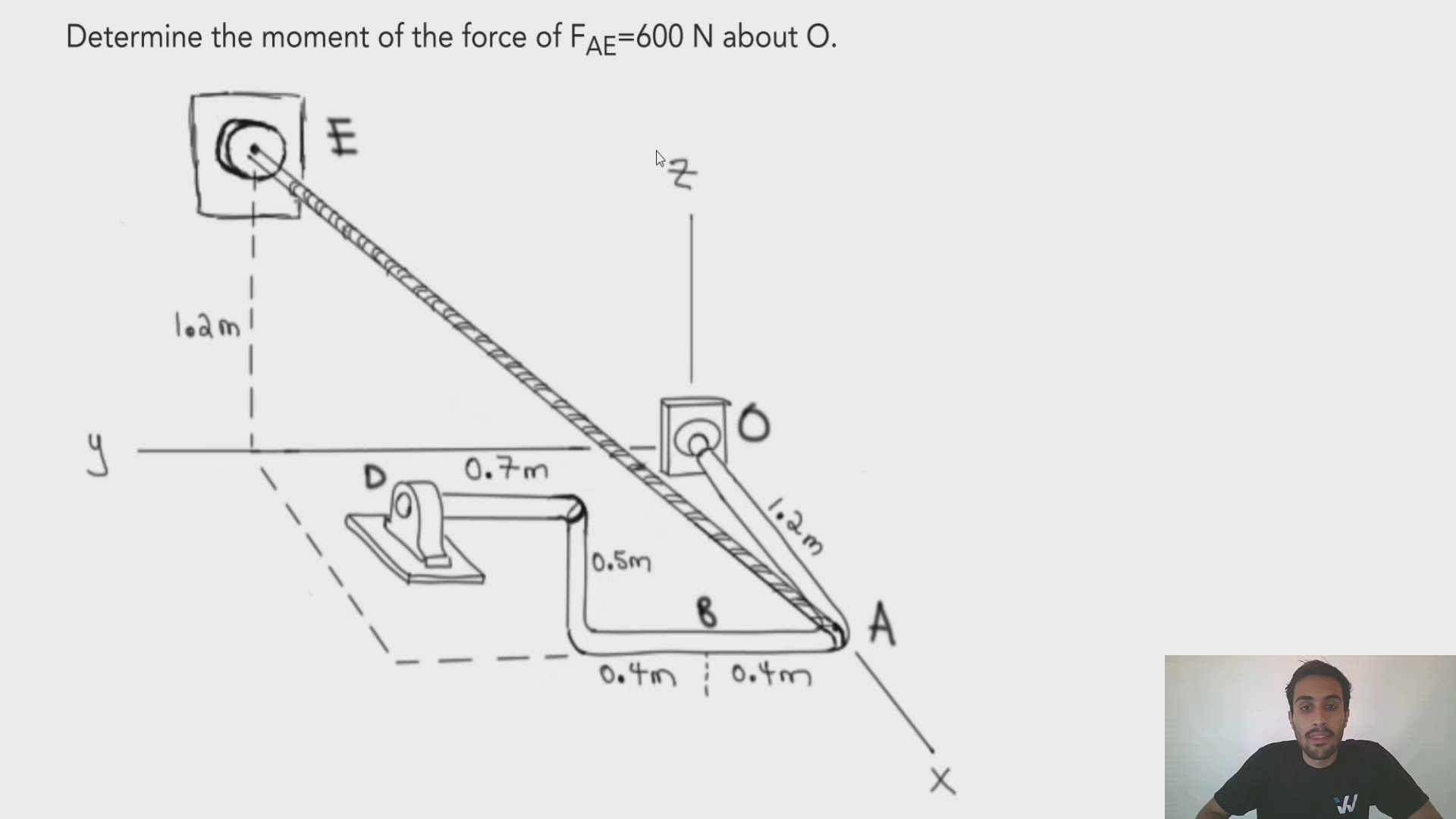
Determine the moment of the force of FAE=600 N about O.
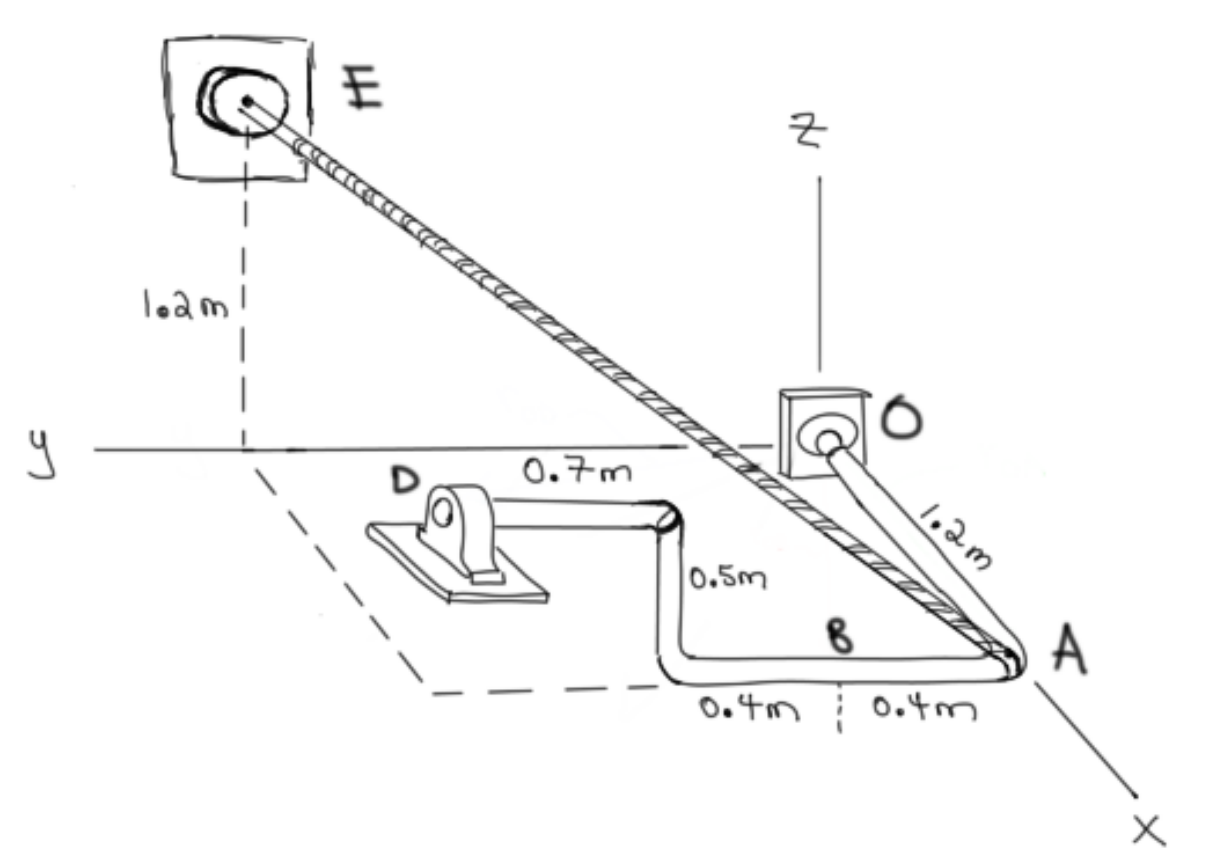
Solution:
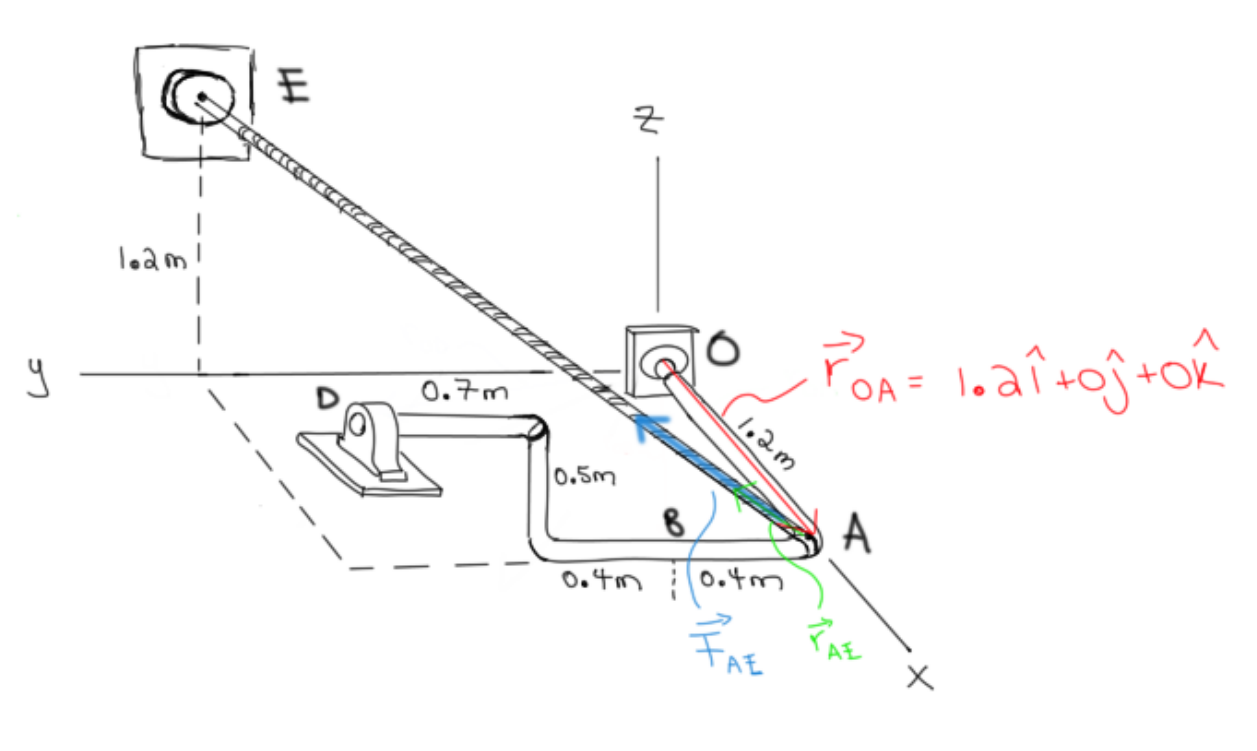
Coordinates,
We know that,
Position vector,
Cartesian force vector,
Solving,
Practice
Calculate the moment caused by point A if cable BC has a tension of 800 N.

Mark Yourself Question
- Grab a piece of paper and try this problem yourself.
- When you're done, check the "I have answered this question" box below.
- View the solution and report whether you got it right or wrong.
Calculate the moment caused by point A if cable BC has a tension of 800 N
Mark Yourself Question
- Grab a piece of paper and try this problem yourself.
- When you're done, check the "I have answered this question" box below.
- View the solution and report whether you got it right or wrong.
Calculate the moment about point A if cable BC has a tension of 800 N
Quiz: Moments About a Point - Practice Questions (3D)
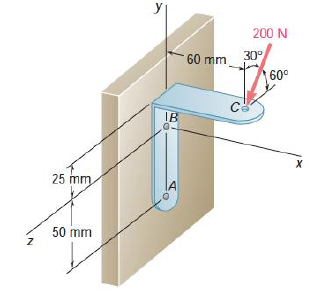
Determine the moment about A, caused by the 200N force.
Determine the moment about O caused by BD, if the tension in BD is 900N