Wize University Statics Textbook (Master) > Force Vectors
Planar Angles (Shaded Triangles)
Popular Courses
ENGG 130
University of Alberta
CIV100H1
University of Toronto
PCS 211
Toronto Metropolitan University
ENGG 202
University of Calgary
ENGSCI 1022A/B/Y
Western University
GNG 1105
University of Ottawa
PHYS 124
University of Alberta
APSC 111
Queen's University
PCS 120
Toronto Metropolitan University
ENGR 242
Concordia University
PHYS 117
University of British Columbia
PHYC 1190
Dalhousie University
ENGG 212
University of Calgary
ENGR 141
University of Victoria
PHYS-1300
University of Windsor
PHY 1121
University of Ottawa
CE 221
Michigan State University
PHY 1124
University of Ottawa
PHYS 121
University of Waterloo
PHYS 227
University of Calgary
0:00 / 0:00
When given a problem with 'shaded triangles' or 'planar angles', the shaded areas can by in the xy, yz, or xz plane (but not always). The shading can usually help you visualize which plane the VECTOR is in.
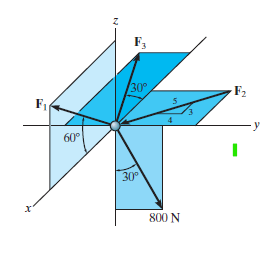
It is helpful to locate the RIGHT ANGLE in the shaded triangle, so you know whether to use SINE or COSINE to get the component. In the following figure, force vector F1 has TWO shaded triangles. How should we approach this?
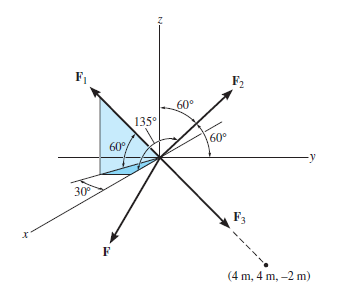
In this case, to find the x, y, and z components, we would need to:
x: "cosine 60° down, then cosine 30°over to the positive x-axis"
y: "cosine 60° down, then sine 30° to the negative y axis" (be careful to apply the correct sign!)
z: "sine 60° to the positive z axis"
How would you approach these THREE vectors (F1, F2, F3 & F) & write them in cartesian vector form? (NOTE: F3 is a vector through 2 points which we'll cover in a few pages).
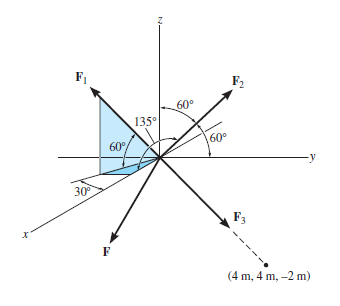
F1 = F1cos(60°)cos(30°)i - F1cos(60°)sin(30°)j + F1sin(60°)
= 0.433F1i - 0.25F1j + 0.866F1k
F2 = F2cos(135°)i + F2cos(60°)j + F2cos(60°)k
= -0.707F2i + 0.5F2j + 0.5F2k
F3: must build the unit vector first:
u3 = (4i+4j-2k)/6 = 0.667i + 0.667j - 0.333k
then F3 = F3mag u3
= 0.667F3i + 0.667F3j - 0.333F3k
F = Fxi + Fyj + Fzk

Mark Yourself Question
- Grab a piece of paper and try this problem yourself.
- When you're done, check the "I have answered this question" box below.
- View the solution and report whether you got it right or wrong.
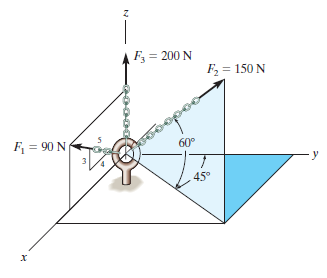
Write each force in Cartesian Vector Form.