SI Units
Some quantities have a lot of different units you can use. For example, for distance, we could use meters, yards, feet, miles, angstroms, astronomical units, parsecs, light-years...
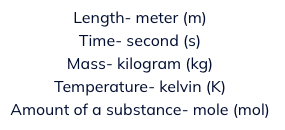
For communication, it helps to have a standard set of units. In chemistry we use base SI units as follows (SI: systeme internationale):
Prefixes
To represent orders of magnitude, we can add prefixes to any unit to scale them to the settings of our measurements.

Exam Tip
Memorizing these units can help you solve questions quickly on exams!
Ex. if you see wavelength in nm instead of m, you should know that 1 nm = 1 x 10⁻⁹ m
Unit Analysis
- Unit analysis is a method of checking the dimensional consistency of a equation.
- Two sides of an equation must be equal numerically, but also in dimension.... units can cancel each other out!
- We can often use units to help guide us in answering questions and making sure we are on the right track.
0:00 / 0:00
Example: Unit Conversion
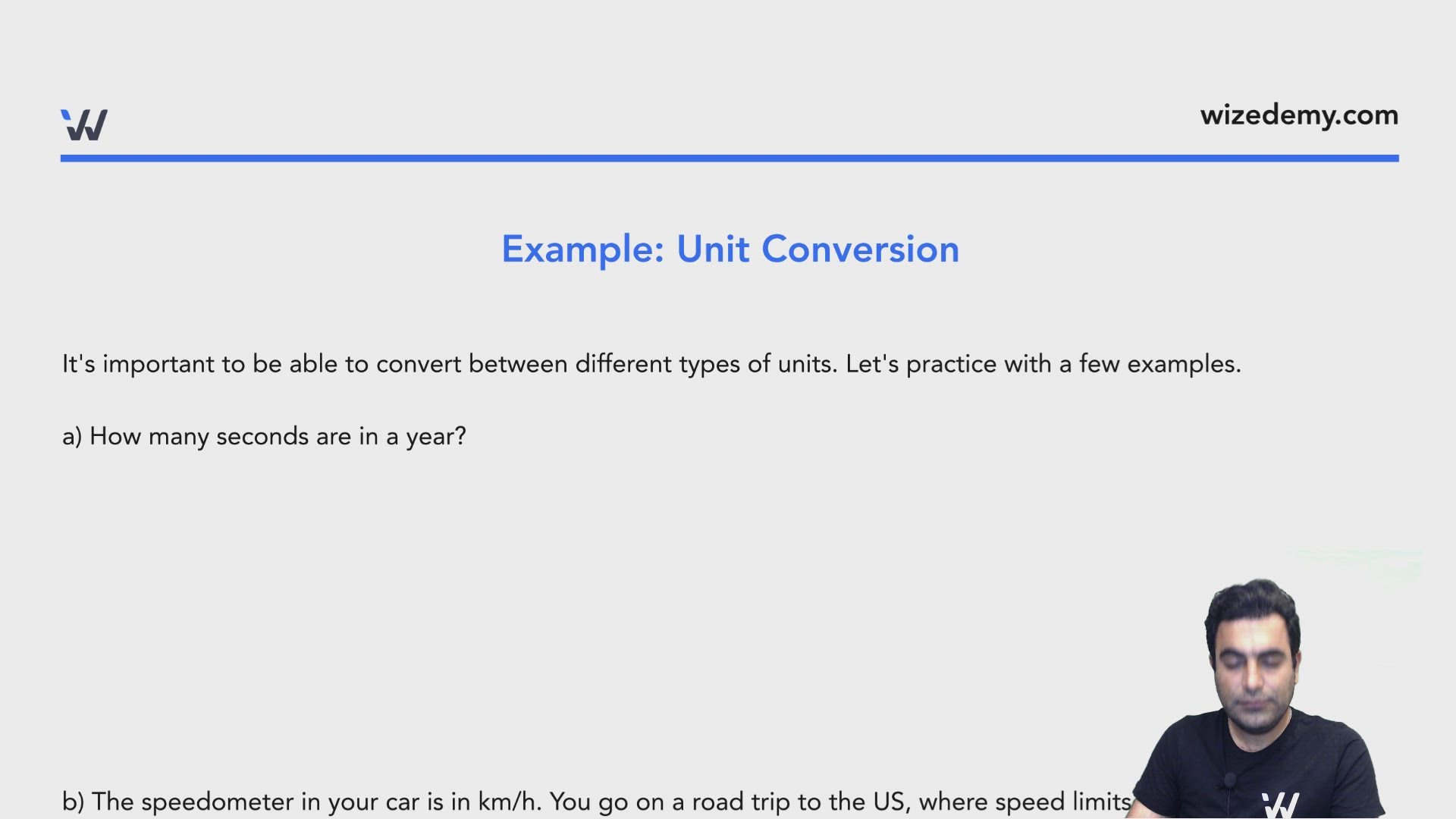
It's important to be able to convert between different types of units. Let's practice with a few examples.
a) How many seconds are in a year?
b) The speedometer in your car is in km/h. You go on a road trip to the US, where speed limits are posted in mph (miles per hour). You're on a highway with a 70 mph speed limit. If you are driving 110 km/h, are you speeding? (1 mile is 1.61 km.)
We need to convert our speed to mph.
This is less than the posted speed limit. We are not going to get a ticket!
Practice: Smartest Unit of Volume
I have a giant balloon, and it can hold up to 54100 human brains. A human brain is actually a measure of volume (1 human brain = 0.046 ft3). There are , so what is the volume of the giant balloon in ?