0:00 / 0:00

Percent Error


Percent error helps us to compare the error size with the actual value of a quantity.

It can be calculated using the following equation:

%Error=Theoretical ValueExperimental ValueTheoretical Value×100%\displaystyle \%\text{Error}=\left|\frac{\text{Theoretical Value}-\text{Experimental Value}}{\text{Theoretical Value}}\right|\times100\%


0:00 / 0:00

Example: Percent Error


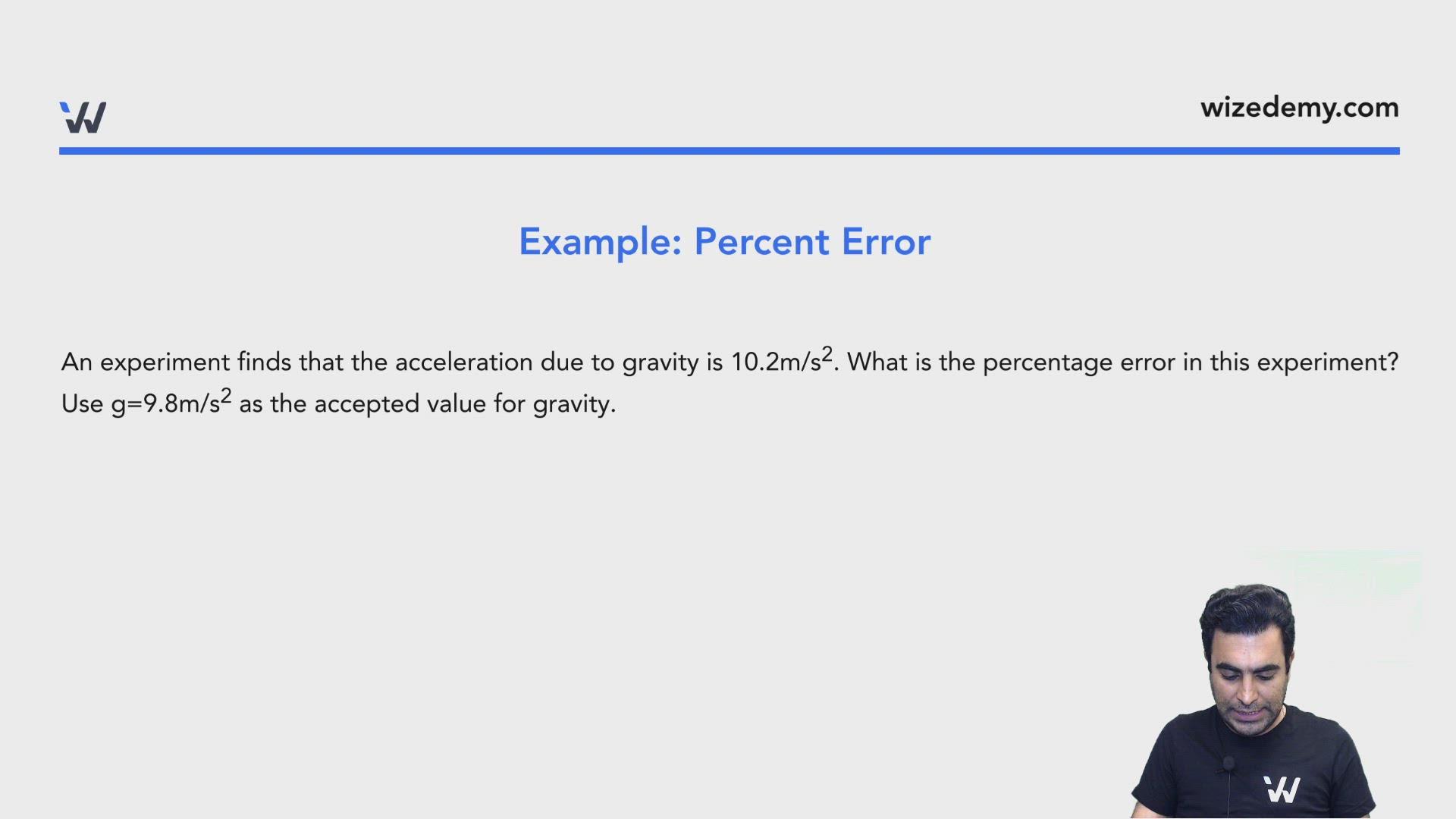
An experiment finds that the acceleration due to gravity is 10.2m/s2. What is the percentage error in this experiment? Use g=9.8m/s2 as the accepted value for gravity.
Solution:
%Error=Theoretical ValueExperimental ValueTheoretical Value×100=9.810.29.8×100%=0.49.8×100%=4.08%\begin{aligned} \%\text{Error} &=\left|\frac{\text{Theoretical Value}-\text{Experimental Value}}{\text{Theoretical Value}}\right|\times100\\[11pt] &= \left|\frac{9.8-10.2}{9.8}\right|\times100\%\\[9pt] &=\left|\frac{-0.4}{9.8}\right|\times100\%\\[9pt] &=4.08\% \end{aligned}
Find the percent error if the molar mass of carbon is 12.01 but the experiment product a value of 12.1.