Wize University Dynamics Textbook (Master) > Kinematics of a Particle
Rectilinear Motion of Particle

0:00 / 0:00
If begin with the basic dynamics equations:
If we assume the acceleration term (a) to be a constant, we can integrate the various forms of these equations to arrive at the following:
The important thing to remember is that these 3 equations can only be used under conditions of uniform acceleration. Common applications of this include projectile motion (due to the earth's gravity), as well as motion at a constant velocity (a = 0).
Application of these equations is fairly straightforward, as long as you can keep track of initial conditions at t=0 vs. other conditions at various times. Some key ideas to remember:
- The maximum displacement occurs when the velocity is 0
- If the system is starting from rest, the initial velocity is 0
- We often don't consider xo if we are looking for distance or displacement - xo is just a reference point
0:00 / 0:00
You throw a ball vertically with a velocity of 20 m/s upwards from the second floor of the engineering building at a height of 7 m from the ground. Determine:
a) The maximum height that the ball reaches, and how long does that take
b) The velocity of the ball as its about to hit the ground
c) The time it takes for the ball to reach the ground
a)
b)
0:00 / 0:00
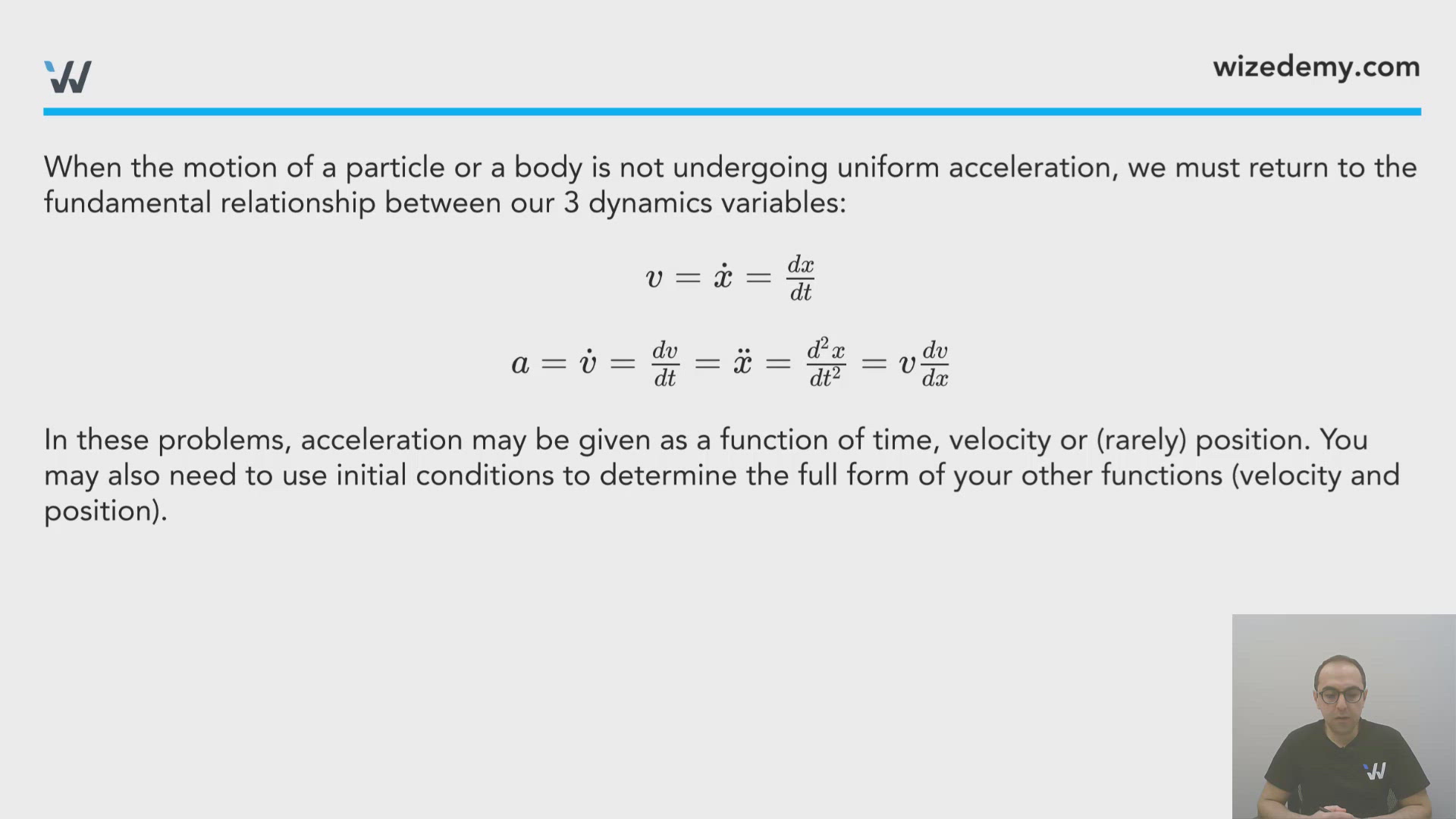
When the motion of a particle or a body is not undergoing uniform acceleration, we must return to the fundamental relationship between our 3 dynamics variables:
In these problems, acceleration may be given as a function of time, velocity or (rarely) position. You may also need to use initial conditions to determine the full form of your other functions (velocity and position).
0:00 / 0:00
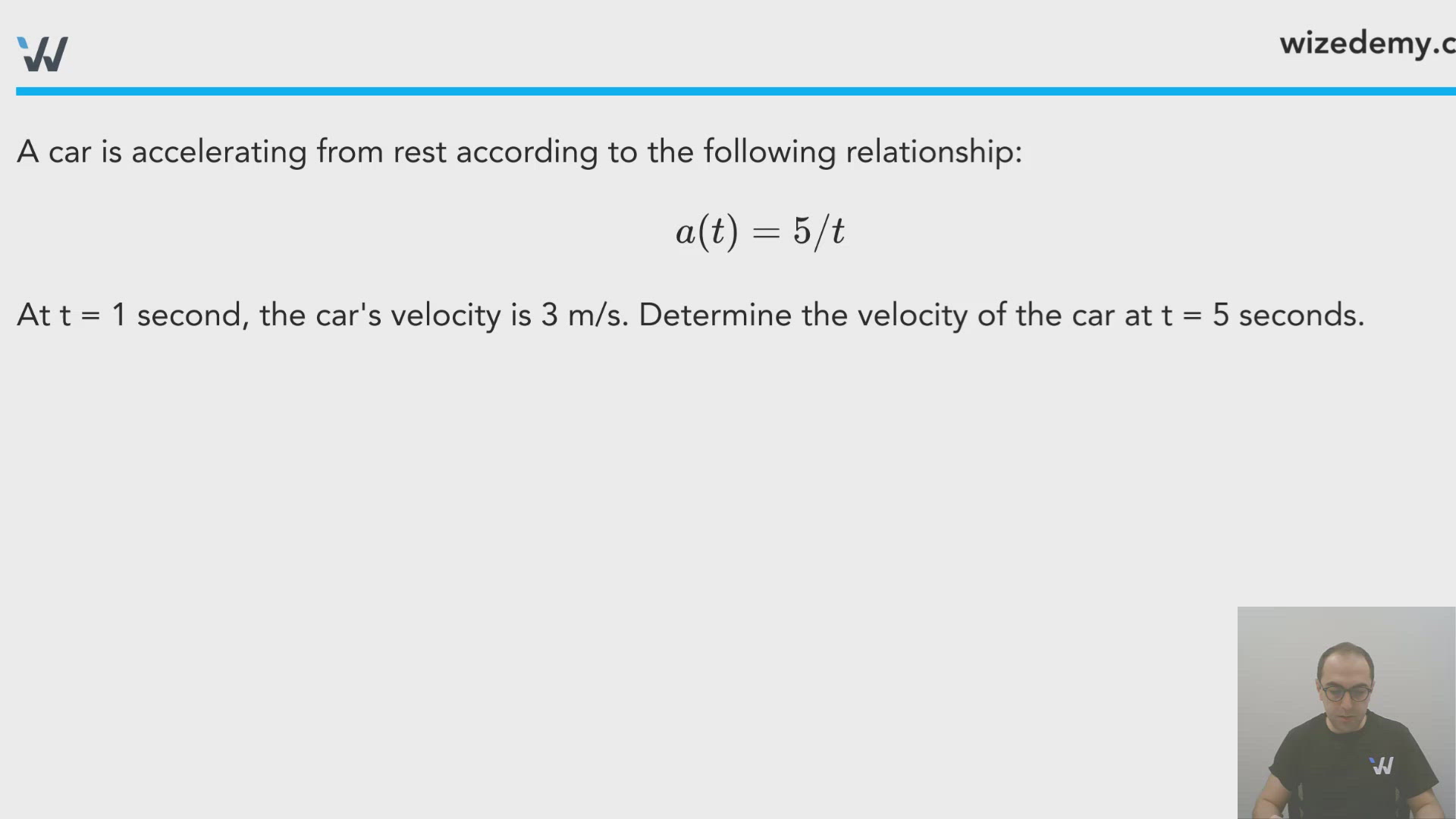
A car is accelerating from rest according to the following relationship:
At t = 1 second, the car's velocity is 3 m/s. Determine the velocity of the car at t = 5 seconds.
While checking your email on your phone as you go up in a helicopter accelerating upwards at a a rate of 2 m/s2, you drop your phone. At that instant the helicopter (and your phone) are travelling upwards at a velocity of 40 m/s. After 14 seconds, your phone signal goes out (indicating that it has hit the ground). Determine:
Note: do not assume that the helicopter began accelerating from the ground. The acceleration of gravity is 9.81 m/s2 downwards.
a) At what speed did your phone hit the ground
b) What is the altitude of the helicopter at that instant
You've timed the traffic light near your house and found that it stays red for exactly 30 seconds. One day you're driving down the road and see the light turn red as you are 3 blocks (300 meters) away from the intersection, and your speedometer reads 60 km/h. Determine the constant rate of deceleration of the car you need in order to not stop at the traffic light. What is your speed as you enter the intersection?
A common metric for comparing the power of different cars is the time they take to accelerate from 0 to 60 km/h. You're asked to evaluated two different designs for the exterior of a car, which effects its acceleration time. For both designs, the acceleration is proportional to the output power of the engine, minus a term to account for the frictional drag force (air resistance). The two acceleration functions are given below:
What is the minimum length of track needed to test the two designs, if they both require 15 m of braking distance?
The velocity of a particle along a straight line is given by the following function:
where the velocity is in m/s and time is in seconds.
Determine:
a) The acceleration of the particle after 3 seconds
b) The displacement of the particle between t = 1 and t = 3 seconds
c) The distance the particle has travelled between t = 5 and t = 8 seconds