Wize University Dynamics Textbook (Master) > Kinematics: Rectilinear Motion
Non-Uniformly Accelerated Motion
0:00 / 0:00
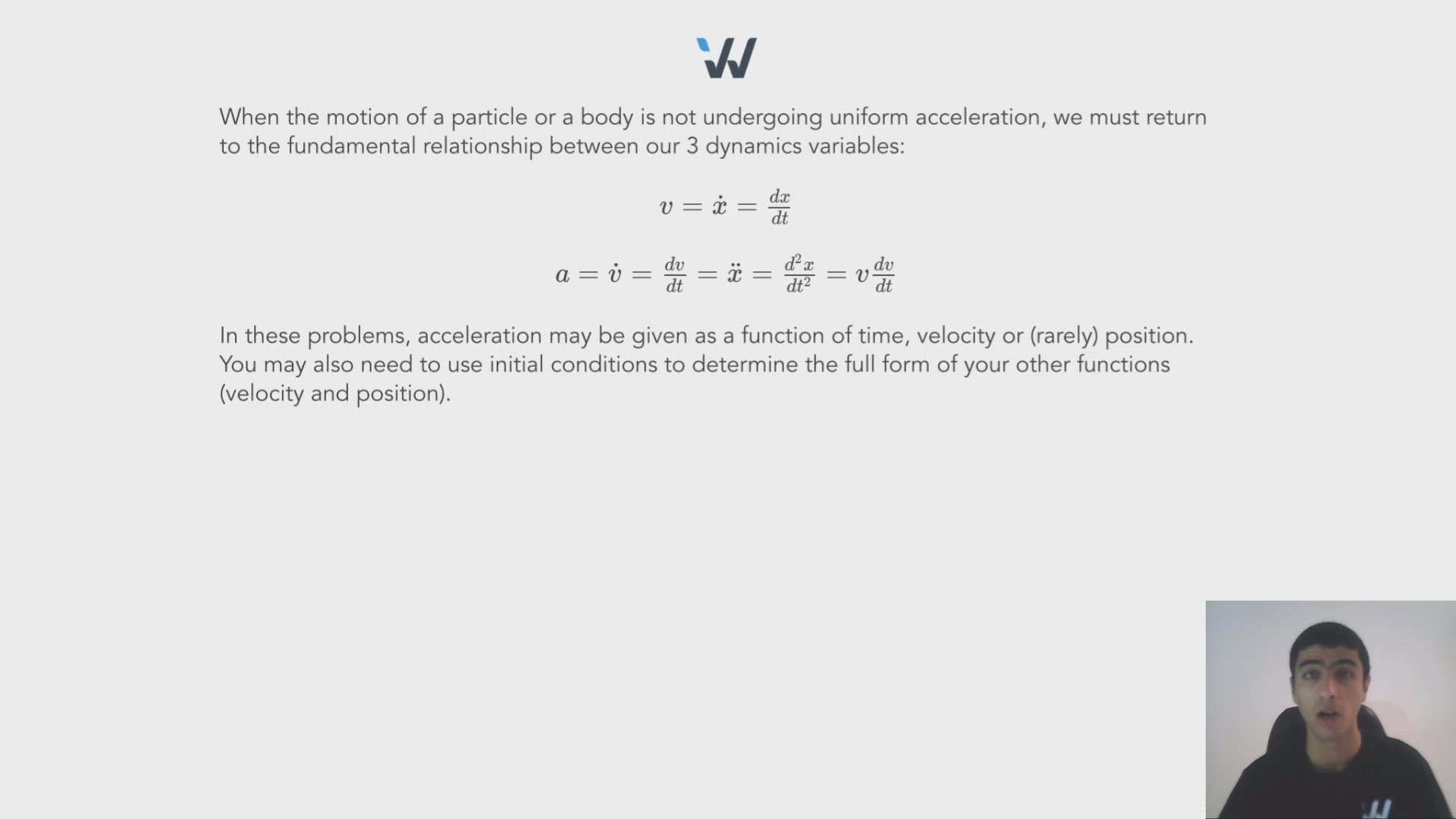
When the motion of a particle or a body is not undergoing uniform acceleration, we must return to the fundamental relationship between our 3 dynamics variables:
In these problems, acceleration may be given as a function of time, velocity or (rarely) position. You may also need to use initial conditions to determine the full form of your other functions (velocity and position).
0:00 / 0:00
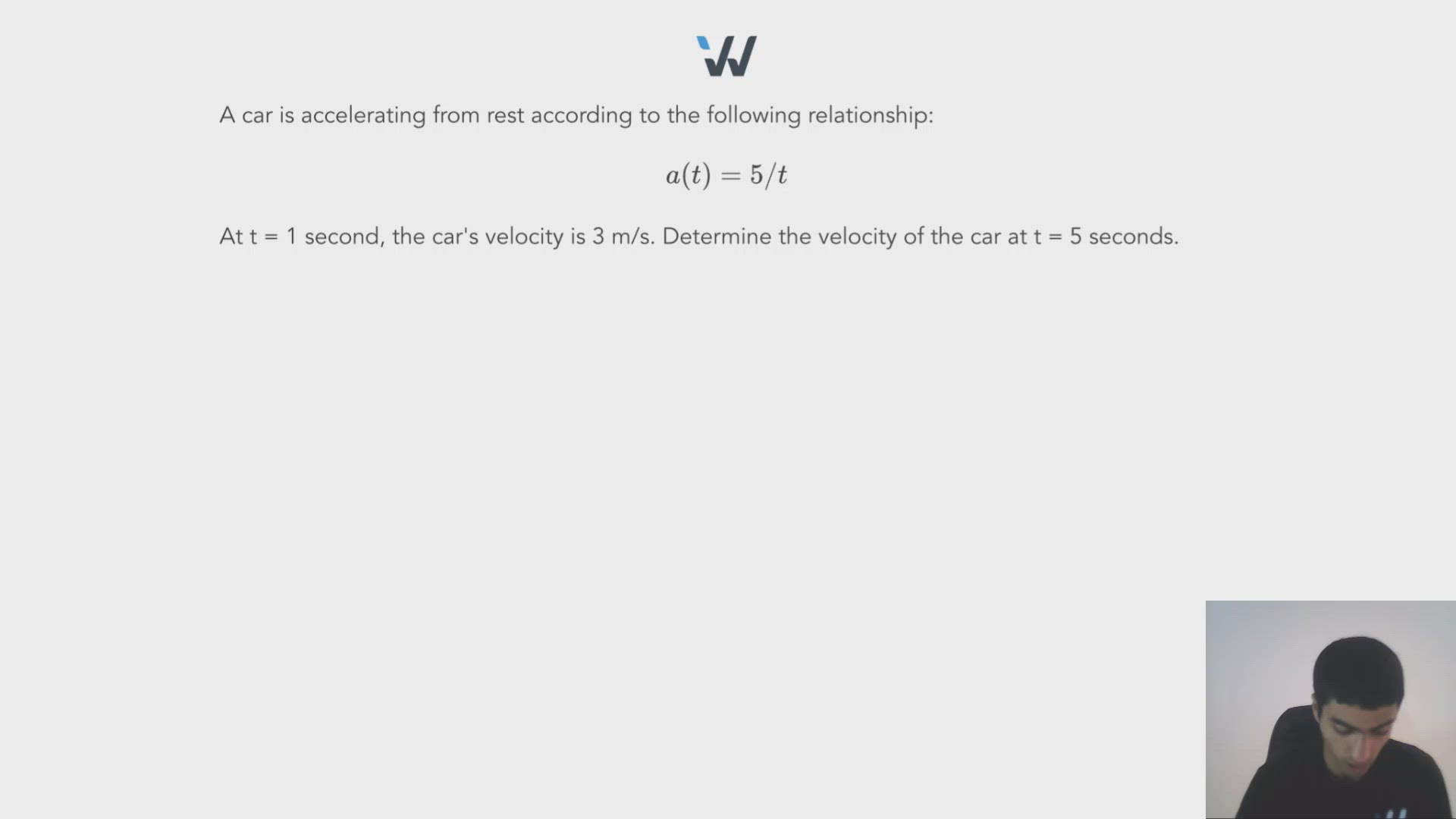
A car is accelerating from rest according to the following relationship:
At t = 1 second, the car's velocity is 3 m/s. Determine the velocity of the car at t = 5 seconds.

Mark Yourself Question
- Grab a piece of paper and try this problem yourself.
- When you're done, check the "I have answered this question" box below.
- View the solution and report whether you got it right or wrong.
A common metric for comparing the power of different cars is the time they take to accelerate from 0 to 60 km/h. You're asked to evaluated two different designs for the exterior of a car, which effects its acceleration time. For both designs, the acceleration is proportional to the output power of the engine, minus a term to account for the frictional drag force (air resistance). The two acceleration functions are given below:
What is the minimum length of track needed to test the two designs, if they both require 15 m of braking distance?
Mark Yourself Question
- Grab a piece of paper and try this problem yourself.
- When you're done, check the "I have answered this question" box below.
- View the solution and report whether you got it right or wrong.
The velocity of a particle along a straight line is given by the following function:
where the velocity is in m/s and time is in seconds.
Determine:
a) The acceleration of the particle after 3 seconds
b) The displacement of the particle between t = 1 and t = 3 seconds
c) The distance the particle has travelled between t = 5 and t = 8 seconds
Quiz: Non-Uniform Acceleration Practice Question
What is the distance travelled within the first 5 seconds of a particle whose motion along a line is described by the following equation: