0:00 / 0:00
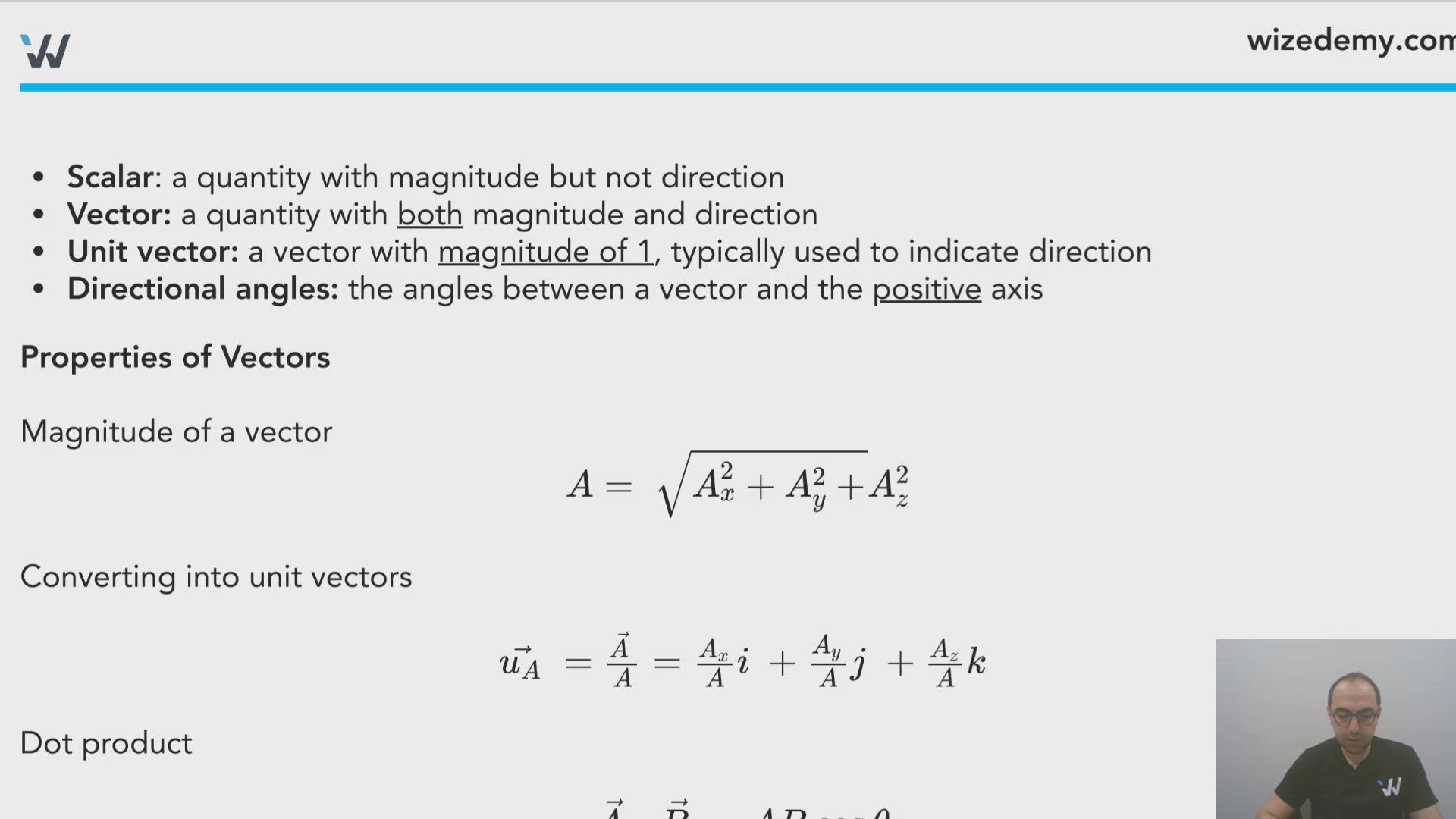
- Scalar: a quantity with magnitude but not direction
- Vector: a quantity with both magnitude and direction
- Unit vector: a vector with magnitude of 1, typically used to indicate direction
- Directional angles: the angles between a vector and the positive axis
Properties of Vectors
Magnitude of a vector
Converting into unit vectors
Dot product
Can also be thought of as a measure of how parallel two vectors are
Properties of Directional Angles
Unit vector with directional angles
Relationship between directional angles
Vector Manipulation
Things you should know:
- How to break down a vector into perpendicular components
- How to break down a vector into non-perpendicular component
- Projecting a vector along a line
- Finding the angle between two vectors
Q: How to break down a vector into perpendicular components?
A: Basic Trigonometric rules, aka. SOH CAH TOA
Q: How to break down a vector into non-perpendicular components?
A: Sine and cosine laws
Q: How to project a vector along a line
A: Using the dot product
Q: Finding the angle between two vectors
A: Modified dot product