Solving Statically Indeterminate Beams by Compatibility
A statically indeterminate beam has more unknown support reactions than independent equilibrium equations can determine. To find its reactions, you also describe how the beam deforms and how its supports restrict that deformation. A propped cantilever provides a useful starting point: one end is fixed, while a vertical prop supports the other end. Its reactions depend on equilibrium together with a displacement condition at the prop.
Identify and release a redundant
Consider a beam carrying transverse loads in one plane. For bending, a fixed end supplies a vertical reaction and a reaction moment; a roller supplies another vertical reaction. The two relevant equilibrium equations are vertical force balance and moment balance. Three bending reaction unknowns therefore leave one additional condition to supply. Any horizontal reaction is zero for the loading considered here.
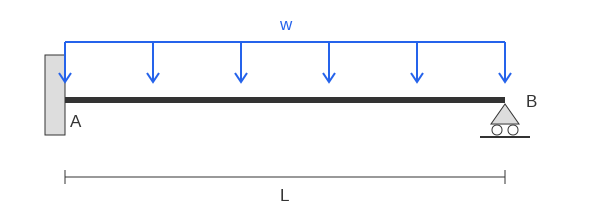
A redundant reaction is a reaction you temporarily remove to obtain a stable, statically determinate structure. Choose the upward prop reaction as the redundant. Removing the prop leaves a cantilever, called the released or primary structure.
The release must leave a stable structure. Removing a restraint that allows rigid-body motion does not give a suitable primary structure for this procedure.
Match the displacement to the support
Displacement compatibility means that the calculated beam displacement agrees with the displacement imposed by its support. Take downward tip displacement as positive and the redundant force as positive upward. If the prop settles downward by , compatibility requires
where is the downward tip displacement caused by the applied loads on the released cantilever. The flexibility coefficient is the magnitude of tip displacement per unit tip force. Its units are length per force.
The minus sign represents the upward displacement produced by an upward redundant. Superposition applies here because the beam is linearly elastic and undergoes small deflections. Use bending deformation only, neglect shear deformation, and assume that the support remains in contact with the beam.
For a constant flexural rigidity , span , and uniform downward load , the cantilever results are
Substitution gives
Use consistent units throughout. For example, in , in , and lengths in metres give in kilonewtons.
Interpret the result and recover reactions
The support displacement changes how much upward force is needed to satisfy compatibility.
Support condition | Compatibility | Consequence for the prop reaction |
|---|---|---|
No settlement | The prop cancels the load-induced tip displacement. | |
Downward settlement, | Less upward reaction is required. | |
Upward movement, | More upward reaction is required. |
For zero settlement, the common factor cancels, giving . With prescribed nonzero settlement, stiffness affects the reaction. A stiffer beam requires a larger force change to accommodate the same imposed movement.
After finding , recover the fixed-end reactions using equilibrium. Let be positive upward and the external support couple be positive counterclockwise:
This external support couple has the opposite sign to the internal bending moment immediately beside the fixed end when sagging bending is positive.
What to remember
- Release a redundant while keeping the primary structure stable.
- Combine load displacement and redundant-force displacement using one sign convention.
- Match the total displacement to the actual support movement.
- Recover the remaining reactions by equilibrium and check support contact.
Example: A Canopy Beam with a Settling Prop
A canopy beam of length is fixed at A and supported by a vertical prop at B. It carries a uniform downward load , including its self-weight. Its constant flexural rigidity is . The prop settles downward by relative to A.
Assume small-deflection linear elastic bending, negligible shear deformation, and maintained contact. Take downward displacement as positive, vertical reactions as positive upward, and the external reaction couple at A as positive counterclockwise. Report forces and moments to three decimal places.
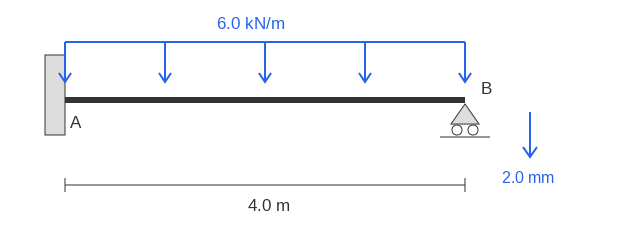
a) Choose a redundant and calculate the load-induced displacement and tip flexibility of the released structure.
Choose the upward prop reaction as the redundant. Removing the prop leaves a stable cantilever fixed at A. For constant , its uniform-load tip displacement and tip flexibility are
Substitute the given quantities using metres and kilonewtons:
The flexibility is a displacement per unit force. An upward therefore produces an upward displacement of magnitude , opposing the load-induced displacement.
b) Determine the prop reaction and verify compatibility with the settled support.
The final beam displacement at B must equal the support settlement, not zero. Convert the settlement to metres:
With downward displacement positive, compatibility is
Using the unrounded flexibility,
The redundant produces of upward displacement, so the total is
This matches the prescribed settlement. The positive upward reaction is also consistent with a prop that remains in contact and supports the beam from below.
c) Find the vertical reaction and external reaction couple at A, then check equilibrium.
The distributed load has resultant
acting downward at the midpoint, from A. Vertical equilibrium gives
Take moments about A, positive counterclockwise. The prop reaction gives a ________ moment and the distributed load gives a ________ moment:
The checks are
Both equilibrium equations are satisfied. The reported couple is the external support reaction; under a sagging-positive convention, the internal bending moment immediately beside A is .
Solving Beam Reactions with Displacement Compatibility
A statically indeterminate beam has more unknown reactions than independent equilibrium equations. You encounter this situation when a beam has additional supports, restrained end rotations, or both. To determine its reactions, you must account for how the beam deforms and how its supports restrict that deformation. The force method makes this connection by temporarily removing a restraint and then finding the force needed to restore it.
Identify and release a redundant
Consider a beam fixed at A and supported by a vertical roller at B. In planar analysis, the fixed support supplies a horizontal reaction, a vertical reaction, and a moment. The roller supplies another vertical reaction. Four unknown reactions exceed the three independent equilibrium equations, so the beam is externally indeterminate to degree one.
For transverse loading, the horizontal reaction is zero. You still have three bending-related unknowns but only vertical-force and moment equilibrium to determine them.
A redundant reaction is an unknown support force or moment selected for determination through deformation. Choose the vertical reaction at B as the redundant and remove the roller. The remaining cantilever is the primary structure. It must be stable and statically determinate; a release that creates a mechanism is unsuitable.
Removing a restraint allows a displacement that the original support prevented. Your task is to calculate the redundant that makes this displacement satisfy the original support condition.
Write the compatibility equation
Compatibility means that the beam's displacements agree with the movements permitted or imposed by its supports. For a rigid roller that does not settle, the beam's vertical displacement at that support must be zero. Its rotation is generally unrestricted.
Use downward displacement as positive and define the redundant as positive upward. For the released cantilever, let be the downward displacement at B caused by the applied loads. Let be the positive displacement magnitude at B per unit vertical force applied there. Its units are length divided by force.
An upward redundant produces downward-coordinate displacement . If the support moves downward by , compatibility requires
Therefore,
This superposition assumes small deflections and linear elastic behavior. In elementary slender-beam analysis, bending deformation is described by flexural rigidity , where is Young's modulus and is the second moment of area. Shear deformation is neglected here.
Match the actual support condition
Different supports require different displacement conditions. For a vertical spring, let be its stiffness and assume it is initially uncompressed. A downward end displacement compresses the spring and produces an upward force .
Support at B | Required downward displacement | Compatibility equation |
|---|---|---|
Rigid roller without settlement | ||
Roller settling downward by | ||
Initially uncompressed vertical spring |
For a constant- cantilever of length carrying a downward uniformly distributed load over its full span, the released displacement and end flexibility are
With a rigid, nonsettling prop, substitution gives
Here, constant cancels. This cancellation does not mean stiffness is irrelevant to indeterminate beams. Support settlement, spring flexibility, and changes in along the beam can change the reaction distribution.
After finding the redundant, restore it to the original beam and use equilibrium to calculate the remaining reactions. For several redundants, write one compatible displacement or rotation equation for each released restraint and solve the equations together.
What to remember
- Select enough redundants to leave a stable, determinate primary structure.
- State positive directions before combining load-induced and redundant-induced displacements.
- Match compatibility to the actual support movement or flexibility.
- Find redundants from deformation, then recover the remaining reactions from equilibrium.
Example: A Propped Equipment-Support Beam
A horizontal equipment-support beam AB is fixed at A and rests on a rigid vertical roller at B. Its length is and its constant flexural rigidity is . A downward equipment load acts at distance from A. Ignore beam self-weight, shear deformation, and support settlement. Assume linear elastic behavior and small deflections.
Take downward displacement as positive. Take vertical support reactions as positive upward and external support moments as positive counterclockwise.
a) Select a redundant and calculate the displacement at B caused by the equipment load on the released structure.
Choose the upward roller reaction as the redundant. Removing the roller leaves a stable cantilever fixed at A. The equipment load then produces a downward displacement at the free end B.
For a cantilever with a point load at distance from its fixed end, the displacement at its free end is
Substitute the load, distances, and flexural rigidity:
The released beam's end B moves 22.4 mm downward under the equipment load alone.
b) Determine the vertical reaction at B.
Restoring the roller requires the final displacement at B to be zero. An upward force at the cantilever's free end produces an upward displacement of magnitude .
The end flexibility is
Using downward displacement as positive, compatibility gives
Solve for the redundant:
Thus, the roller reaction is upward. Its upward displacement contribution is 22.4 mm, which exactly cancels the load-induced downward displacement.
c) Determine the vertical reaction and reaction moment at A.
With the redundant known, apply equilibrium to the original supported beam. Retain the unrounded value during these calculations.
Vertical-force equilibrium gives
Taking moments about A, counterclockwise positive, gives
The fixed support therefore supplies 8.67 kN upward and an external reaction moment of counterclockwise. The horizontal reaction is zero because no horizontal load acts.