Elastic and Plastic Behaviour of Materials
Elastic and plastic behaviour of materials determines whether a component returns to its original dimensions after you remove a load. A metal strip may stretch temporarily under a modest tensile force, yet remain longer after a larger force is removed. To predict that remaining deformation, you need to distinguish the strain present under load from the strain left after unloading.
Recognizing elastic and plastic deformation
Elastic deformation is deformation that is recovered when the load is removed. Plastic deformation is deformation that remains after complete unloading. Here, consider an initially unstressed metal specimen under uniform, small tensile strain. Take tensile stress and extension as positive, keep temperature constant, and neglect creep and damage.
The elastic range describes recoverability. For the metal model used here, the initial elastic response is also linear. Yield marks the onset of plastic deformation. Beyond yield, increasing extension can produce both elastic and plastic strain; yielding does not mean that every subsequent part of the deformation is permanent.
Stage | What happens to strain? | Result of complete free unloading |
|---|---|---|
Initial elastic loading | Recoverable strain increases | Original length is restored |
Loading beyond yield | Plastic strain develops alongside elastic strain | Some extension remains |
Elastic unloading after yield | Elastic strain decreases while plastic strain stays fixed | Permanent extension remains at zero stress |
A curved loading response alone does not establish plasticity: some materials are nonlinearly elastic. Recovery after unloading is the defining distinction.
Separating total strain
For small uniaxial strains, split the total strain into elastic and plastic parts:
Here, is total strain, is recoverable elastic strain, is plastic strain, is tensile stress, and is the elastic modulus. Use matching stress units for and : for example, . Strain is dimensionless; means .
Engineering strain uses the original gauge length . Therefore, the peak extension, recovered extension, and permanent extension are respectively
These expressions assume uniform deformation. After complete free unloading, stress is zero and the elastic strain is zero, but the plastic strain can remain positive. A constrained or nonuniform component requires additional analysis before you infer its internal stress from the removed external load.
Reading unloading and reloading
In the idealized metal model, unloading after yield follows a straight line with slope , parallel to the initial elastic loading line. Its intersection with the strain axis gives the permanent strain.
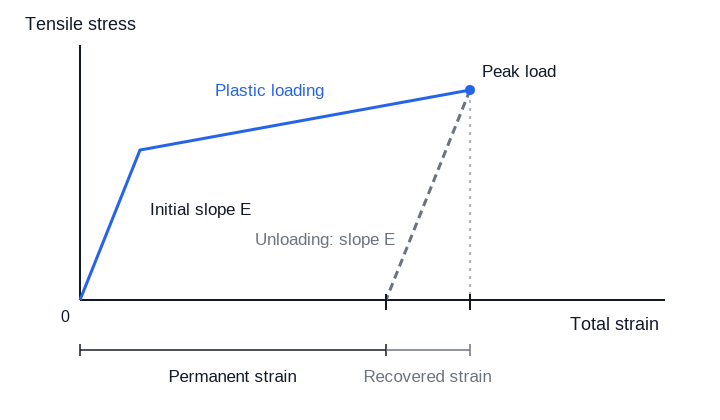
The rising slope during plastic loading is generally different from . For a strain-hardening material, increasing stress is needed to continue plastic deformation. An elastic–perfectly plastic idealization instead allows continued plastic strain at constant yield stress. Both idealizations can use the same elastic unloading rule.
Loading history also matters. In the idealized strain-hardening model, reloading in the same tensile direction retraces the unloading line until the previous maximum stress is reached. During this elastic reloading, total strain increases but plastic strain stays fixed. Further plastic flow begins when loading continues beyond that previous peak. This description assumes no reverse yielding, damage, or time-dependent effects.
What to remember
- Elastic strain recovers; plastic strain remains after complete free unloading.
- At small strain, total strain equals elastic strain plus plastic strain.
- Calculate elastic recovery using , with matching stress units.
- Use the original gauge length to convert strain into extension.
- After plastic loading, both the current stress and the loading history affect the response.
Example: Recovery and permanent extension of a steel tie
A steel tie has an original gauge length , elastic modulus , and initial tensile yield stress . During a forming operation, it strain-hardens to a tensile stress of at a measured total strain of .
Assume uniform small strain, constant temperature, negligible creep and damage, and elastic unloading and reloading with modulus . In this idealized hardening model, further plastic flow during tensile reloading begins only when loading continues beyond the previous peak stress. The tie has free ends when fully unloaded.
a) Find the elastic and plastic strains at the peak load.
The total strain contains both recoverable and permanent parts. Convert the modulus to the stress units used in the calculation:
The recoverable elastic strain at the peak is
Subtract this elastic part from the measured total strain:
Thus the peak strain consists of elastic strain and plastic strain, or and , respectively. Their sum is the measured total strain.
b) Find the recovered extension and the final gauge length after complete unloading.
Use the original gauge length for both strain-to-extension calculations. The extension recovered during unloading is
The permanent extension is
The final unloaded gauge length is therefore
Check against the loaded length: the peak extension was , giving a loaded length of . Recovering leaves , as required.
c) After complete unloading, the tie is reloaded to . Find its total strain and gauge length, and determine whether new plastic deformation occurs.
The new tensile stress is below the previous peak of . Under the specified model, reloading is elastic and the existing plastic strain stays at .
The elastic strain at is
Add the retained plastic strain to obtain the total strain relative to the original gauge length:
The total extension and current gauge length are
No new plastic deformation occurs. Relative to the unloaded length, the tie extends elastically by , which also gives .
Yielding, Plastic Strain, and Elastic Recovery
When you stretch a metal specimen beyond its elastic range, removing the load no longer restores its original length. Part of the deformation remains. Plastic response describes how that permanent deformation develops during loading and how the material responds when you unload and reload it. Here, you will use an idealized uniaxial model for small engineering strains, before necking, with tension taken as positive.
Yielding and permanent strain
The total axial strain can be separated into elastic and plastic contributions:
The elastic contribution is recoverable. The plastic strain is the permanent contribution that remains after complete unloading, provided the unloading itself causes no additional plastic deformation. Strain is dimensionless; a strain of corresponds to .
For a model with a constant elastic modulus , the elastic contribution at tensile stress is . Therefore,
Yielding marks the onset of plastic deformation. Some materials have a distinct yield point; others transition gradually. For a gradual transition, a commonly reported value is the proof stress. On a stress–strain graph, this is the intersection of the loading curve with a line parallel to the initial elastic line but shifted to the right by strain:
Under the constant-modulus unloading model, that intersection corresponds to a permanent strain of after unloading. The proof stress is a specified reporting convention, rather than necessarily the first stress at which microscopic plastic deformation occurs.
Modelling the response after yield
Many metals require increasing tensile stress to continue plastic deformation. This behaviour is called strain hardening. A simple bilinear model represents the initial loading curve with two straight segments:
Here, is the initial yield stress, is the strain at first yield, and is the slope of the stress–total-strain curve after yield. Use consistent stress units for , , and .
Idealized response | Slope of the loading curve | Behaviour after first yield |
|---|---|---|
Elastic–perfectly plastic | after yield | Plastic strain increases at constant stress |
Bilinear strain hardening | after yield | Increasing stress produces additional plastic strain |
These are simplified material models. A real tensile curve may have a yield plateau or a changing hardening slope. In the bilinear model, describes changes in total strain; it is not the unloading modulus.
Unloading and reloading
Suppose you reach a maximum state and then reduce the tensile load. Assume unloading is linear with slope and introduces no further plastic strain. The unloading line is
At zero stress, the remaining total strain equals . For an original gauge length , the permanent extension and recovered extension are
If you reload in the same tensile direction, the idealized response retraces the unloading line. No additional plastic strain develops until the previous maximum stress is reached. Loading beyond that point continues along the hardening curve. This history matters: the same stress can correspond to different total strains in a virgin specimen and a previously stretched specimen.
What to remember
- Total strain is the sum of recoverable elastic strain and permanent plastic strain.
- Calculate permanent strain using .
- Strain hardening raises the stress required for further plastic deformation.
- In the idealized model, unloading and tensile reloading follow slope .
Example: Permanent Extension of a Steel Tie
A steel tie has an original gauge length of . Its idealized tensile response is bilinear, with elastic modulus , initial yield stress , and post-yield slope . The post-yield slope relates stress to total engineering strain. Unloading and tensile reloading follow slope , with additional plastic deformation beginning only beyond the previous maximum stress. Take tension as positive and neglect changes in geometry.
a) The tie is stretched to a total strain of . Determine whether it has yielded and calculate its stress.
First express both moduli in the same stress units as the yield stress:
The strain at first yield is
Because , the tie has yielded. Use the post-yield loading segment, measured from the yield point:
The tie has yielded, and its tensile stress is .
b) The load is removed completely. Calculate the recovered extension and the permanent extension.
Unloading recovers the elastic strain associated with the maximum stress. The remaining strain is plastic because the unloading model introduces no additional plastic deformation.
Multiply each strain by the original gauge length:
As a check, the maximum extension was
The recovered and permanent extensions add to . The tie recovers and retains a permanent extension of .
c) The unloaded tie is loaded again to a tensile stress of . Calculate its total strain and extension relative to its original length. State whether additional plastic deformation occurs.
The new stress is below the previous maximum of . Reloading therefore remains on the elastic line, even though exceeds the initial yield stress of the virgin material. The plastic strain stays at .
The total strain is , and the extension relative to the original length is . No additional plastic deformation occurs; further plastic deformation begins when loading proceeds beyond .