Wize University Introduction to Finance Textbook > Introduction to Finance
Introduction to Finance
Popular Courses
COMM 308
Concordia University
Intro to Finance
University Study Guides
Intro to Finance
University Study Guides
FINA 230
Concordia University
MGCR 341
McGill University
FIN 301
University of Alberta
FIN 300
Toronto Metropolitan University
COMM 121
Queen's University
FIN*2000
University of Guelph
FINC 341
Texas A&M University
COMMERCE 2FA3
McMaster University
COMM 2202
Dalhousie University
BU283
Wilfrid Laurier University
FIN 300
Arizona State University - Tempe
BUSFIN 3220
Ohio State University
SB/FINE 2000 3.00
York University
FIN 301
Pennsylvania State University
BUS-F 255
Indiana University - Bloomington
FIN 3403
University of Central Florida
FIN 3403
University of Florida
0:00 / 0:00
Introduction to Finance
What is Finance?
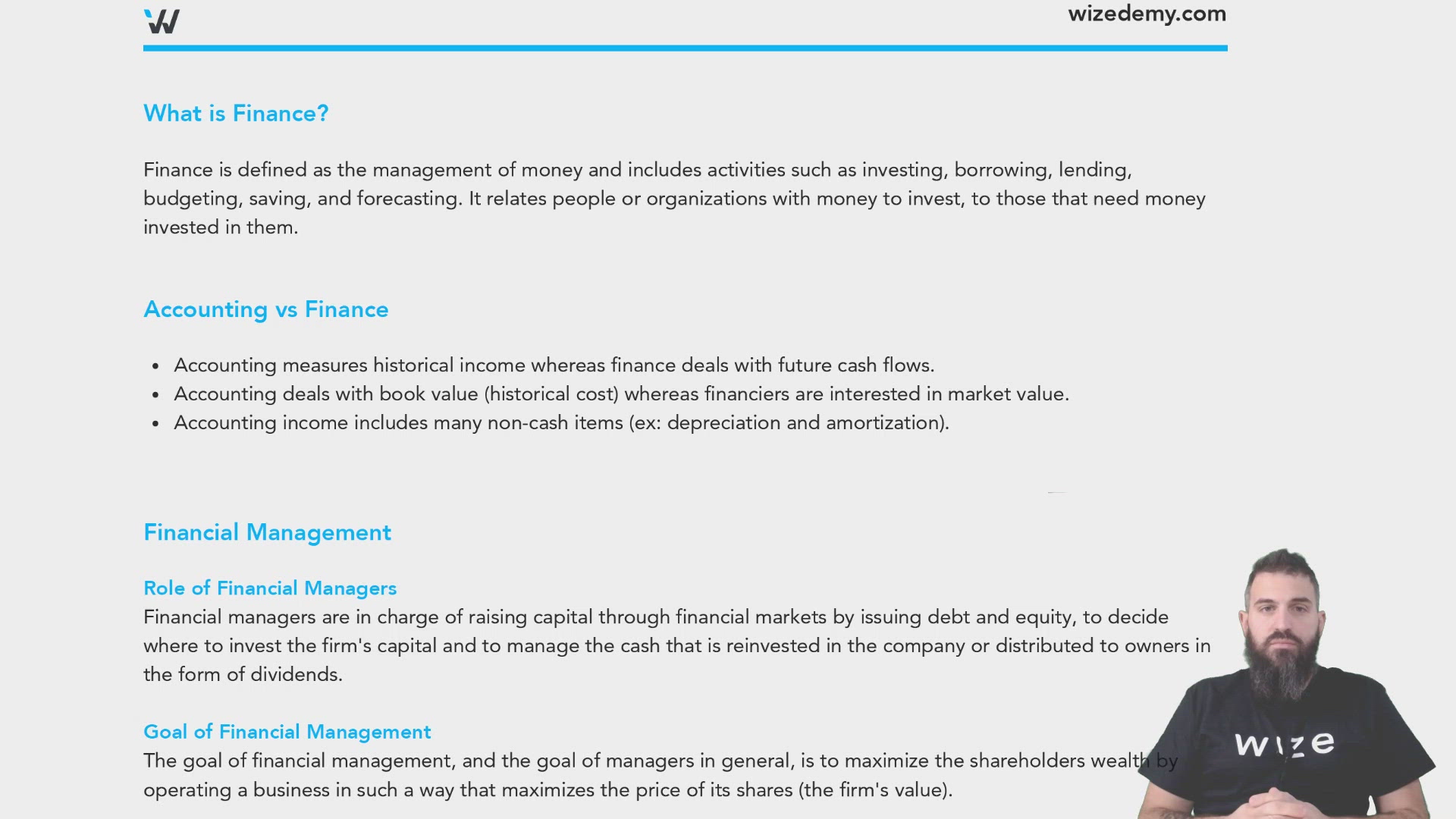
Finance is defined as the management of money and includes activities such as investing, borrowing, lending, budgeting, saving, and forecasting. It relates people or organizations with money to invest, to those that need money invested in them.
Accounting vs Finance
- Accounting measures historical income whereas finance deals with future cash flows.
- Accounting deals with book value (historical cost) whereas financiers are interested in market value.
- Accounting income includes many non-cash items (ex: depreciation and amortization).
Financial Management
Role of Financial Managers
Financial managers are in charge of raising capital through financial markets by issuing debt and equity, deciding where to invest the firm's capital, managing the cash that is reinvested in the company or distributed to owners in the form of dividends.
The Goal of Financial Management
The goal of financial management, and the goal of managers in general, is to maximize the shareholders' wealth. Accomplished by operating a business in such a way that maximizes the price of its shares (the firm's value).
0:00 / 0:00
Markets
The Role of Financial Markets
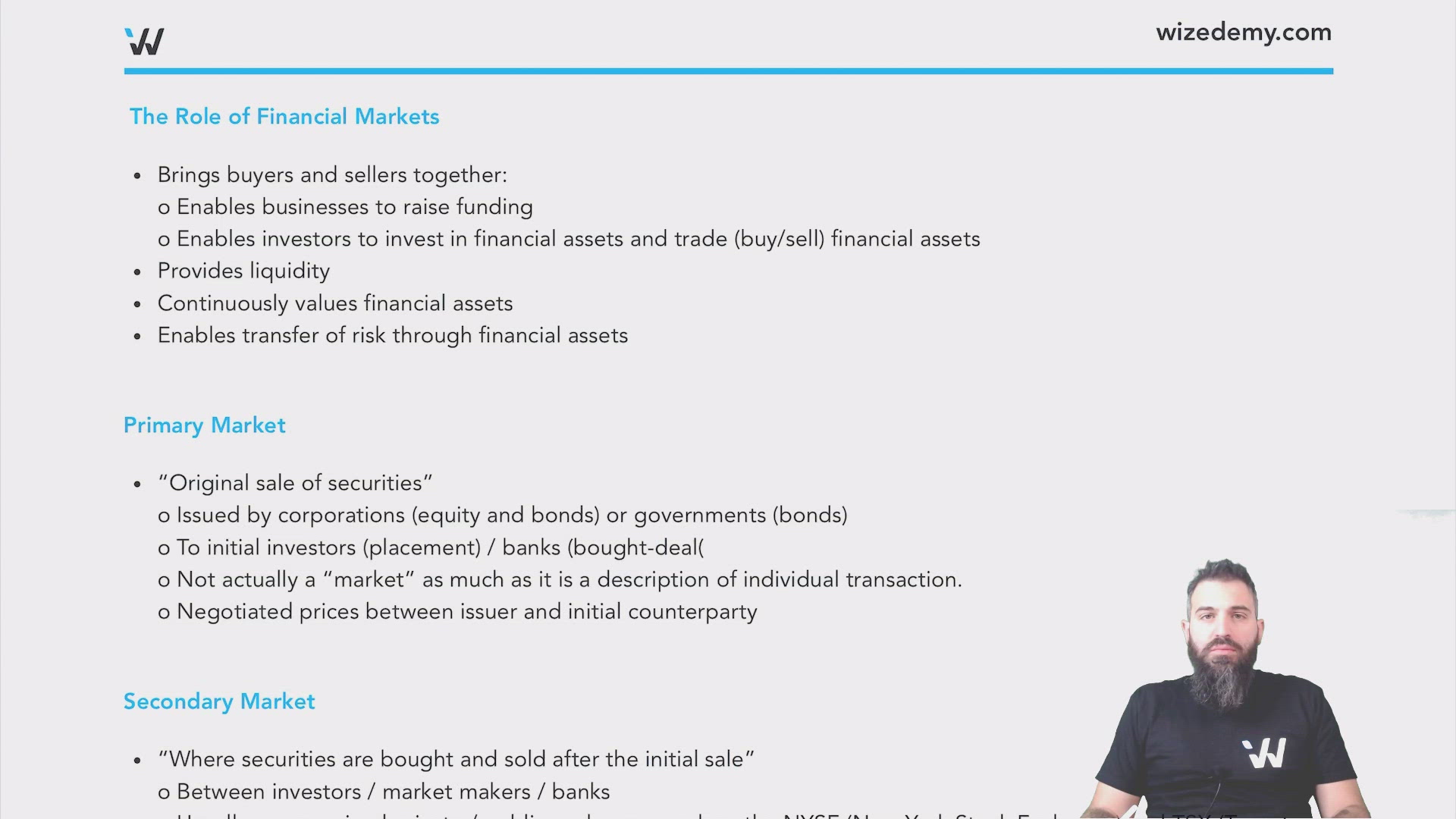
- Brings buyers and sellers together: o Enables businesses to raise funding o Enables investors to invest in financial assets and trade (buy/sell) financial assets
- Provides liquidity
- Continuously values financial assets
- Enables transfer of risk through financial assets
Primary Market
- “Original sale of securities” o Issued by corporations (equity and bonds) or governments (bonds) o To initial investors (placement) / banks (bought-deal) o Not actually a “market” as much as it is a description of individual transaction o Negotiated prices between the issuer and initial counterparty
Secondary Market
- “Where securities are bought and sold after the initial sale” o Between investors/market makers/banks o Usually on organized private/public exchanges such as the NYSE (New York Stock Exchange) and TSX (Toronto Stock Exchange) o Market-established prices through demand/supply
Major Assets
- Real asset are tangible assets like buildings, vehicles, equipment and commodities.
- Financial assets are intangible like receivables, stocks, bonds and cash.