Wize University Introduction to Finance Textbook > Cost of Capital
Weighted-Average Cost of Capital
Popular Courses
COMM 308
Concordia University
Intro to Finance
University Study Guides
Intro to Finance
University Study Guides
FINA 230
Concordia University
FIN 301
University of Alberta
COMM 121
Queen's University
FIN*2000
University of Guelph
FINC 341
Texas A&M University
COMMERCE 2FA3
McMaster University
COMM 2202
Dalhousie University
FIN 300
Arizona State University - Tempe
BUSFIN 3220
Ohio State University
SB/FINE 2000 3.00
York University
FIN 301
Pennsylvania State University
BUS-F 255
Indiana University - Bloomington
FIN 3403
University of Central Florida
FIN 3403
University of Florida
FIN 320
California State University - Fullerton
FINC-UB 7
New York University
FINC-UB 2
New York University

0:00 / 0:00
The Weighted-Average Cost of Capital
Cost of Capital
- The weighted average cost of debt and equity.
- This includes bonds, other long-term debt, common equity, and preferred equity.
- The more capital that is raised through a specific channel, the most significant the cost of that channel will be to the average.
- Weights are based on the market values of debt and equity.
- Represents the average cost of every dollar of capital a firm controls.
Capital Structure
- The proportion of a company's capital (assets) that is financed through debt and equity.
- Typically measured using the debt-to-equity ratio
- Changes to capital structure affect a firm's cost of capital when the cost of debt and equity are different.
Weighted-Average Cost of Capital Formula

Formula Break-Down
- RI: After-tax cost of debt
- RP: Cost of preferred equity
- RE: Cost of common equity
- D: Market value of debt
- P: Market value of preferred shares
- E: Market value of common shares
0:00 / 0:00
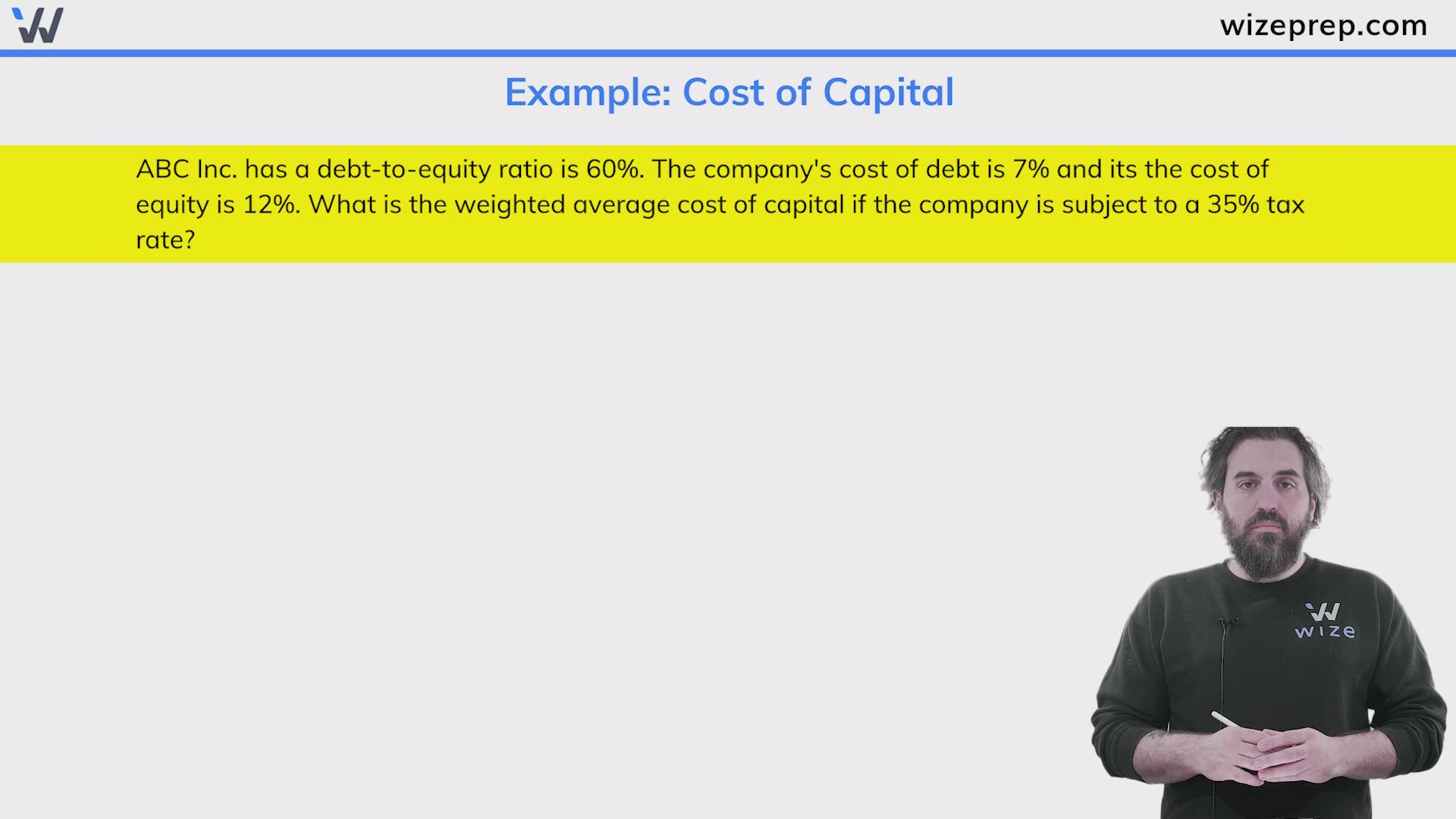
Example: Cost of Capital
ABC Inc. has a debt-to-equity ratio is 60%. The company's cost of debt is 7% and its the cost of equity is 12%. What is the weighted average cost of capital if the company is subject to a 35% tax rate?
Practice: Weighted-Average Cost of Capital
The debt-to-equity ratio for XYZ Corporation is 120%. The cost of debt is 8% and the beta of the company's stock is 1.2. What is the weighted-average cost of capital if the risk free rate is 3%, the market's expected return is 10% and the tax rate is 40%?
Round your final answer to 2 decimal places and enter a percentage.
Example: Cost of Capital
You have obtained the following information on the ABC Inc.
- Book values: assets = $250,000; common equity = $25,000; preferred stock = $150,000 and debt = $75,000. Coupons on debt are paid once a year.
- Number of shares outstanding: 10,000 common and 25,000 preferred
- Market prices per share: common stock $25, preferred $10
- Preferred dividend $1.00 per share; coupon rate on debt is 8%; ABC does not pay dividends on its common stock
- Beta of the stock is 1.25
- Yield to maturity of debt is equal to the coupon rate
- Tax rate is 35%, risk free rate is 2%, and expected return on the market is 15%.
Calculate the weighted average cost of capital (WACC) or the ABC Inc.
Practice: Cost of Capital
- XYZ Corp. as 100,000 15-year 10% annual coupon bonds that were issued 6 years ago. The current YTM on the bonds is 7%.
- XYZ Corp. also has 10,000,000 outstanding common shares with a beta of 1.2, the common shareholders expect to receive a dividend of $2 next year and 5% more per year indefinitely.
- The company also has 500,000 outstanding preferred shares with a dividend rate of 4%, the preferred shares are currently trading at 92% of par value.
- The standard deviation of the TSX returns is 19%, the expected Return on the market portfolio is 9%, T-bills are yielding 5% and the company's tax rate is 40%.
What is the WACC?
Round your final answer to 2 decimal places and enter a percentage.
| The WACC is | % |