Wize University Introduction to Finance Textbook > Bond Valuation
Interest Rate Risk
Popular Courses
COMM 308
Concordia University
Intro to Finance
University Study Guides
Intro to Finance
University Study Guides
FINA 230
Concordia University
MGCR 341
McGill University
FIN 301
University of Alberta
FIN 300
Toronto Metropolitan University
COMM 121
Queen's University
FIN*2000
University of Guelph
FINC 341
Texas A&M University
COMMERCE 2FA3
McMaster University
COMM 2202
Dalhousie University
BU283
Wilfrid Laurier University
FIN 300
Arizona State University - Tempe
BUSFIN 3220
Ohio State University
SB/FINE 2000 3.00
York University
FIN 301
Pennsylvania State University
BUS-F 255
Indiana University - Bloomington
FIN 3403
University of Central Florida
FIN 3403
University of Florida
0:00 / 0:00
Bond Price Sensitivity
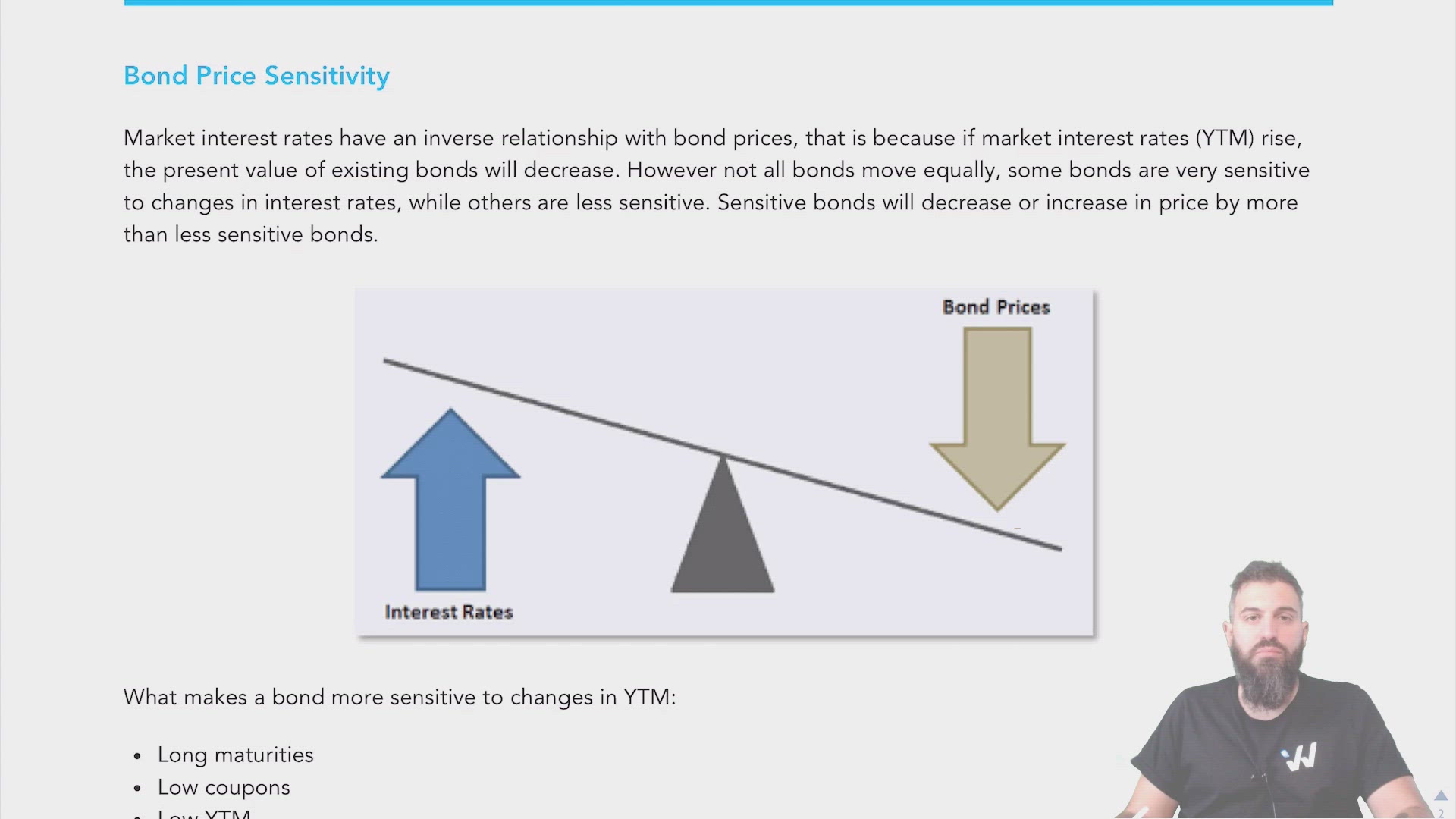
Market interest rates have an inverse relationship with bond prices, that is because if market interest rates (YTM) rise, the present value of existing bonds will decrease. However not all bonds move equally, some bonds are very sensitive to changes in interest rates, while others are less sensitive. Sensitive bonds will decrease or increase in price by more than less sensitive bonds.
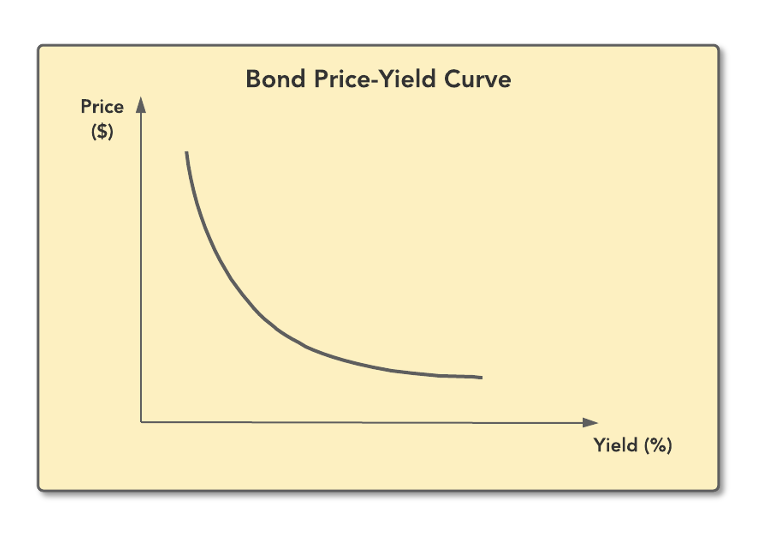
What does the Price-Yield Curve tell us?
- Bonds are more sensitive to change in interest rates when yields are lower.
- Bonds are more sensitive when rates/yields decrease then when they increase.
Characteristics that increase bond sensitivity
- Long maturities
- Low coupons
- Low YTM
- Higher frequency of payments
For Example:
Consider the following two bonds, both have a face value of $1,000
Bond A: 10-year maturity, 5% coupons paid annually
Bond B: 30-year maturity, 5% coupons paid annually
Bond A: When YTM = 6%, Bond A is priced at $926.40; if YTM increases to 7% the price decreases by 7.21% to $859.53
Bond B: When YTM = 6%, Bond B is priced at $862.35; if YTM increases to 7% the price decreases by 12.82% to $751.82
Example: Bond Price Sensitivity
ABC Inc. has bonds outstanding with a $1,000 face value. The coupon rate on these bonds is 7% and coupons are paid annually. The bonds mature in 10 years. What is the percentage change in the price of the bond if the yield to maturity increases from 7% to 8%?
Practice: Bond Price Sensitivity
ABC Inc. has bonds outstanding with a $1,000 face value. The coupon rate on these bonds is 6% and coupons are paid semi-annually. The bonds mature in 8 years. The bond's are currently priced at par. What will be the percentage change in the price of the bond if the yield to maturity decreases by 50 basis points?
The percentage change in price is %
Round your final answer to 2 decimal places.