Wize University Introduction to Finance Textbook > Capital Budgeting
Net Present Value
Popular Courses
COMM 308
Concordia University
Intro to Finance
University Study Guides
Intro to Finance
University Study Guides
FINA 230
Concordia University
MGCR 341
McGill University
FIN 301
University of Alberta
FIN 300
Toronto Metropolitan University
COMM 121
Queen's University
FIN*2000
University of Guelph
FINC 341
Texas A&M University
COMMERCE 2FA3
McMaster University
COMM 2202
Dalhousie University
FIN 300
Arizona State University - Tempe
BUSFIN 3220
Ohio State University
SB/FINE 2000 3.00
York University
FIN 301
Pennsylvania State University
BUS-F 255
Indiana University - Bloomington
FIN 3403
University of Central Florida
FIN 3403
University of Florida
FIN 320
California State University - Fullerton
0:00 / 0:00
Net Present Value
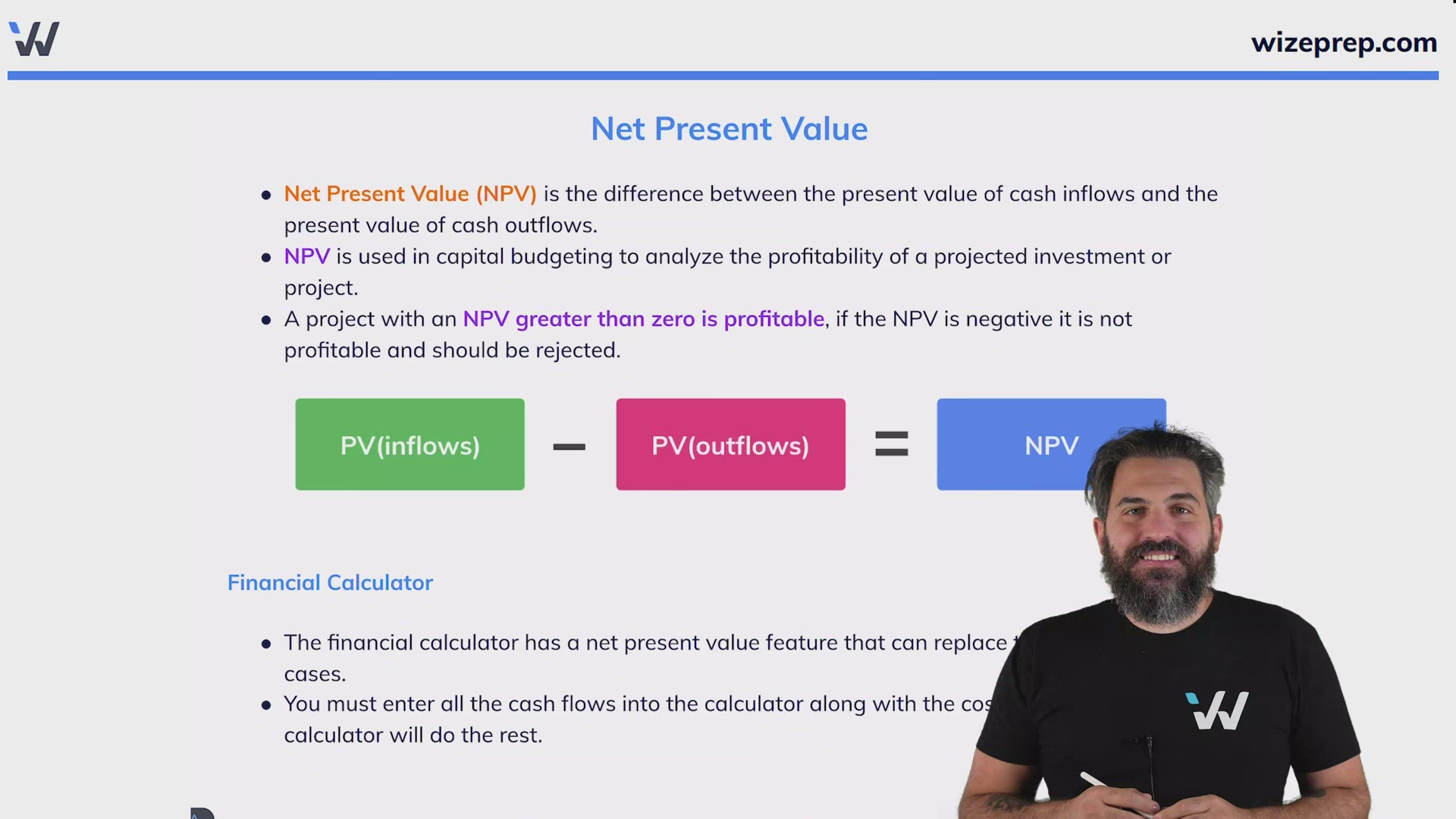
- Net Present Value (NPV) is the difference between the present value of cash inflows and the present value of cash outflows.
- NPV is used in capital budgeting to analyze the profitability of a projected investment or project.
- A project with an NPV greater than zero is profitable, if the NPV is negative it is not profitable and should be rejected.

Financial Calculator
- The financial calculator has a net present value feature that can replace the formula in most cases.
- You must enter all the cash flows into the calculator along with the cost of capital, the calculator will do the rest.
0:00 / 0:00
Example: Net Present Value (NPV)
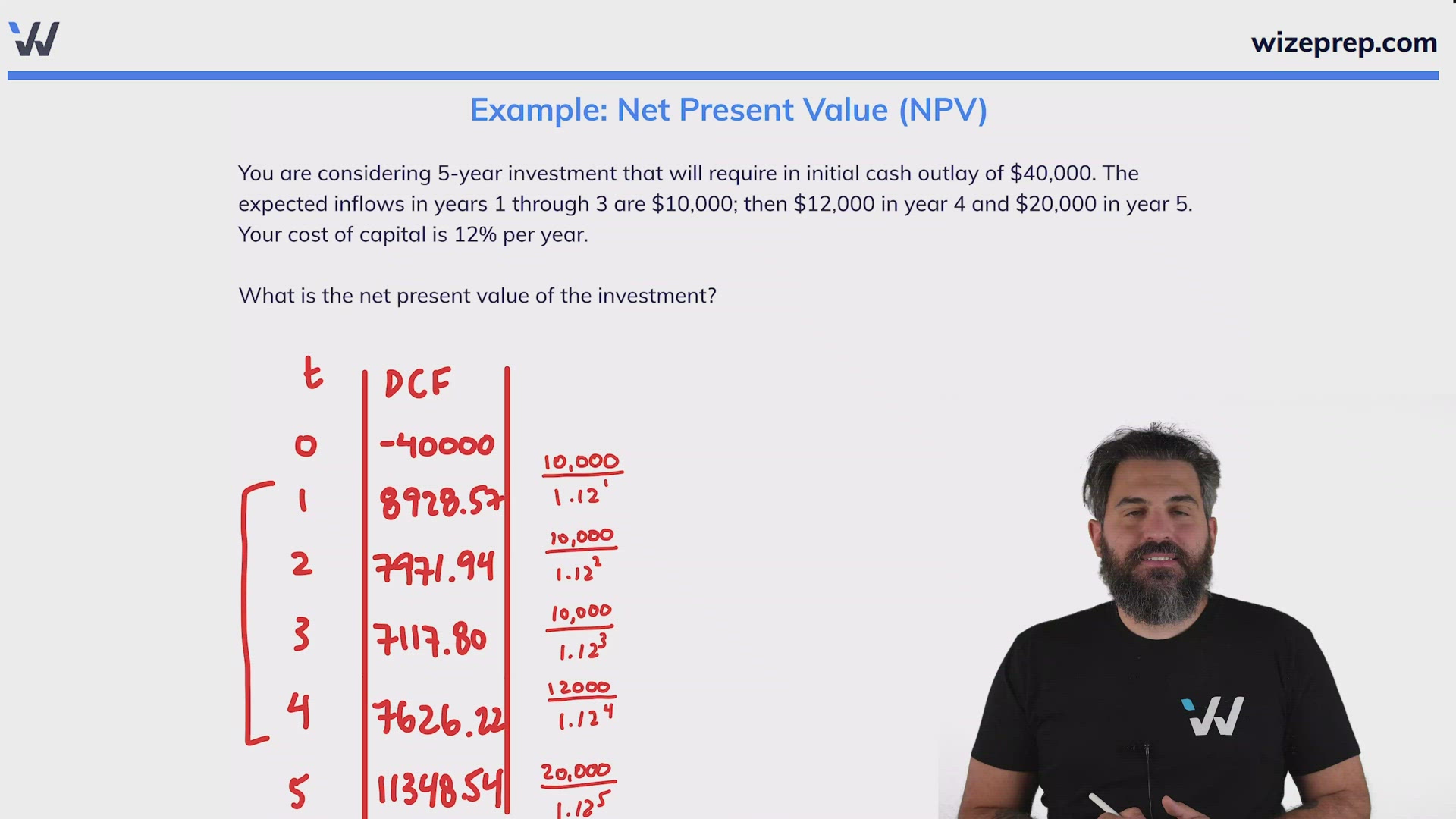
You are considering 5-year investment that will require in initial cash outlay of $40,000. The expected inflows in years 1 through 3 are $10,000; then $12,000 in year 4 and $20,000 in year 5. Your cost of capital is 12% per year.
What is the net present value of the investment?
Practice: Net Present Value (NPV)
An investment requires an initial after-tax cash outlay of $6,000 and will return $3,000 in the first year, $3,000 in the second year and $4,000 in the third. If the investor's cost of capital if 9%, what is the net present value of this investment?
Round final answer to 2 decimal places
| The net present value is | $ |
0:00 / 0:00
Example: Net Present Value
Calculate the net present value of an investment that requires an upfront outflow of $100,000 and will return $24,000 per year forever. The investor's cost of capital is 15%.
Practice: Net Present Value
An investment requires an initial after-tax cash outlay of $50,000. The investor will receive $8,000 per year indefinitely. At the end of the 5th year, the investor will be required to pay a one-time $10,000 maintenance fee.
What is the net present value of this investment if the investor's cost of capital is 12%.
Round your final answer to 2 decimal places
| The net present value is | $ |