Popular Courses
COMM 308
Concordia University
Intro to Finance
University Study Guides
Intro to Finance
University Study Guides
FINA 230
Concordia University
MGCR 341
McGill University
FIN 301
University of Alberta
FIN 300
Toronto Metropolitan University
COMM 121
Queen's University
FIN*2000
University of Guelph
FINC 341
Texas A&M University
COMMERCE 2FA3
McMaster University
COMM 2202
Dalhousie University
FIN 300
Arizona State University - Tempe
BUSFIN 3220
Ohio State University
SB/FINE 2000 3.00
York University
FIN 301
Pennsylvania State University
BUS-F 255
Indiana University - Bloomington
FIN 3403
University of Central Florida
FIN 3403
University of Florida
FIN 320
California State University - Fullerton

0:00 / 0:00
The Cross-over Rate
When multiple investment opportunities are present but only one can be selected, these investments are said to be mutually exclusive. The crossover rate tells us when the NPV of two investments are equal (cross over).
Steps to Compute Crossover Rate:
1. Compute the difference in cash outflows and inflows in the two investments
2. Use the differences to compute IRR
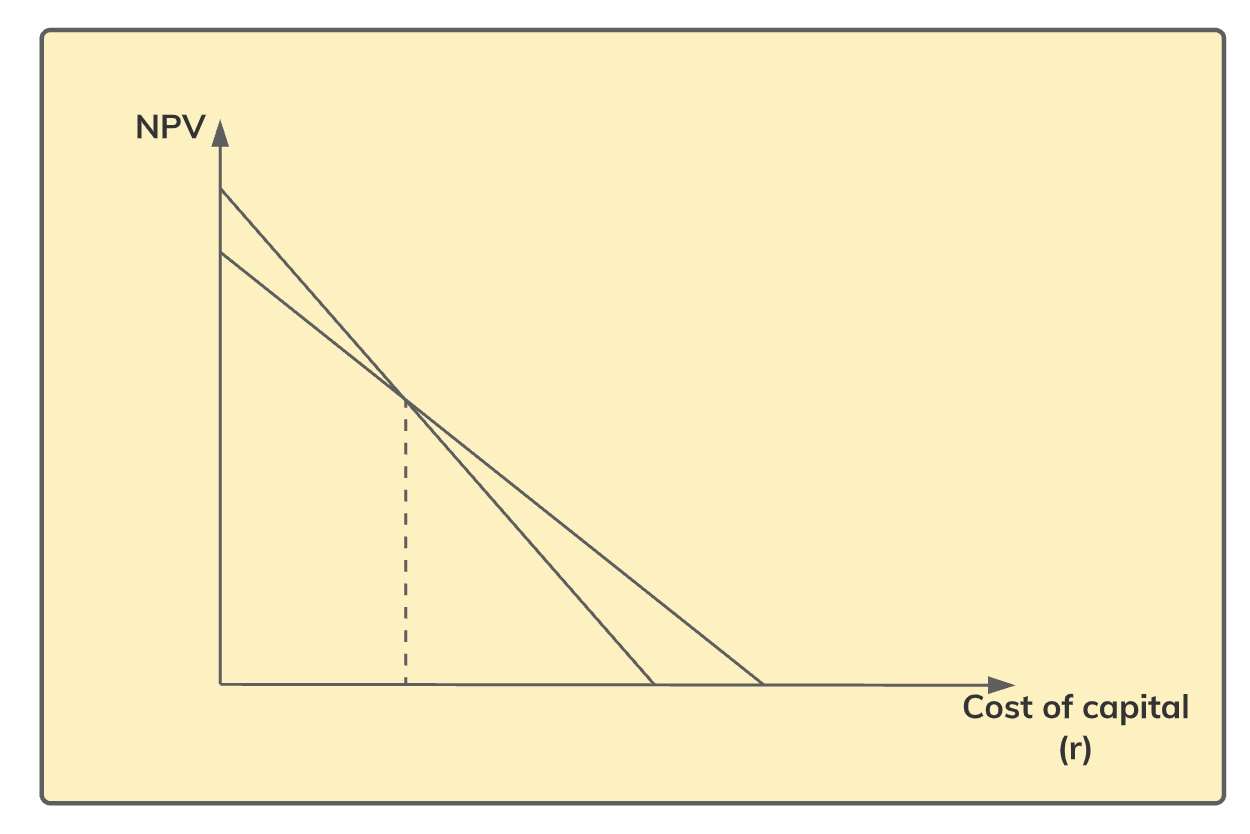
Using the Cross-Over Rate
- If r < cross-over rate, choose the the project with the lower IRR.
- if r > cross-over rate, choose the project with the higher IRR.
- Unless r > IRR of both projects, then choose neither project.

0:00 / 0:00
Example: The Cross-Over Rate
A company is considering two mutually exclusive projects A and B. Project A requires an initial investment of $100,000 and is expected to generate after-tax cash flows of $45,000 per year for three years. Project B requires an initial investment of $150,000 and is expected to generate after-tax cash flows of $50,000 per year for four years. The appropriate discount rate is 10 percent. What is the crossover rate for projects A and B?

Practice: Cross-over Rate
You are considering two mutually exclusive investments. Investment A requires an initial after-tax outlay of $120,000 and will return $25,000 per year for 6 years. Investment B requires an initial after-tax outlay of $80,000 and will return $20,000 per year for 3 years and $15,000 per year for the next 3 years. Your cost of capital is 5%.
What is the cross-over rate?
| The cross-over rate is | % |