Create a free account to get started

Unlock full course notes by signing up

  • Video lessons taught by top educators
  • Practice questions with guided solutions
  • Written review notes for reference
  • Expert answers anytime from course tutors

Annual Percentage Rate vs Effective Annual Rate

Annual Percentage Rate

  • APR is a quoting convention where short-term interest rates (monthly, quarterly, semi-annually, etc.) are multiplied by the number of periods in a year.
  • Not particularly useful because APR does not take into account compounding!
  • An interest rate is “APR” when:
  • A quotation is provided;
  • Compounding frequency is indicated; or
  • The periodicity of the interest rate is not annual and is not specified to be “effective” (e.g. “monthly” interest rate).
  • Also called the nominal rate, stated rate, or quoted rate


Effective Annual Rate

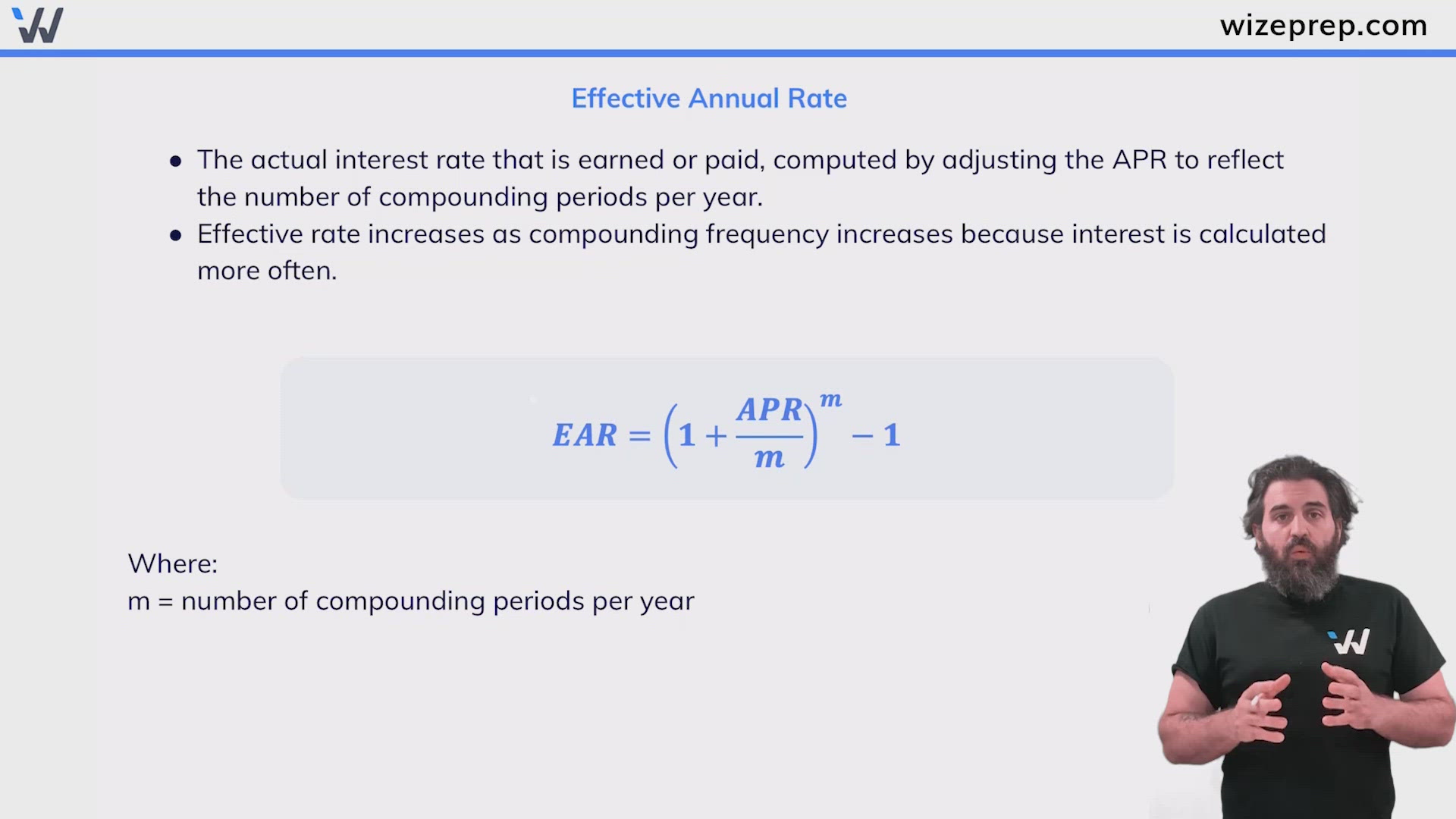
  • The actual interest rate that is earned or paid, computed by adjusting the APR to reflect the number of compounding periods per year.
  • Effective rate increases as compounding frequency increases because interest is calculated more often.


Image illustrating Annual Percentage Rate (APR) and Effective Annual Rate (EAR)


Where:

m = number of compounding periods per year


Create a free account to get started

Unlock full course notes by signing up

  • Video lessons taught by top educators
  • Practice questions with guided solutions
  • Written review notes for reference
  • Expert answers anytime from course tutors

Example: Effective Annual Rate

APR of 10% compounded monthly is equal to what effective annual rate?

Practice: Effective Annual Rate

Steve is planning on investing his money into a new account offered by his bank. The ad for the new account stated that the account earns 5.1% APR compounded monthly. His current account pays 5% compounded daily. Which account should he choose?

Choose an answer

Create a free account to get started

Unlock full course notes by signing up

  • Video lessons taught by top educators
  • Practice questions with guided solutions
  • Written review notes for reference
  • Expert answers anytime from course tutors

Extra Practice