Wize University Calculus 3 Textbook > Appendix: Review Table for lines and planes
Appendix A: Trigonometric Functions
Popular Courses
MATH 200
University of British Columbia
MATH 253
University of British Columbia
MATH 209
University of Alberta
SC/MATH 2015 3.00
York University
MAT 2322
University of Ottawa
MATH 237
University of Waterloo
MAT235Y1
University of Toronto
MAT 2384
University of Ottawa
MATH 200
University of Victoria
MATH 251
Simon Fraser University
MAT237Y1
University of Toronto
MAT 2122
University of Ottawa
MATH 2214
Virginia Tech
MATH 10C
University of California - San Diego
SC/MATH 2310 3.00
York University
MATH 20E
University of California - San Diego

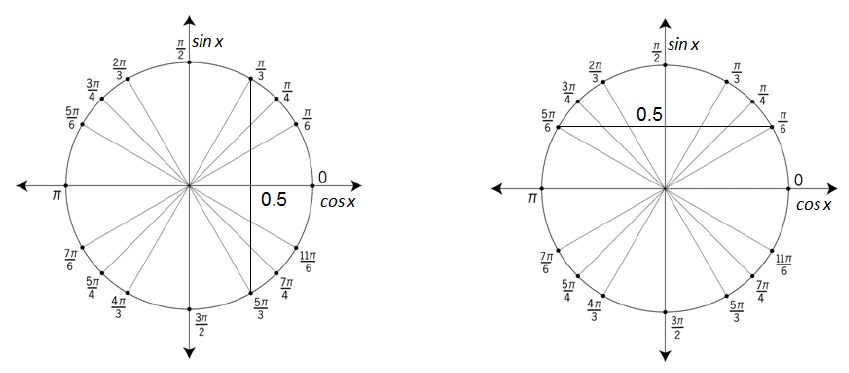
- The unit circle shows the values of functions sin and cos for different angles. For example we have:
- Note that adding or subtracting multiples of does not change the values of trigonometric functions.
- If we are looking for an angle that its equals to 0.5, we have two answers:
- In the general form we have:
- If we are looking for an angle that its equals to 0.5, we have two answers:
- In the general form we have:
- An easy way to visualize and find the answers to the inverse of trigonometric functions is to draw a line from the axis and find the intersections with the unit circle.