0:00 / 0:00

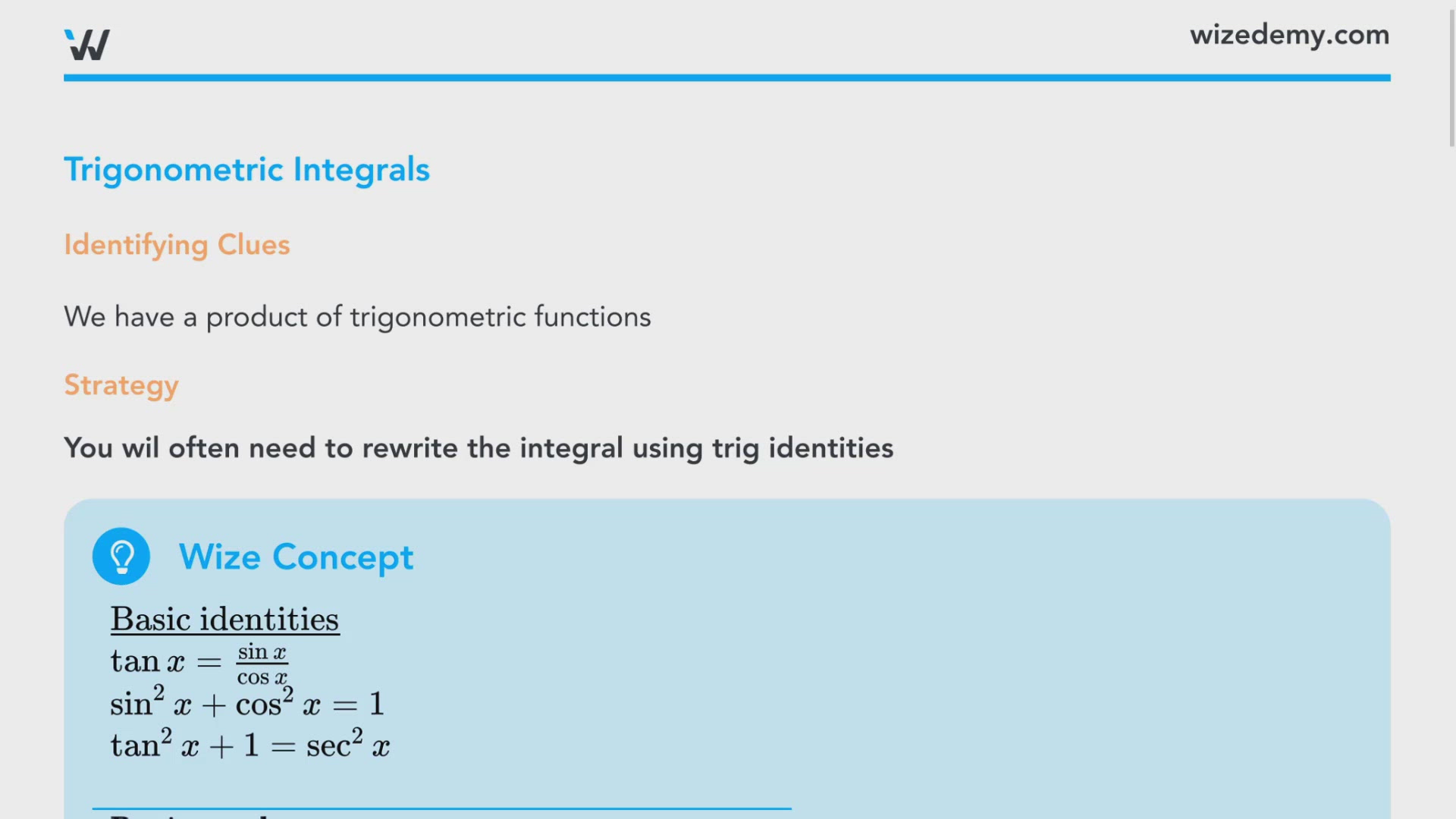
Trigonometric Integrals (Disclaimer: Please note that the reciprocal of cscx should read 1/sinx and not 1/secx as indicated within the attached video).

Identifying Clues

We have a product of trigonometric functions
Strategy

You will often need to rewrite the integral using trig identities

Wize Concept
Basic identitiestanx=sinxcosxsin2x+cos2x=1tan2x+1=sec2xReciprocalssecx=1cosxcscx=1sinxcotx=1tanxDouble & half angle identitiessin(2x)=2sinxcosxcos2x=1+cos(2x)2sin2x=1cos(2x)2Angle sum & difference identitiessinA cosB=12[sin(AB)+sin(A+B)]sinA sinB=12[cos(AB)cos(A+B)]cosA cosB=12[cos(AB)+cos(A+B)]\begin{array}{l} \displaystyle \color{black}\underline{\text{Basic identities}}\\ \color{black}\tan x=\frac{\sin x}{\cos x}\\ \color{black}\sin^2x+\cos^2x=1\\ \color{black}\tan^2x+1=\sec^2x\\\\\hline \color{black}\underline{\text{Reciprocals}}\\ \color{black}\sec x=\frac{1}{\cos x}\\ \color{black}\csc x=\frac{1}{\sin x}\\ \color{black}\cot x=\frac{1}{\tan x}\\\\\hline \color{black}\underline{\text{Double \& half angle identities}}\\ \color{black}\sin(2x)=2\sin x\cos x\\ \color{black}\cos^2x=\frac{1+\cos(2x)}{2}\\ \color{black}\sin^2x=\frac{1-\cos(2x)}{2}\\\\\hline \color{black}\underline{\text{Angle sum \& difference identities}}\\ \color{black}\sin A\ \cos B=\frac{1}{2}\left[\sin\left(A-\color{black}B\right)+\sin\left(A+B\right)\right]\\ \color{black}\sin A\ \sin B=\frac{1}{2}\left[\cos\left(A-B\right)-\color{black}\cos\left(A+B\right)\right]\\ \color{black}\cos A\ \cos B=\frac{1}{2}\left[\cos\left(A-\color{black}B\right)+\cos\left(A+B\right)\right]\\\\ \end{array}


PAGE BREAK
Try u-substitution: let uu be one part of the function such that uu' shows up elsewhere in the expression

Wize Concept
ddx(sinx)=cosxddx(cosx)=sinxddx(tanx)=sec2xddx(secx)=secxtanxddx(cscx)=cscxcotxddx(cotx)=csc2x\begin{array}{l} \color{black}\frac{d}{dx}\left(\sin x\right)=\cos x\\\\ \color{black}\frac{d}{dx}\left(\cos x\right)=-\sin x\\\\ \color{black}\frac{d}{dx}\left(\tan x\right)=\sec^2 x\\\\ \color{black}\frac{d}{dx}\left(\sec x\right)=\sec x\tan x\\\\ \color{black}\frac{d}{dx}\left(\csc x\right)=-\csc x\cot x\\\\ \color{black}\frac{d}{dx}\left(\cot x\right)=-\csc^2 x\\\\ \end{array}

PAGE BREAK
Some note-worthy special trig integrals
tanx dx=lncosx+C \color{orange}\displaystyle\int_{ }^{ }\tan x\ dx=-\ln\cos x+C
  • Rewrite tanx=sinxcosx\tan x=\frac{\sin x}{\cos x}
  • Then use a u-substitution *(Try this as an exercise)

secx dx=lnsecx+tanx+C\color{orange}\displaystyle\int_{ }^{ }\sec x\ dx=\ln\left|\sec x+\tan x\right|+C
  • Multiply by secx+tanxsecx+tanx\frac{\sec x+\tan x}{\sec x+\tan x}
  • Then use a u-substitution *(See Concept Clarifier)

cscx dx=lncscx+cotx+C\color{orange}\displaystyle\int_{ }^{ }\csc x\ dx=-\ln\left|\csc x+\cot x\right|+C
  • Multiply by cscx+cotxcscx+cotx\frac{\csc x+\cot x}{\csc x+\cot x}
  • Then use a u-substitution *(Similar to secx dx\int_{ }^{ }\sec x\ dx)

sec3x dx=secx tanx+lnsecx+tanx2+C\color{orange}\displaystyle\int_{ }^{ }\sec^3x\ dx=\frac{\sec x\ \tan x+\ln\left|\sec x+\tan x\right|}{2}+C
  • Rewrite as secx (sec2x)dx\int_{ }^{ }\sec x\ \left(\sec^2x\right)dx
  • Then use Integration by Parts (See practice questions)

Practice Question

Find sin4xcos3x   ⁣dx{\displaystyle\int}\sin^4x\cos^3x\space\de{x}.

Hint:
  • Factor out one copy of cosx\cos x
  • Convert the rest to sinx\sin x using the identity cos2x=1sin2x\cos^2x=1-\sin^2x
  • Use u-substitution

Practice Question

Compute sin7x  ⁣dx{\displaystyle\int}\sin^7x\de{x}.
Hint:
  • Factor out one copy of sinx\sin x
  • Convert the rest to cosx\cos x using the identity sin2x=1cos2x\sin^2x=1-\cos^2x
  • Use u-substitution

Practice Question

Evaluate sin2xcos2x   ⁣dx{\displaystyle\int} \sin^2x\cos^2x\space\de{x}.
Hint:
  • Use the half angle formulas sin2x=1cos2x2\sin^2x=\frac{1-\cos2x}{2} and cos2x=1+cos2x2\cos^2x=\frac{1+\cos2x}{2}

Practice Question

Findsec8xtan6x   ⁣dx{\displaystyle\int}\sec^8x\tan^6x\space\de{x}.
Hint:
  • Factor out one copy of sec2x\sec^2x
  • Convert the rest to tanx\tan x using the identity sec2x=1+tan2x\sec^2x=1+\tan^2x
  • Use u-substitution

Practice Question

Evaluate π0sec3xtan3xdx\displaystyle \int_{ -\pi}^{0 }\sec^3x\tan^3xdx.
Hint:
  • Factor out secxtanx\sec x\tan x
  • Convert the rest of the tanx\tan x into secx\sec x using tan2x=sec2x1\tan^2x=\sec^2x-1
  • Use a u-sub

Practice Question

Evaluate sin(3x)sin(2x)   ⁣dx{\displaystyle \int} \sin(3x)\sin(2x)\ \de{x}.
Hint:
  • Use the angle sum and difference formula sinA sinB=12[cos(AB)cos(A+B)]\sin A\ \sin B=\frac{1}{2}\left[\cos\left(A-B\right)-\cos\left(A+B\right)\right]

Example: Special Case

Find secx dx\int_{ }^{ }\sec x\ dx.

Hint:
  • Multiply by secx+tanxsecx+tanx\frac{\sec x+\tan x}{\sec x+\tan x}
  • Then use a u-substitution

Practice Question

Evaluatesec3x   ⁣dx{\displaystyle\int}\sec^3x \space\de{x}.
Hint:
  • Rewrite as secx (sec2x)dx\int_{ }^{ }\sec x\ \left(\sec^2x\right)dx
  • Then use integration by parts with u=secx,   dv=sec2x dxu=\sec x,\ \ \ dv=\sec^2x\ dx
0:00 / 0:00

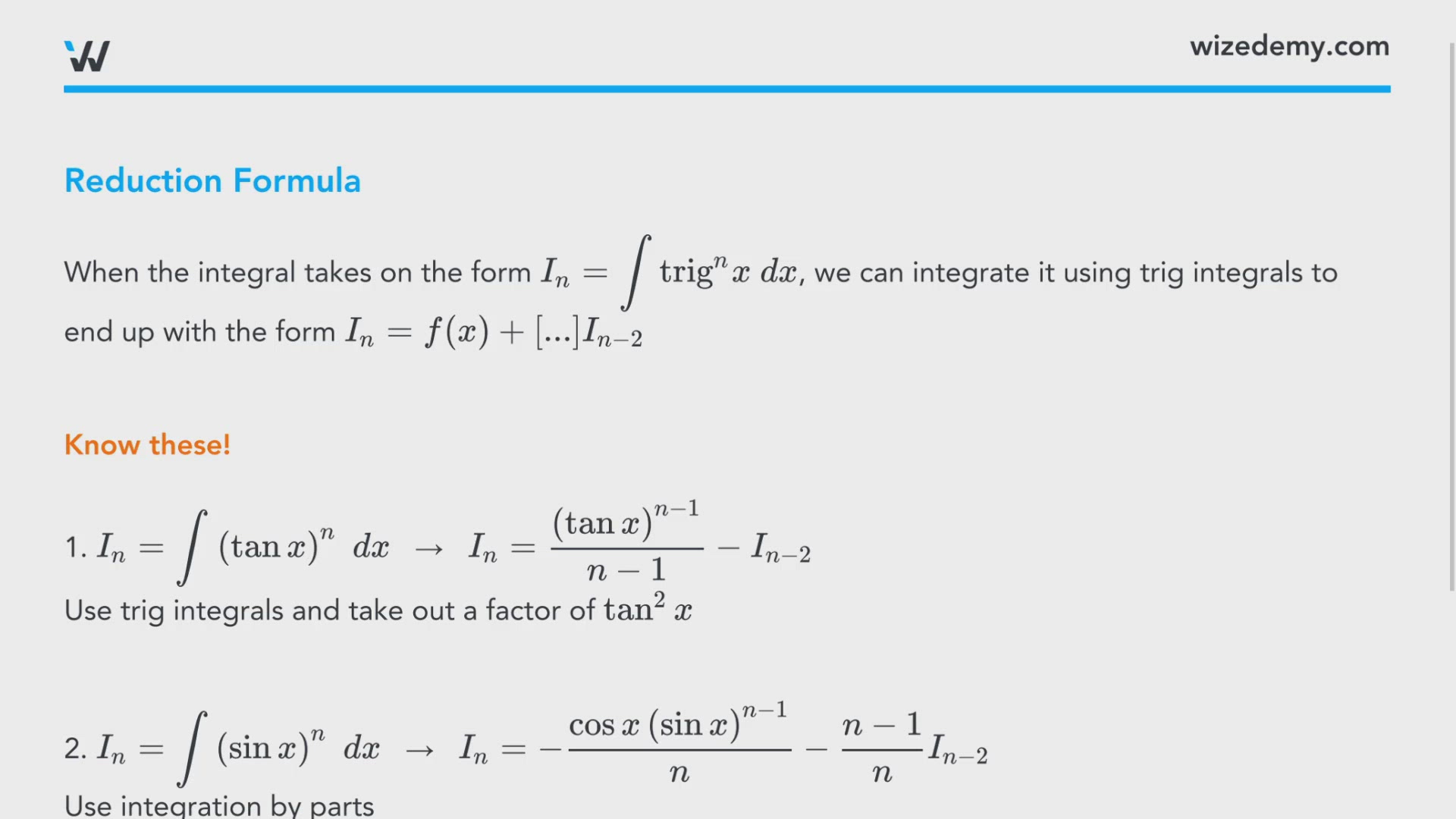
Reduction Formula

When the integral takes on the form In=trignx dx\displaystyle I_n=\int \text{trig}^nx\ dx, we can integrate it using trig integrals to end up with the form In=f(x)+[...]In2\displaystyle I_n=f(x)+[...]I_{n-2}

Know these!

1. In=(tanx)n dx\displaystyle I_n=\int_{ }^{ }\left(\tan x\right)^n\ dxIn=(tanx)n1n1In2\displaystyle I_n=\frac{\left(\tan x\right)^{n-1}}{n-1}-I_{n-2}
Use trig integrals and take out a factor of tan2x\tan^2x


2. In=(sinx)n dx\displaystyle I_n=\int\left(\sin x\right)^n\ dxIn=cosx(sinx)n1n+n1nIn2\displaystyle I_n=-\frac{\cos x\left(\sin x\right)^{n-1}}{n}+\frac{n-1}{n}I_{n-2}
Use integration by parts


3. In=(cosx)n dx\displaystyle I_n=\int\left(\cos x\right)^n\ dxIn=(cosx)n1sinxn+n1nIn2\displaystyle I_n=\frac{\left(\cos x\right)^{n-1}\sin x}{n}+\frac{n-1}{n}I_{n-2}
Use integration by parts

Practice Question

Given that In=(sinx)n dx\displaystyle I_n=\int\left(\sin x\right)^n\ dx, find the reduction formula of the form In=f(x)+n1nIn2\displaystyle I_n=f(x)+\frac{n-1}{n}I_{n-2}, for n2n\ge2.

Practice: Reduction Formula

Given that In=(tanx)ndx\displaystyle I_n=\int (\tan x)^ndx, find the reduction formula of the form In=f(x)In2I_n=f(x)-I_{n-2}, for n2n\ge2.