Wize University Calculus 2 Textbook > Sequences and Series
Basic Definitions
Popular Courses
Calculus 2
University Study Guides
AP Calculus (BC) Exam Prep Course
AP Exam Prep
MATH 275
University of Calgary
MATH*1080
University of Guelph
MATH 101
University of British Columbia
Calculus 2
General Course
CALCULUS 1301A/B
Western University
Calculus 2
University Study Guides
MATH 205
Concordia University
MAT 1322
University of Ottawa
MATH 267
University of Calgary
MATH 101
University of Alberta
MATH 101A
University of British Columbia
SC/MATH 1014 3.00
York University
MATH 105
University of British Columbia
MATH 117
University of Waterloo
NMM 1414A/B
Western University
MATH 101
University of Victoria
MATH 103
University of British Columbia
MATH 101B
University of British Columbia
0:00 / 0:00
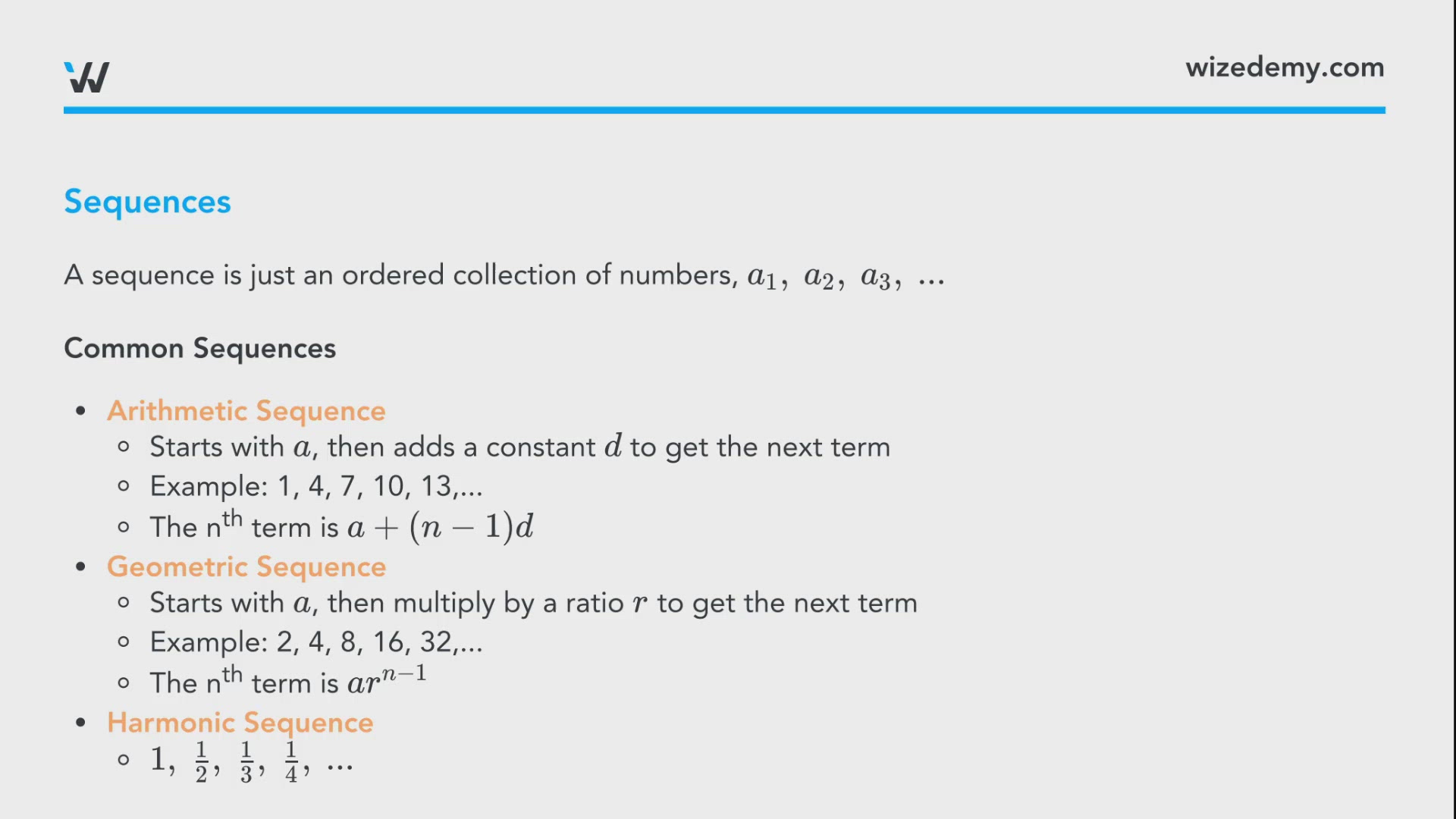
Sequences
A sequence is just an ordered collection of numbers,
Common Sequences
- Arithmetic Sequence
- Starts with , then adds a constant to get the next term
- Example: 1, 4, 7, 10, 13,...
- The nth term is
- Geometric Sequence
- Starts with , then multiply by a ratio to get the next term
- Example: 2, 4, 8, 16, 32,...
- The nth term is
- Harmonic Sequence
Sequence Convergence
A sequence is said to converge if the terms eventually approach a finite number. In other words, the sequence converges if , where is a finite number.
Otherwise, we say that the sequence diverges.
Examples
- The harmonic sequence converges to 0 because
- The sequence diverges because the terms oscillate back and forth between -1 and 1, it never approaches a certain value (i.e. the limit does not exist!)
Definitions
- If the terms inside a sequence are always increasing (each term gets bigger and bigger) OR always decreasing (each term gets smaller and smaller), we call this sequence a monotonic sequence.
- If a sequence is bounded above by a certain finite number (all the terms are smaller than this number) AND if the a sequence is bounded below by a certain finite number (all the terms are bigger than this number), we call this sequence a bounded sequence.
Note-Worthy Theorems
1. Squeeze Theorem for Sequences:
Say we have 3 sequences:.
Suppose that after a certain points, all the terms in one sequence has values that are sandwiched between the terms of the other two sequences (i.e. ). Then if , then . In other words, if the sandwiching sequences converge to the same finite number, the middle sandwiched sequence must also converge to that value.
2. Monotonic Sequence Theorem
Every bounded, monotonic sequence is convergent
In plain English:
1.) if you can find a number that is bigger than all the terms in your sequence,
2.) if you can find a number that is smaller than all the terms in your sequence, and
3.) the terms inside the sequence are either always getting larger or always getting smaller,
then the sequence will converge to a finite number.
0:00 / 0:00
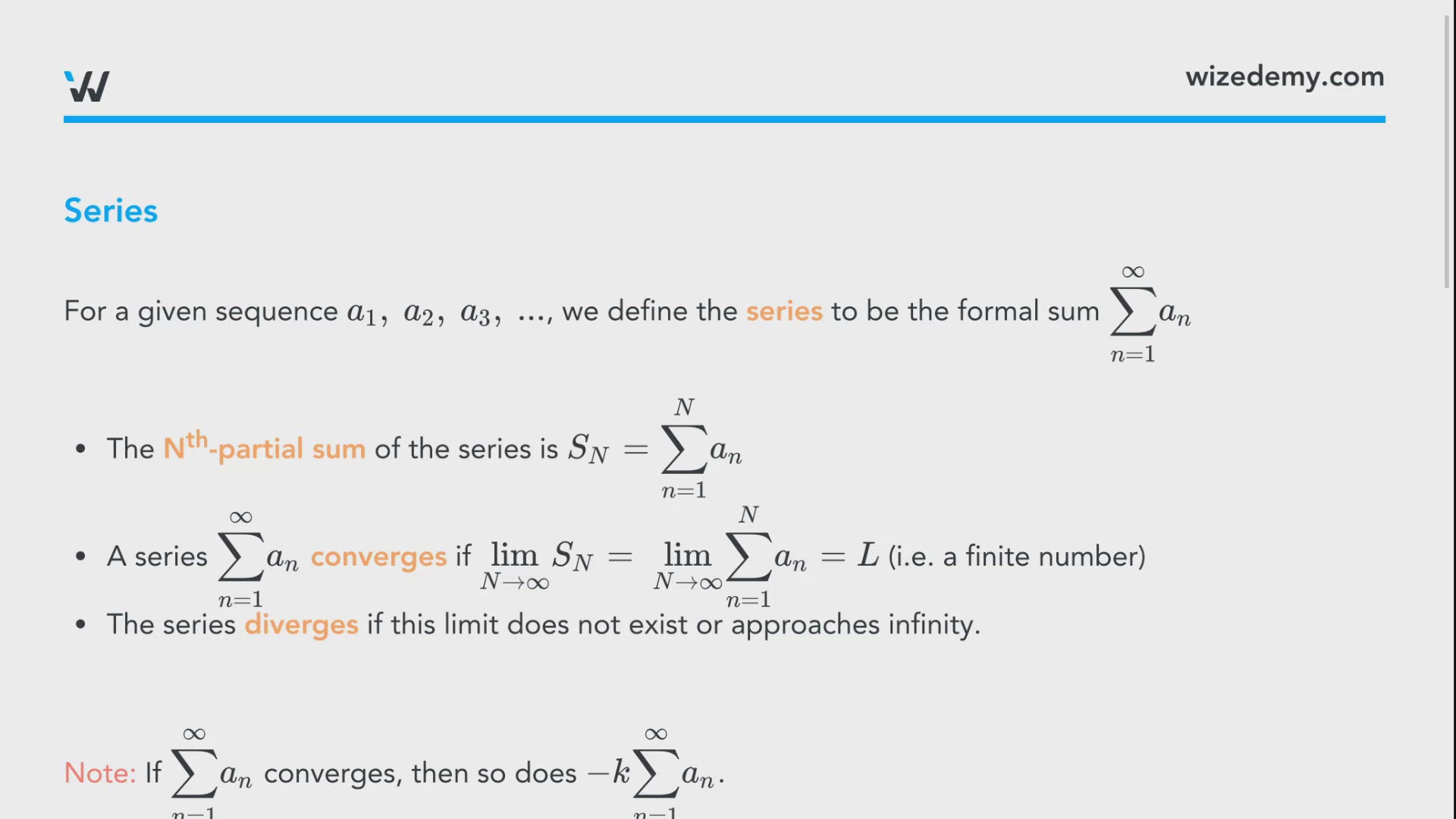
Series
For a given sequence , we define the series to be the formal sum
- The Nth-partial sum of the series is
- A series converges if (i.e. a finite number)
- The series diverges if this limit does not exist or approaches infinity.
Note: If converges, then so does .
Common/Known Series (memorize!)
Geometric Series
or
- If : converges to
- If : diverges
P-Series
- If : converges
- If : diverges
Harmonic Series
- Diverges always (special case of p-series)
Example
Determine whether the following series converge or diverge:
a.)
This is a geometric series with
Since , the series converges.
b.)
This is a p-series with . Therefore, the series converges.
Practice: Partial Sums
Suppose that the partial sums of the series is given by .
Determine whether the series converges or diverges.
Practice: Geometric Series
Determine whether the series converges or diverges.
If it converges, determine the value of the sum.
Practice: Geometric Series
Suppose that converges to 5. Does converge or diverge?
If it converges, what does it converge to?
Practice Question
Write as a fraction .
How to Test if a Series Converges?
In the next few sections, you will learn about the following tests that are used to determine if a series converges or diverges:
- Test of divergence
- Integral test
- (Limit/Series) Comparison Test
- Absolute Convergence Test
- Alternating Series Test
- Ratio Test
- Root Test
In many cases, even if we determine that a series converges, we may not know what it converges to.