Wize University Calculus 2 Textbook > Sequences and Series
Absolute Convergence & Alternating Series Test
Popular Courses
Calculus 2
University Study Guides
AP Calculus (BC) Exam Prep Course
AP Exam Prep
MATH 101
University of British Columbia
Calculus 2
General Course
CALCULUS 1301A/B
Western University
Calculus 2
University Study Guides
MATH 205
Concordia University
MAT 1322
University of Ottawa
MATH 267
University of Calgary
MATH 101
University of Alberta
MATH 101A
University of British Columbia
SC/MATH 1014 3.00
York University
MATH 105
University of British Columbia
NMM 1414A/B
Western University
MATH 101
University of Victoria
MATH 103
University of British Columbia
MATH 101B
University of British Columbia
MTH 240
Toronto Metropolitan University
MTH 240
Toronto Metropolitan University
MATH 101C
University of British Columbia

0:00 / 0:00
Absolute Convergence Test
Note: If converges, then converges.
Wize Concept
Definitions:
- We say that a series, is absolutely convergent if the series converges
- We say that a series, is conditionally convergent if it converges but is not absolutely convergent
*If the terms in the series are all positive, we don't have to make this distinction.
Absolute Convergence Test
If it is easier to work with , then determine whether converges.
If it does converge, then the original series must also converge.
Identifying Clues
- If the series involves negative and positive terms
- The question will ask specifically for "absolute convergence", "conditional convergence", or divergence
Example: Absolute Convergence Test
Determine whether the following series are absolutely convergent, conditionally convergent, or divergent:
a.)
b.)
c.)
0:00 / 0:00
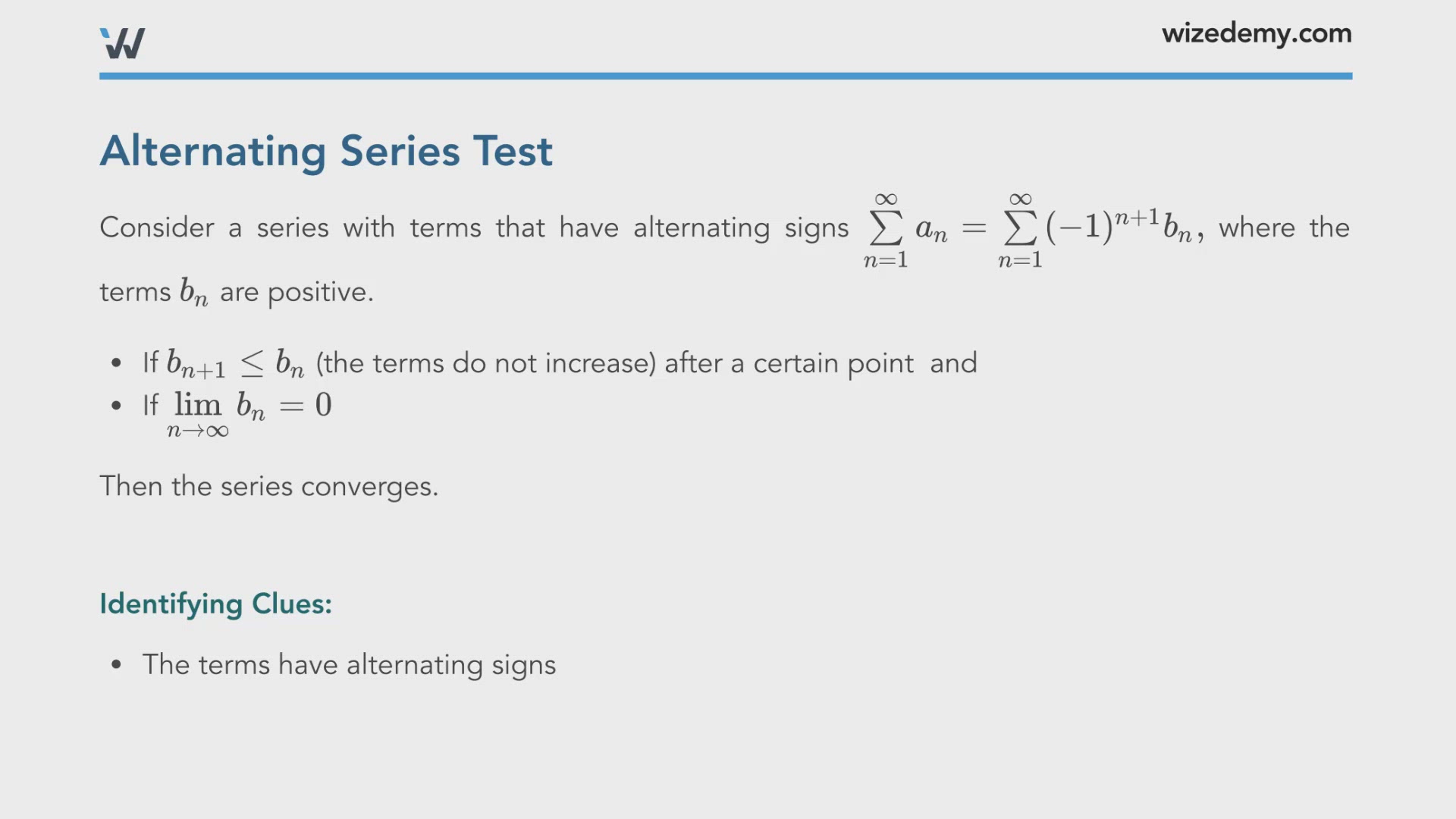
Alternating Series Test
Consider a series with terms that have alternating signs
where the terms are positive.
- If (the terms do not increase) after a certain point and
- If
Then the series converges.
Identifying Clues:
- The terms have alternating signs
Practice: AST
Is the series convergent or divergent?