Wize University Calculus 2 Textbook > Applications of Integrals
Basic Applications of Integrals
Popular Courses
Calculus 2
University Study Guides
MATH 101
University of British Columbia
Calculus 2
General Course
Calculus 2
University Study Guides
MAT 1322
University of Ottawa
MAT136H1
University of Toronto
SC/MATH 1014 3.00
York University
MAT 1332
University of Ottawa
MATH 105
University of British Columbia
MATH 117
University of Waterloo
NMM 1414A/B
Western University
MATH 103
University of British Columbia
MTH 240
Toronto Metropolitan University
MATH-1730
University of Windsor
MATH 1700
University of Manitoba
MATH 138
University of Waterloo
MTH 231
Toronto Metropolitan University
MATH 119
University of Waterloo
MATH 1226
Virginia Tech
MATH 136
University of Alberta
0:00 / 0:00
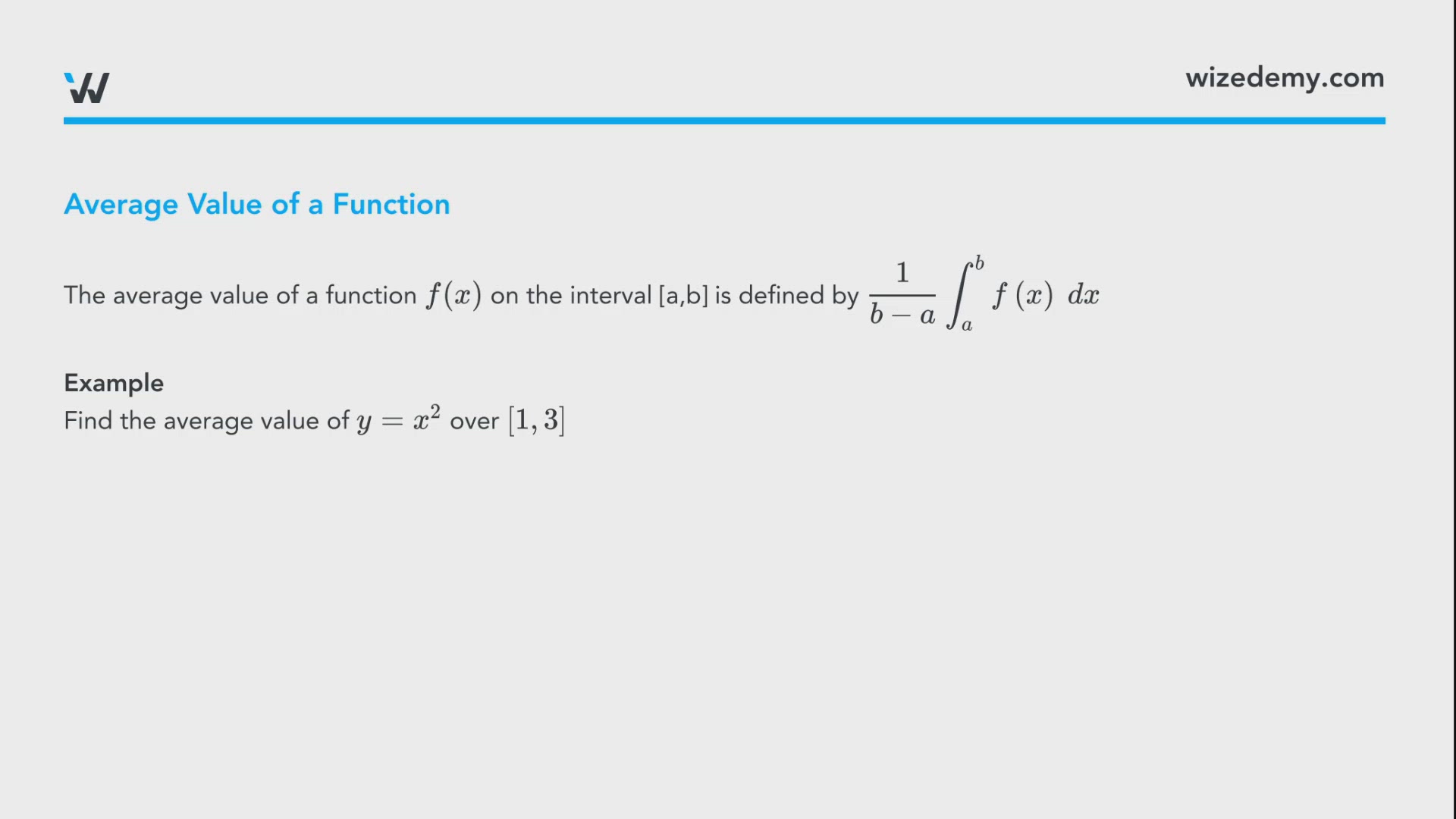
Average Value of a Function
The average value of a function on the interval [a,b] is defined by
Example
Find the average value of over

0:00 / 0:00
Example: Average Value
Compute the average value of on the interval .
Find the average value of the function over the interval .
0:00 / 0:00
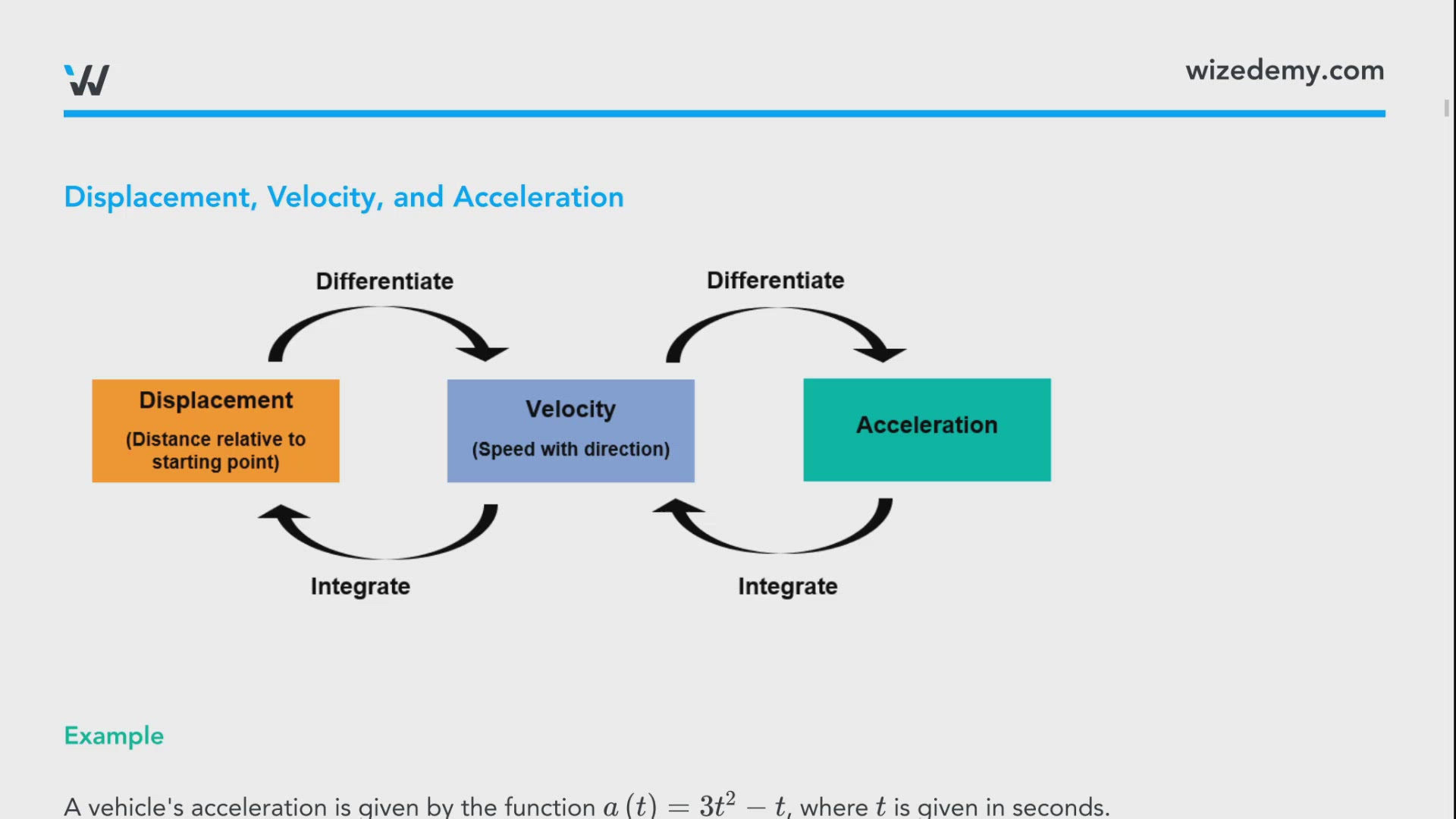
Displacement, Velocity, and Acceleration

Example
A vehicle's acceleration is given by the function , where is given in seconds.
a.) If the vehicle's initial velocity is 7m/s, find a function that represents the velocity of the vehicle.
We sub in the initial velocity to solve for c:
Therefore, the velocity of the vehicle is given by the function
b.) What is the vehicle's displacement between and s?
So, the displacement between 0 and 2 seconds is given by the definite integral
m
0:00 / 0:00
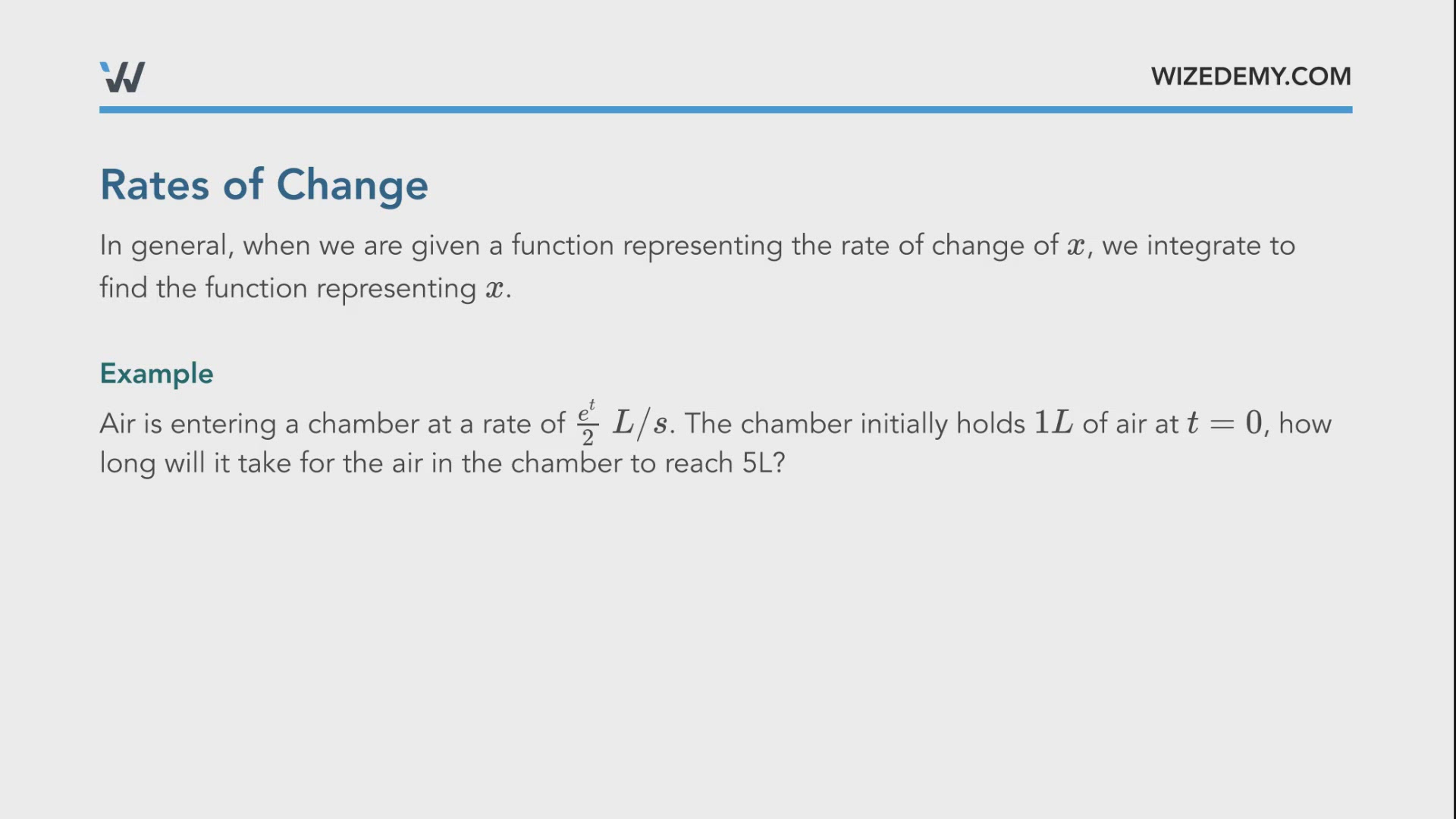
Rates of Change
In general, when we are given a function representing the rate of change of , we integrate to find the function representing .
Example
Air is entering a chamber at a rate of . The chamber initially holds of air at , how long will it take for the air in the chamber to reach 5L?
To find the function representing the volume of air in the chamber, we integrate the rate of change function.
Substitute the initial volume to solve for c:
So, the volume function is .
Set the volume equal to 5:
Therefore, the air in the chamber will reach at .