Wize University Calculus 2 Textbook > Applications of Integrals
Volumes of Revolution (Disks/Washer Method)
Popular Courses
Calculus 2
University Study Guides
MATH 121
Queen's University
MATH 141
McGill University
MATH 101
University of British Columbia
Calculus 2
General Course
Calculus 2
University Study Guides
MATH 205
Concordia University
MAT 1322
University of Ottawa
MATH 267
University of Calgary
MATH 101
University of Alberta
MATH 101A
University of British Columbia
MAT136H1
University of Toronto
SC/MATH 1014 3.00
York University
MAT 1332
University of Ottawa
MATH 105
University of British Columbia
MATH 117
University of Waterloo
NMM 1414A/B
Western University
MATH 101
University of Victoria
MATH 103
University of British Columbia
MTH 240
Toronto Metropolitan University

0:00 / 0:00
Volumes of Revolution (Disk/Washer Method)
The question will ask you to compute the volume of the solid obtained by rotating a bouonded region around the x or y axis (or a line parallel to one of these axes).
Steps for finding the volume
1. Draw the curve
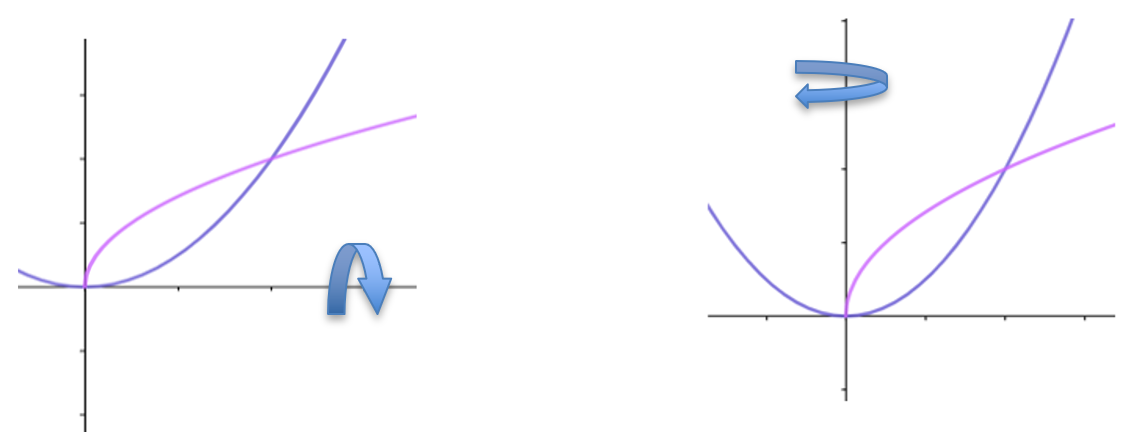
2. Rearrange the curve equations
- If we're rotating around the x-axis: set up the equations as
- If we're rotating around the y-axis: set up the equations as
3. Find the integral bounds
- These could be given by the question
- Otherwise set the two curve equations equal one another and solve for the points of intersection
4. Set up the volume integral and solve
- If we're rotating around the x-axis:
- If we're rotating around the y-axis:
Rotating around a line
Rotating around (parallel to the x-axis) or (parallel to the y-axis): follow the same steps but make an adjustment for your outer and inner radius
Practice: Volumes of Revolution
Find the integral that represents the volume of the solid obtained by revolving the region enclosed by and about the -axis.
Practice: Volumes of Revolution
Find the integrals that represents the volume of the solid obtained by rotating the region bounded by , , and around the -axis.
Practice: Volumes of Revolution
Write the integral that represents the volume generated by rotating the region bounded by and around the line .