Popular Courses
Calculus 2
University Study Guides
MATH 100A
University of British Columbia
MATH 100C
University of British Columbia
MATH 100B
University of British Columbia
Calculus 2
General Course
Calculus 2
University Study Guides
MAT133Y1
University of Toronto
MTH 240
Toronto Metropolitan University
MATH 1700
University of Manitoba
MATH 119
University of Waterloo
MATH 1LT3
McMaster University
MATH 10B
University of California - San Diego
MATH 1005
Carleton University
MATH 1B
University of California - Berkeley
M 408D
The University of Texas at Austin
MAT 021C
University of California - Davis
MATH 124
Queen's University
MATH 151
McGill University
MAT 267
Arizona State University - Tempe
MATH-1524
Virginia Tech
0:00 / 0:00
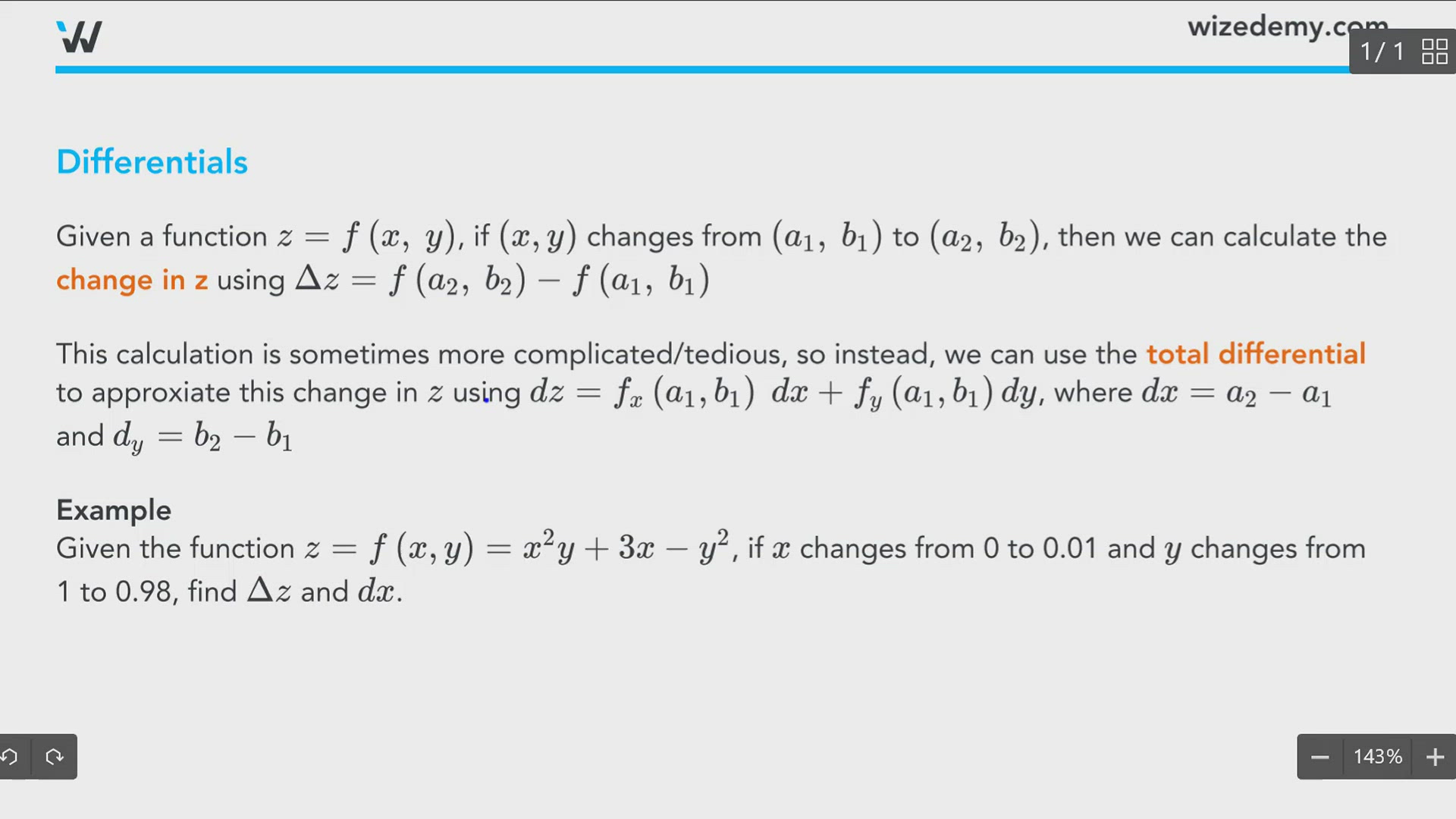
Differentials
Given a function , if changes from to , then we can calculate the change in z using
This calculation is sometimes more complicated/tedious, so instead, we can use the total differential to approxiate this change in using , where and
Example
Given the function , if changes from 0 to 0.01 and changes from 1 to 0.98, find and .
Change in z:
Total Differential:
Practice: Differentials
Suppose z = kxmyn for constants k, m, n. Approximate the percent change in z if x changes by r% and y changes by s%.
Practice: Differentials
The escape velocity for a massive body is where M is the mass of the object escaping and R is the distance from the centre of mass of the body to the object, and G is the universal gravitational constant. Estimate the percent change in the escape velocity if the mass of the object increases by 3.2% and the distance to the centre of mass decreases by 0.8%.