Popular Courses
Calculus 2
University Study Guides
MATH 100A
University of British Columbia
MATH 100C
University of British Columbia
MATH 100B
University of British Columbia
Calculus 2
General Course
Calculus 2
University Study Guides
MAT133Y1
University of Toronto
MATH 262
McGill University
MATH 105
University of British Columbia
MATH 157
Simon Fraser University
MTH 240
Toronto Metropolitan University
MTH 240
Toronto Metropolitan University
MATH 1700
University of Manitoba
MATH 119
University of Waterloo
MATH 1LT3
McMaster University
MATH 10B
University of California - San Diego
MATH 1005
Carleton University
MATH 1B
University of California - Berkeley
MAT 211
Arizona State University - Tempe
M 408D
The University of Texas at Austin
0:00 / 0:00
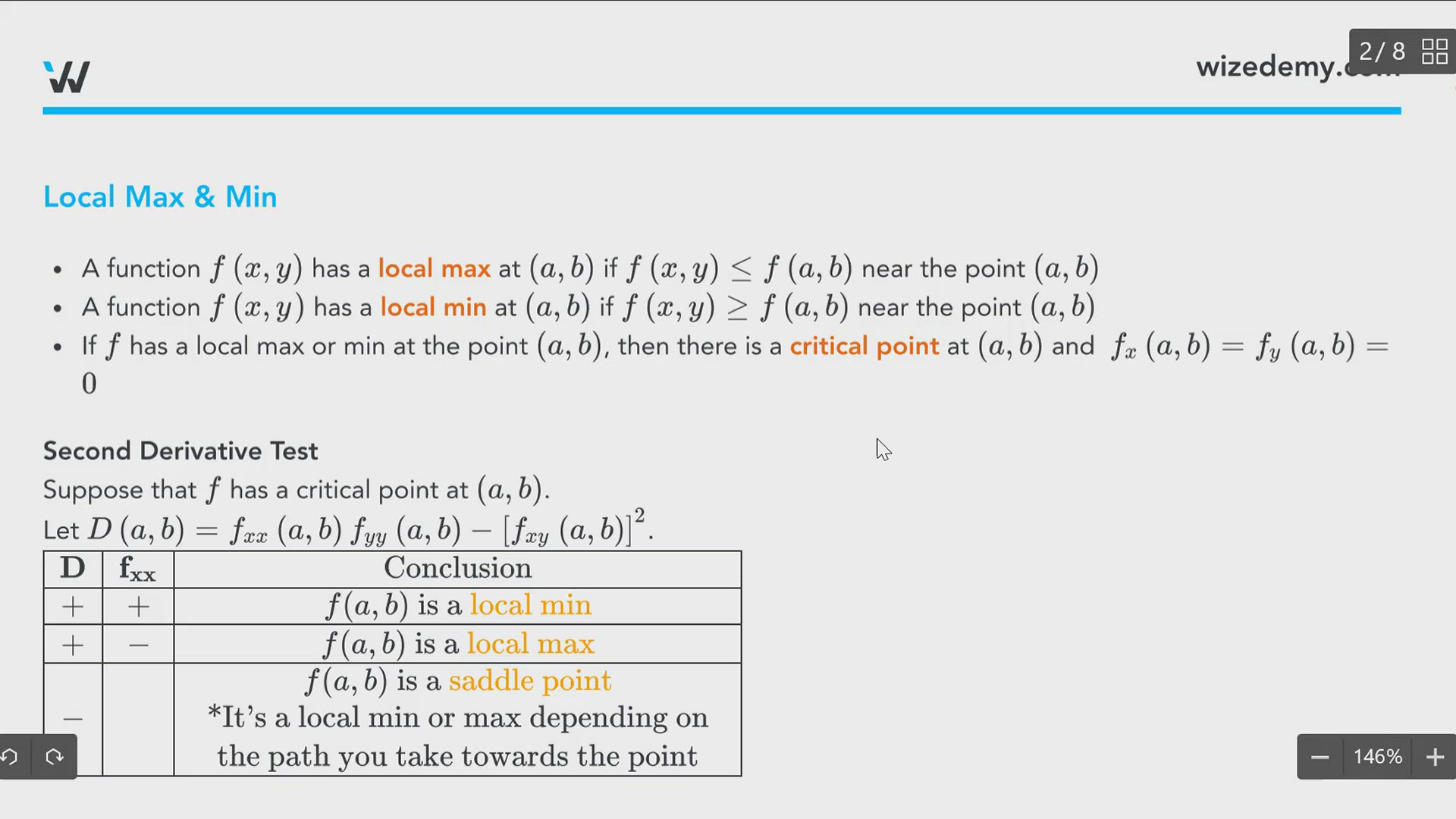
Local Max & Min
- A function has a local max at if near the point
- A function has a local min at if near the point
- If has a local max or min at the point , then there is a critical point at and
Second Derivative Test
Suppose that has a critical point at .
Let .
Example
Identify all local max, min, and saddle points of the function
Critical points occur when the first partials equal 0:
Solving these 2 equations, we see that the only critical point is
Second partials:
Since is negative at this critical point, we know that is a saddle point.
0:00 / 0:00
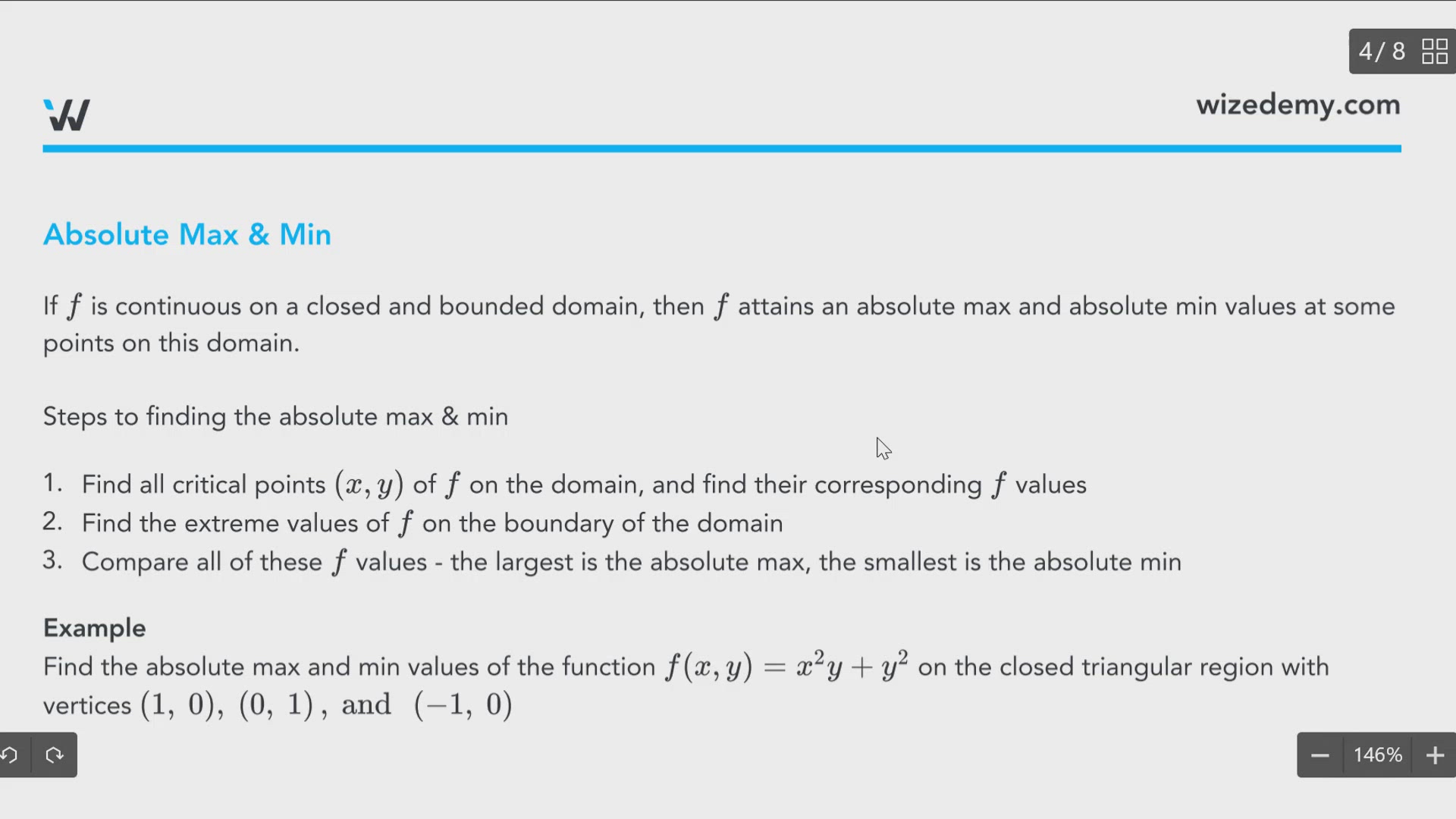
Absolute Max & Min
If is continuous on a closed and bounded domain, then attains an absolute max and absolute min values at some points on this domain.
Steps to finding the absolute max & min
- Find all critical points of on the domain, and find their corresponding values
- Find the extreme values of on the boundary of the domain
- Compare all of these values - the largest is the absolute max, the smallest is the absolute min
Example
Find the absolute max and min values of the function on the closed triangular region with vertices
1. We first need to find the critical points
The only point that satisfies both of these equations is , so this is the only critical point.
2. Now we need to find the max and min on the boundary of the domain, which consists of the 3 lines in the following graph:
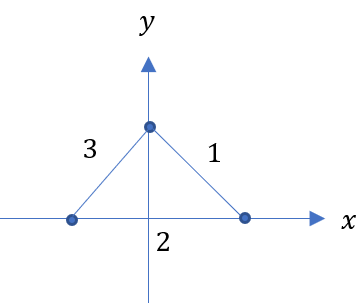
On line 1:
- The max value of is when →
- The min value of is when →
On line 2:
- The and , so the max and min value of on this line is 0
One line 3:
- The max value of is when , →
- The min value of is when →
3. Comparing these values, we see that the absolute max is 1 at the point and the absolute min is 0 at .
0:00 / 0:00
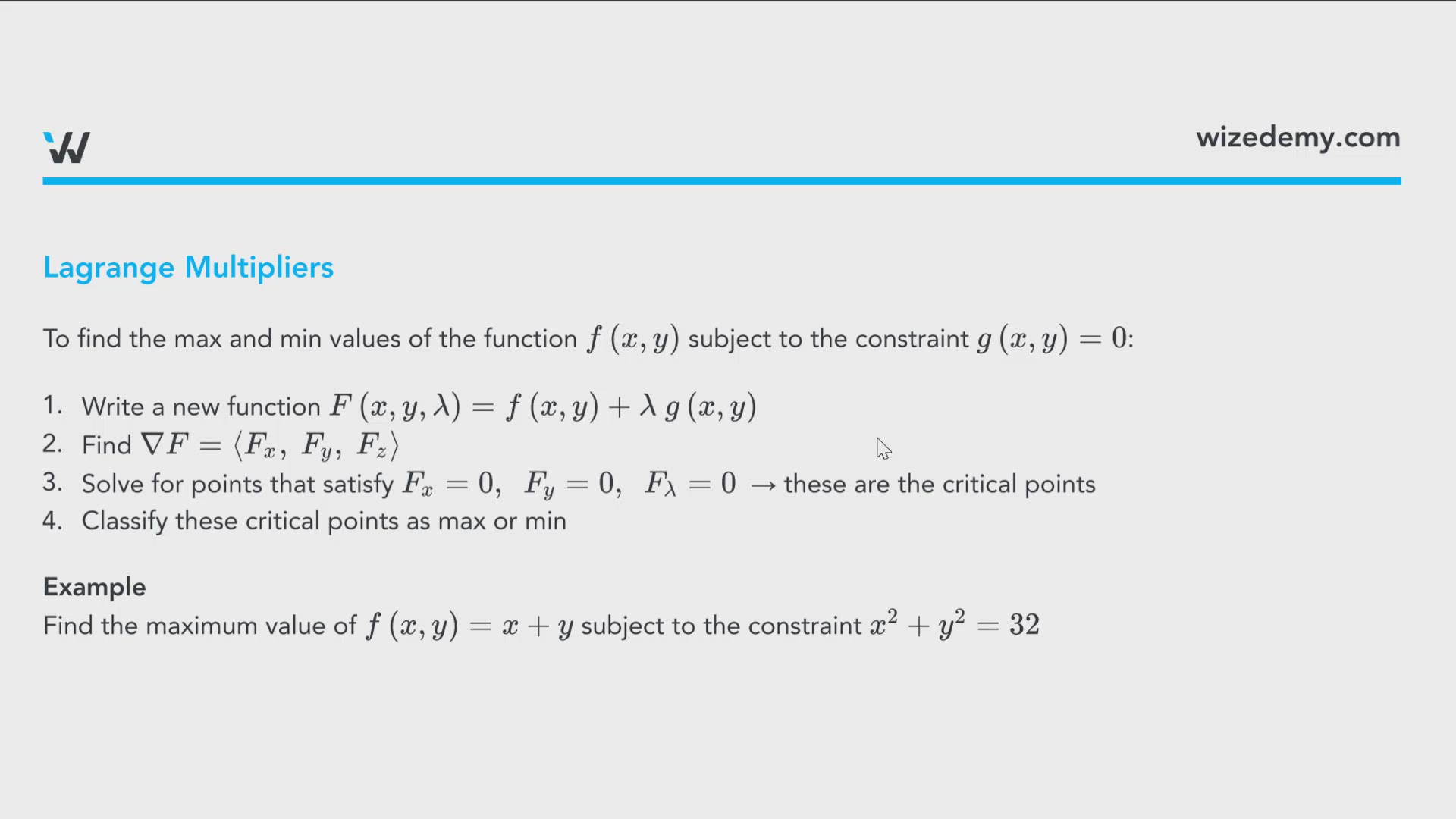
Lagrange Multipliers
To find the max and min values of the function subject to the constraint :
- Write a new function
- Find
- Solve for points that satisfy → these are the critical points
- Classify these critical points as max or min
Example
Find the maximum value of subject to the constraint
First we need to rewrite the constraint as , now we can use the method of Lagrange Multipliers:
1.
2.
3. We need to solve
From the first equation:
From the second equation:
Substitute both of these into the third equation:
So, the corresponding critical points are and
4. and
Therefore, the max value is 8 and it occurs at , and the min value is and it occurs at
Practice: Lagrange Multipliers
You want to maximize the volume of an opened-top rectangular based cardboard box. You only have 100 cm2 of cardboard available. Which of the following is a mathematical model that represents this problem?
Practice: Lagrange Multipliers
Which of the following is true about subject to the constraint ?