Wize University Calculus 1 Textbook > Pre-Calculus (Review)
Interval Notation vs. Set Notation
Popular Courses
Grade 12 Advanced Functions
Ontario High School
CALCULUS 1000A/B
Western University
Calculus 1
University Study Guides
Grade 12 Pre-Calculus/Functions
Canada High School
AP Calculus (AB) Exam Prep Course
AP Exam Prep
Math 30-1
Alberta High School
Pre-Calculus 12
British Columbia High School
MATH 249
University of Calgary
MATH 265
University of Calgary
Calculus 1
General Course
MATH 275
University of Calgary
MATH 140
McGill University
MAT135H1
University of Toronto
MATH*1080
University of Guelph
MATH 154
University of Alberta
Calculus 1
University Study Guides
MAT 1320
University of Ottawa
MATH 100
University of Alberta
MATH 203
Concordia University
MAT 1330
University of Ottawa

0:00 / 0:00
Interval Notation
Interval notation is a way of writing subsets of the real number line.
Closed Interval
- A closed interval is one that includes its endpoints
- We use square brackets [ ].
Example 1
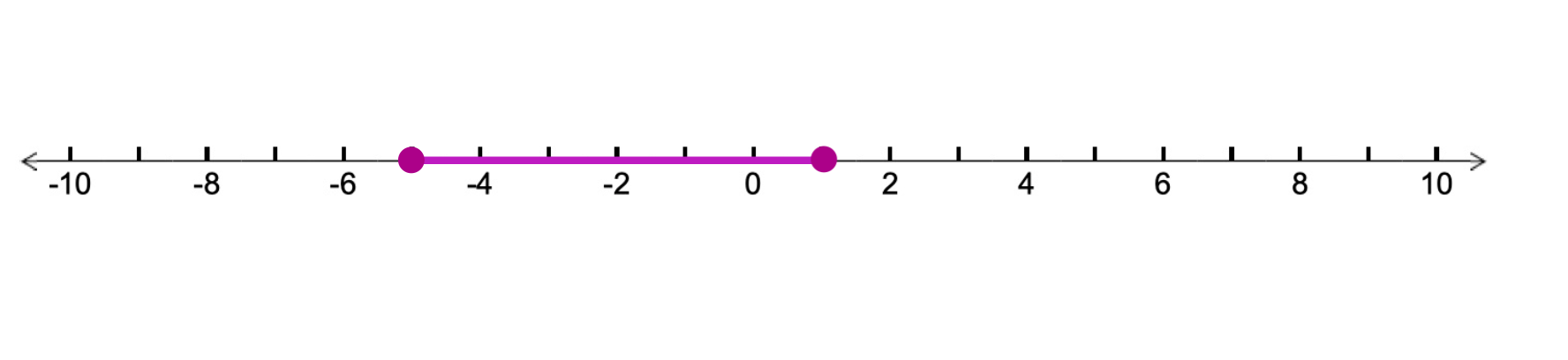
[-5, 1] denotes the set of real numbers between -5 and 1 inclusively and can be shown on a number line as follows:
Open Interval
- An open interval is one that excludes its endpoints
- We use parentheses ( ).
Example 2
(-5, 1) denotes the set of real numbers between -5 and 1 exclusively and can be shown on a number line as follows:

Wize Tip
A closed interval contains its endpoints → the endpoints are solid dots.
An open interval does not contain its endpoints → the endpoints are hollow dots.
Mixed Intervals
Mixed intervals contain both open and closed intervals.
Example 1
[3, 8) denotes the set of real numbers between 3 and 8 that are greater than or equal to 3 but strictly less than 8. On a number line, it is shown as follows:

Infinite Intervals
Infinite intervals are intervals that tend towards infinity in one or both directions.
Example 2
denotes the set of real numbers greater than or equal to 4 and can be shown on a number line as follows:

Note: When working with positive & negative infinity, , parenthesis are always used next to infinity.
Union of Sets
The union of two sets A and B is the set of elements in A, in B, or in both.
- The symbol used to indicate the union of two sets is
- We use the union symbol to combine two or more intervals together
Example
The interval denotes the set of real numbers less than -5 and greater than or equals to 3. On a number line, this it looks like:

In interval notation, we can express the above interval & number line as:
0:00 / 0:00
Set Notation
Set notation is a flexible (but slightly more complicated) way of writing down sets and it is an alternative method to interval notation.
What is a set?
A set is a collection of well-defined objects and we encounter sets in math frequently.
Example
Let us look at the list of numbers 0, 1, 2, 3, 4, 5. We can call our list of numbers a set and label it whatever we like so let us call this set X. Therefore, the list of numbers in set X is:
Note: Sets and set notation are delimited by curly braces { }.
Common Sets
Set Notation
We can also use set notation instead of interval notation.
Example 1
[-5, 1] denotes the set of real numbers between -5 and 1 inclusively and can be shown on a number line as follows:

In set notation, our answer would be:
Example 2
(-5, 1) denotes the set of real numbers between -5 and 1 exclusively and can be shown on a number line as follows:

In set notation, our answer would be:

0:00 / 0:00
Example: Interval Notation vs. Set Notation
Express the following inequalities in both interval notation and set notation:
Match the interval with its appropriate notation.
A.
B.
C.
D.
E.
Convert the following set into set notation: