Create a free account to get started

Unlock full course notes by signing up

  • Video lessons taught by top educators
  • Practice questions with guided solutions
  • Written review notes for reference
  • Expert answers anytime from course tutors

Exponential Functions

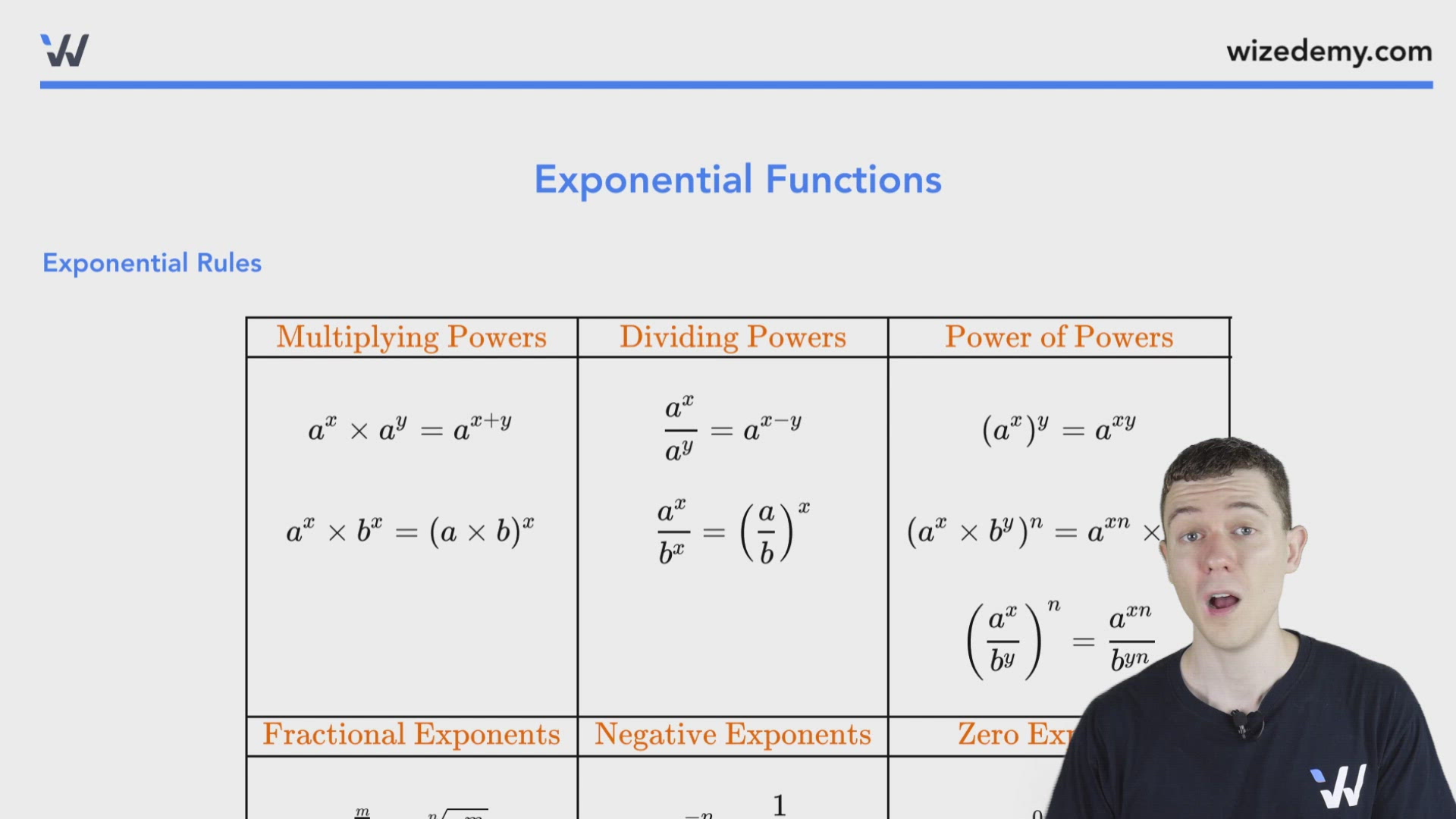
Exponential Rules

Multiplying PowersDividing PowersPower of Powersax×ay=ax+yaxay=ax−y(ax)y=axyax×bx=(a×b)xaxbx=(ab)x(ax×by)n=axn×byn(axby)n=axnbynFractional ExponentsNegative ExponentsZero Exponentamn=amna−n=1ana0=1a1n=an\begin{array}{|c|c|c|} \hline \colorFour{\text{Multiplying Powers}}&\colorFour{\text{Dividing Powers}}&\colorFour{\text{Power of Powers}}\\ \hline\\ \displaystyle a^x\times a^y=a^{x+y}&\displaystyle \frac{a^x}{a^y}=a^{x-y}&\displaystyle (a^x)^y=a^{xy}\\\\ \displaystyle a^x\times b^x=(a\times b)^x&\displaystyle \frac{a^x}{b^x}=\left(\frac{a}{b}\right)^x&\displaystyle (a^x\times b^y)^n=a^{xn}\times b^{yn}\\\\ &&\displaystyle \left(\frac{a^x}{b^y}\right)^n=\frac{a^{xn}}{b^{yn}}\\\\\hline \colorFour{\text{Fractional Exponents}}&\colorFour{\text{Negative Exponents}}&\colorFour{\text{Zero Exponent}}\\ \hline\\ \displaystyle a^{\frac{m}{n}}=\sqrt[n]{a^m}&\displaystyle a^{-n}=\frac{1}{a^n}&a^0=1\\\\ \displaystyle a^{\frac{1}{n}}=\sqrt[n]{a}\\\\ \hline \end{array}


Exponential Functions and Graphs

Exponential Functions have the form: f(x)=ax, for a>1f\left(x\right)=a^x , \text{ for } a>1.

Image illustrating Exponential Functions

f(x)f(x) has a horizontal asymptote at ________.


The most common exponential function is f(x)=exf\left(x\right)=e^x, where ee is Euler's number.


Euler's Number

The exponential number (Euler's number) is e=2.71828...e=2.71828...


Example: Which is larger: 3−23^{-2}, 2−22^{-2},or e−2e^{-2}?

2−2>e−2>3−22^{-2}>e^{-2}>3^{-2}

Create a free account to get started

Unlock full course notes by signing up

  • Video lessons taught by top educators
  • Practice questions with guided solutions
  • Written review notes for reference
  • Expert answers anytime from course tutors

Example: Solving Exponential Equations

Solve for xx in 2x2−x=642^{x^2-x}=64


2x2−x=64\displaystyle 2^{x^2-x}=64

2x2−x=262^{x^2-x}=2^6

x2−x=6x^2-x=6

x2−x−6=0x^2-x-6=0

(x−3)(x+2)=0\left(x-3\right)\left(x+2\right)=0

x=3   or   x=−2x=3\ \ \ \text{or}\ \ \ x=-2

Create a free account to get started

Unlock full course notes by signing up

  • Video lessons taught by top educators
  • Practice questions with guided solutions
  • Written review notes for reference
  • Expert answers anytime from course tutors

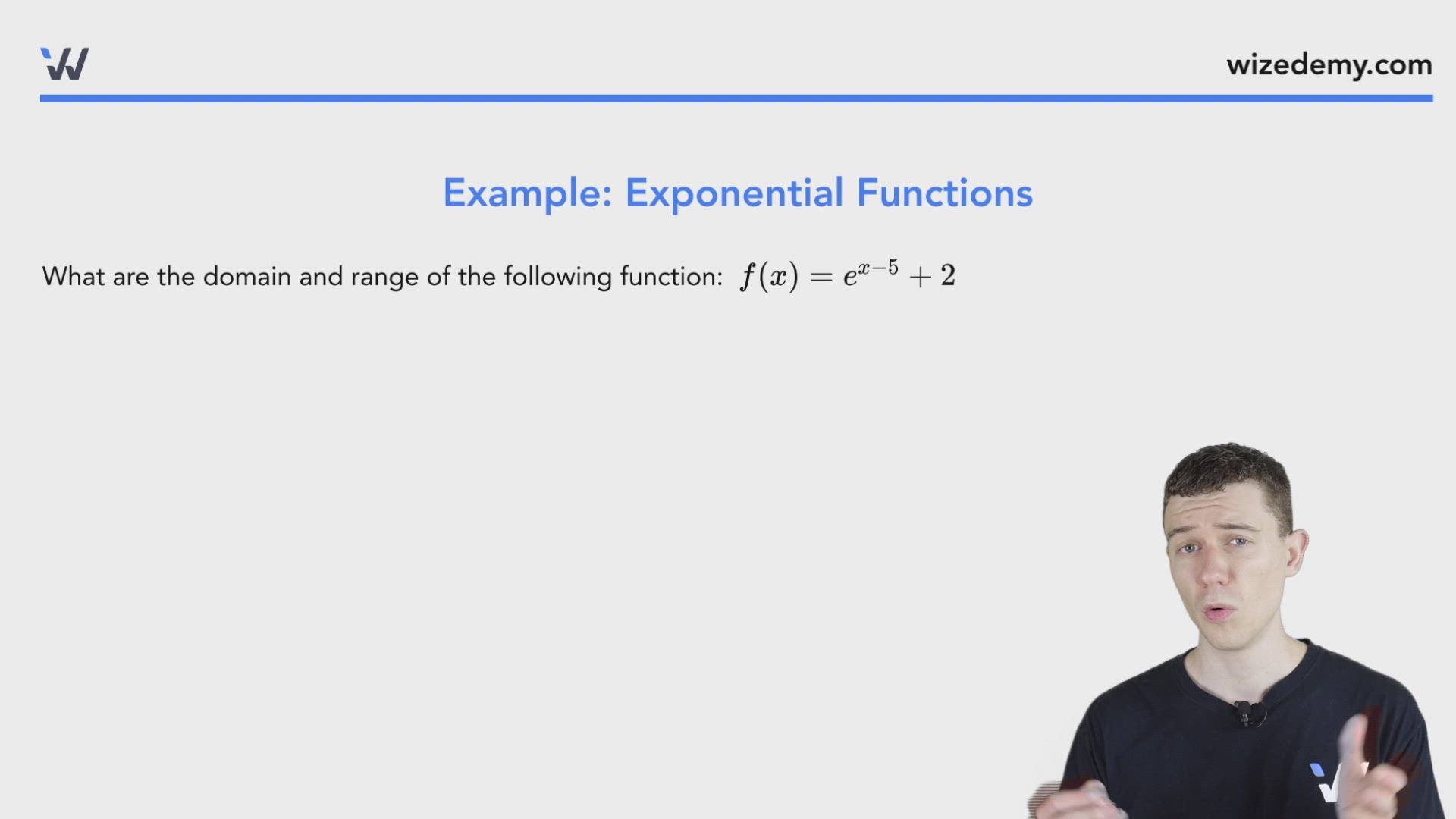
Example: Exponential Functions

What are the domain and range of the following function: f(x)=ex−5+2f(x) = e^{x-5}+2


exe^x has a domain of all real numbers, so f(x)f(x)has a domain of all real numbers, x∈Rx\in\mathbb{R}


The standard graph of y=exy = e^xhas a range ofy>0y>0, andf(x)f(x) is shifted two units up, so the range is y>2y>2.


domain(f)=R and range(f)=(2,∞)\text{domain}(f) = \R \: \text{and} \: \text{range}(f) = (2,\infty)

Extra Practice