Popular Courses
CALCULUS 1000A/B
Western University
Calculus 1
University Study Guides
AP Calculus (AB) Exam Prep Course
AP Exam Prep
MATH 209
Concordia University
MATH 100A
University of British Columbia
MATH 100C
University of British Columbia
MATH 1LS3
McMaster University
MATH 249
University of Calgary
MATH 265
University of Calgary
Calculus 1
General Course
MATH 275
University of Calgary
MATH 140
McGill University
MATH 121
Queen's University
MAT135H1
University of Toronto
MATH*1080
University of Guelph
MATH 134
University of Alberta
MATH 154
University of Alberta
Calculus 1
University Study Guides
MAT 1320
University of Ottawa
MATH 100
University of Alberta

0:00 / 0:00
Limit Basics
When we talk about limits we look for what is happening close to a function at a certain value of . The question is: What happens to a function's output (the value) as we approach a certain input (the value)?
Definition of a Limit
Let be a function and let and be real numbers.
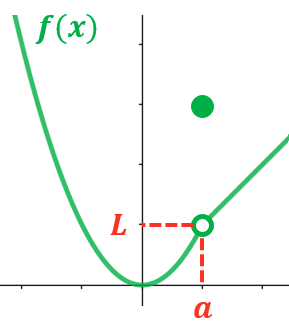
If approaches as approaches then we say has limit and denote it as
Note: We read this as "the limit as approaches of equals ".
Watch Out!
- does not have to be in the domain of
- does not necessarily ever need to be equal to (just approach it)
0:00 / 0:00
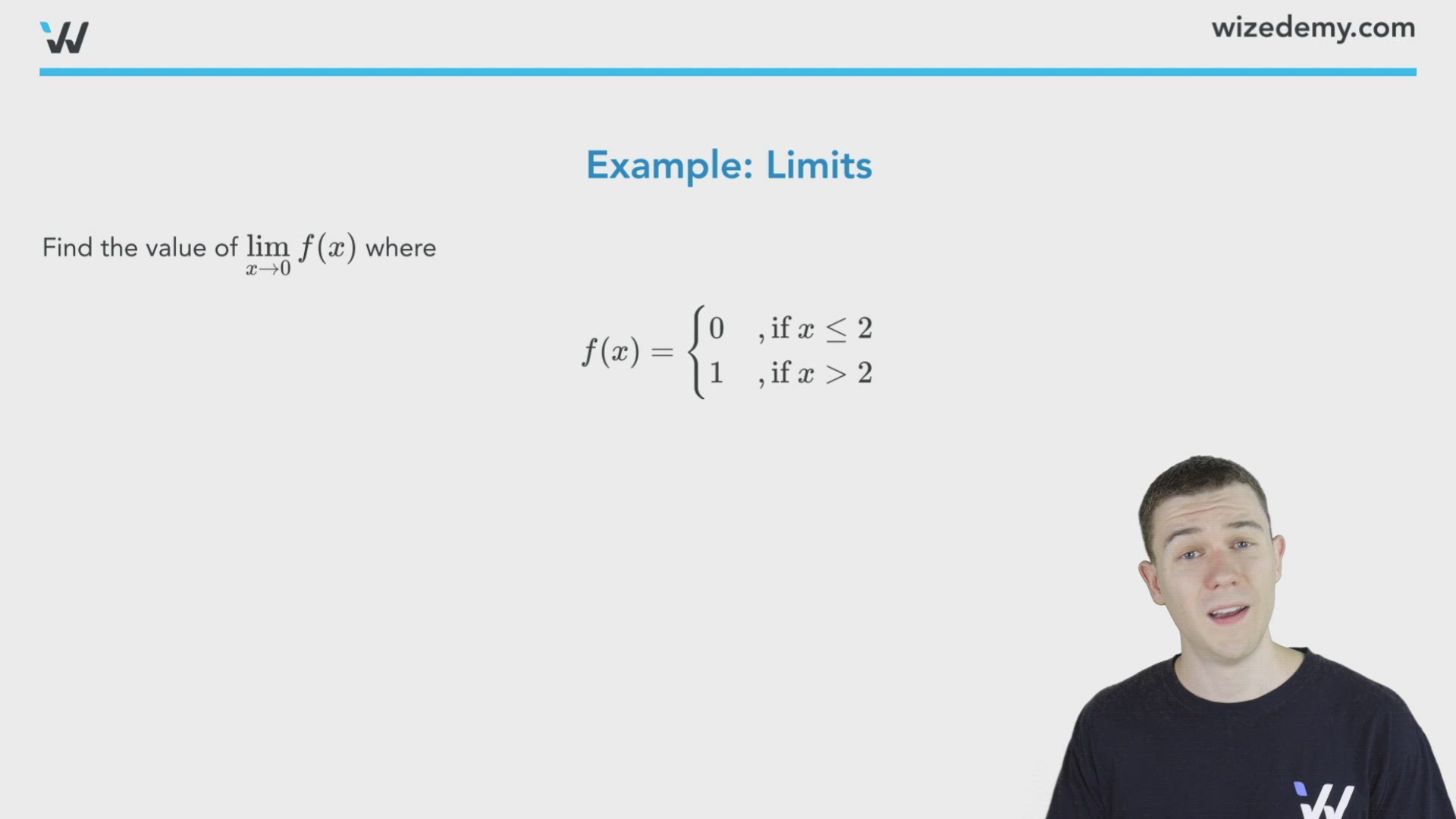
Example: Limits
Find the value of where
Notice how as "approaches" , we are located in the first row of the piecewise function .
So, .