Wize University Calculus 1 Textbook > Integration Techniques
Integration by Parts
Popular Courses
Calculus 1
University Study Guides
AP Calculus (BC) Exam Prep Course
AP Exam Prep
Calculus 1
General Course
MATH 275
University of Calgary
MATH 121
Queen's University
MATH 134
University of Alberta
Calculus 1
University Study Guides
MAT 1320
University of Ottawa
MAT 1330
University of Ottawa
MAT137Y1
University of Toronto
MAT133Y1
University of Toronto
APSC 171
Queen's University
MATH*1030
University of Guelph
ADM 1305
University of Ottawa
MTH 131
Toronto Metropolitan University
MATH 116
University of Waterloo
MATH 1225A/B
Western University
MATH 1500
University of Manitoba
MA103
Wilfrid Laurier University
MATH 146
University of Alberta

0:00 / 0:00
Integration by Parts (IBP)
There is no "Product Rule for integrals" like there is for derivatives. When trying to integrate the product of two functions, we can use the technique of Integration By Parts.
When to use IBP
We can use IBP when integrating a product of two different function types.
Procedure for IBP
- Identify the two different function types
- Let one part be and the other be .
- L - Logarithmic Functions
- I - Inverse Functions
- A- Algebraic Functions
- T- Trig Functions
- E - Exponential Functions
- Differentiate and integrate
- Rewrite the integral using the formula
Watch Out!
Sometimes you may need to use IBP more than once in the same problem!

0:00 / 0:00
Example: (Repeated) Integration By Parts
Compute the following indefinite integral
1. Identify the 2 function types
There is an algebra and a trig .
2. Pick u and dv
Let and .
3. Differentiate and integrate
and
4. Rewriting using the formula:
The integral looks a little simpler than before, but we still have a product of two different function types. So we need to use I by P again:
1. algebra: and trig:
2. Let and
3. Then and
4. The new integral becomes
0:00 / 0:00
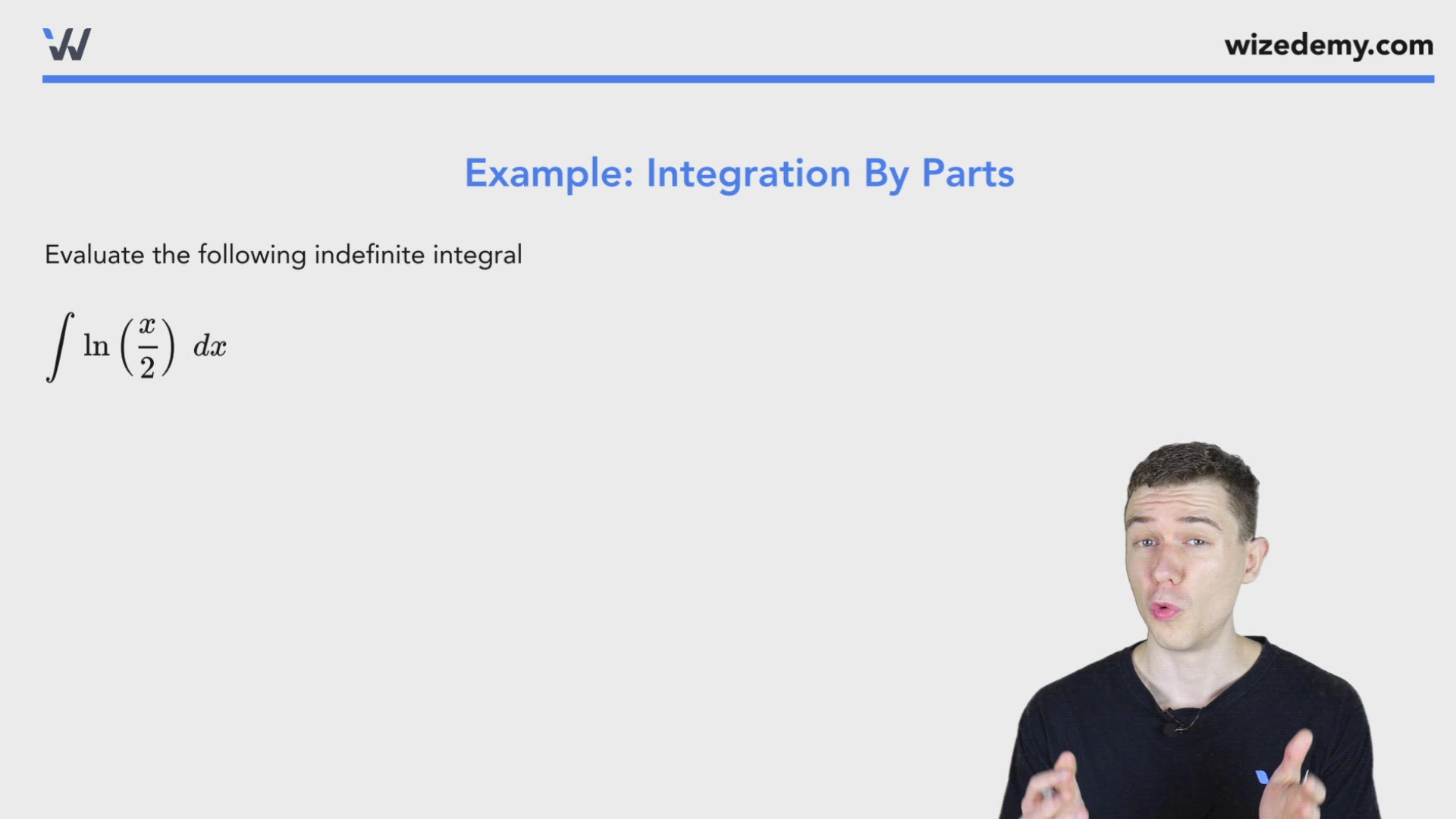
Example: Integration By Parts
Evaluate the following indefinite integral
1. ln/log: and algebra: (*tricky)
2. Let and
3. Then
and
4. The new integral becomes:
0:00 / 0:00
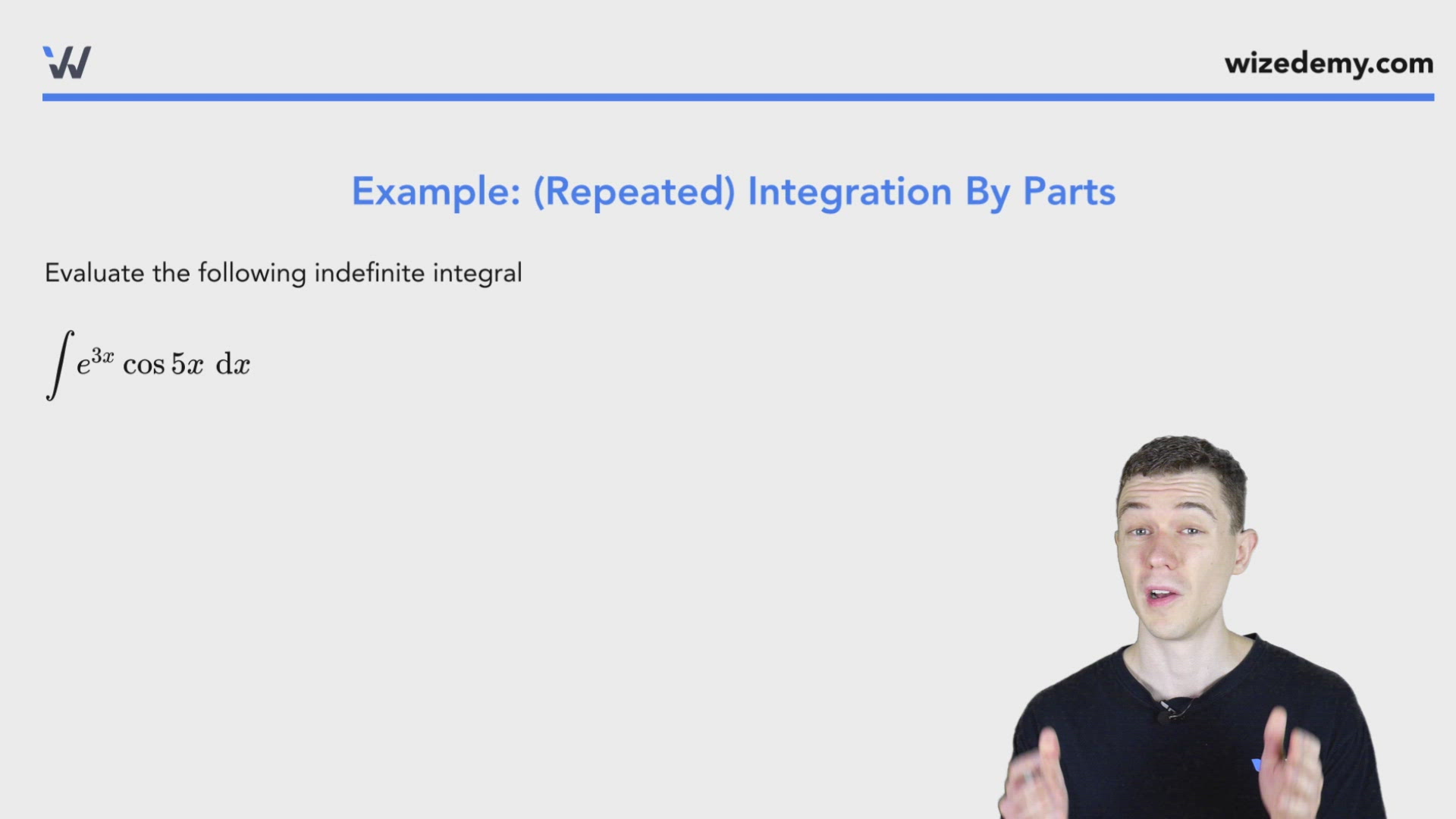
Example: (Repeated) Integration By Parts
Evaluate the following indefinite integral
1. Exponential: and Trig:
2. Let and
3. Then and
4. The new integral becomes:
Notice that the integral has a product of two different function types, so we use I by P again:
1. Exponential: and Trig:
2. Let and
3. Then and
4. The new integral becomes:
The new integral looks like the original question.
Notice that this seems to repeat over and over again.
The trick here is to let (original integral).
We can rewrite:
or
Therefore,
Practice: Integration By Parts
Evaluate the following indefinite integral
Practice: Integration By Parts
Evaluate the following indefinite integral