0:00 / 0:00

Partial Fractions Decomposition

Sometimes we have to split up a fraction into multiple parts in order to integrate. This method is call Partial Fraction Decomposition (PFD).

Strategy

Wize Concept

Case 1: The denominator only has linear factors
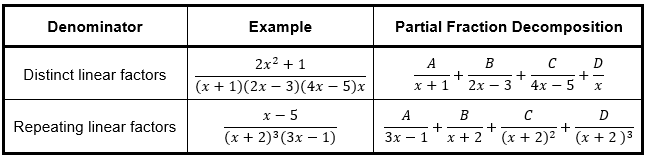

Case 2: The denominator has quadratic factors


PAGE BREAK

Steps For PFD

  1. If the degree of the numerator is greater than that of the denominator, do polynomial long division
  2. Factor the denominator fully
  3. Rewrite the rational function using the partial fractions decomposition
  4. Multiply both side of the equation by the factored denominator and simplify
  5. Solve for the constants: A,B,C,....
  6. Compute the new integral

Wize Concept
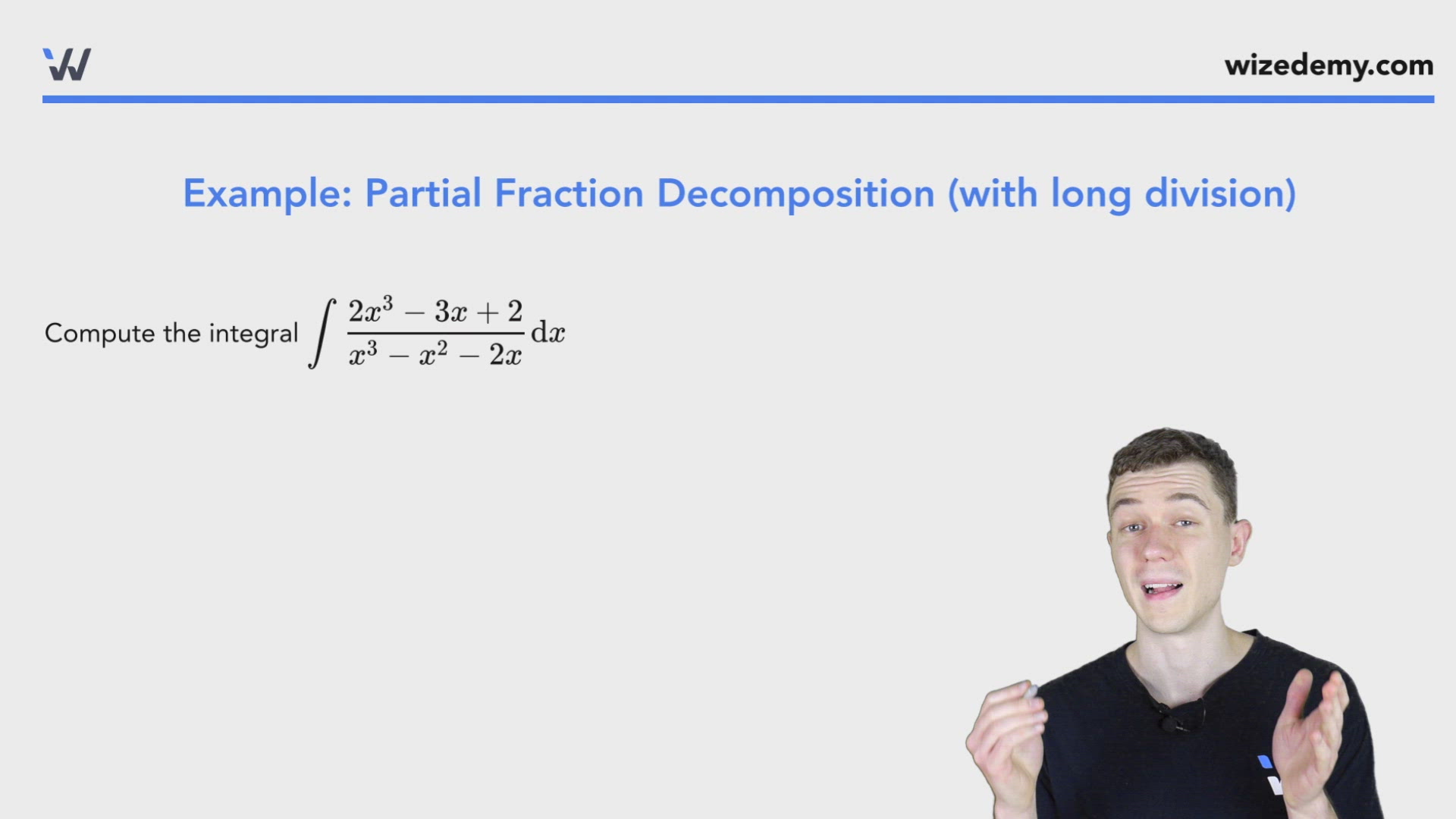
Remember the following useful integral formulas:
1ax+bdx=1alnax+b+C1x2+a2dx=1aarctan(xa)+C\begin{array}{c} \displaystyle \int\dfrac{1}{ax+b}dx=\frac{1}{a}\ln|ax+b|+C \\ \\ \displaystyle \int\frac{1}{x^2+a^2}dx=\frac{1}{a}\arctan \left(\frac{x}{a}\right)+C \end{array}


0:00 / 0:00

Example: Partial Fraction Decomposition (with long division)

Compute the integral 2x33x+2x3x22x  ⁣dx\displaystyle\int\frac{2x^3-3x+2}{x^3-x^2-2x}\de{x}

1. If degree of numerator \ge degree of denominator, use long division
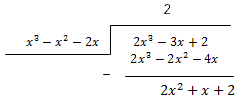
So, we can rewrite:
2x33x+2=2(x3x22x)+(2x2+x+2)2x^3-3x+2=2\left(x^3-x^2-2x\right)+\left(2x^2+x+2\right)

Rewriting the rational function:
2x33x+2x3x22x=2(x3x22x)+(2x2+x+2)x3x22x=2+2x2+x+2x3x22x\displaystyle \frac{2x^3-3x+2}{x^3-x^2-2x}=\frac{2\left(x^3-x^2-2x\right)+\left(2x^2+x+2\right)}{x^3-x^2-2x}=2+\frac{2x^2+x+2}{x^3-x^2-2x}.
2. Factor the denominator fully

2+2x2+x+2x3x22x=2+2x2+x+2x(x2)(x+1)\displaystyle 2+\frac{2x^2+x+2}{x^3-x^2-2x}=2+\frac{2x^2+x+2}{x\left(x-2\right)\left(x+1\right)}
3. Rewrite the rational function into partial fraction form

We can ignore the constant (2) for now because it is not part of the rational function.
Since we only have distinct linear factors in the denominator:
2x2+x+2x(x2)(x+1)=Ax+Bx2+Cx+1\displaystyle \frac{2x^2+x+2}{x\left(x-2\right)\left(x+1\right)}=\frac{A}{x}+\frac{B}{x-2}+\frac{C}{x+1}
4. Multiply both sides by the factored denominator and simplify

2x2+x+2=A(x2)(x+1)+B(x)(x+1)+C(x)(x2)2x^2+x+2=A\left(x-2\right)\left(x+1\right)+B\left(x\right)\left(x+1\right)+C\left(x\right)\left(x-2\right)
5. Solve for constants A, B, C,...

Let x=0x=0: 2=A(2)(1)A=12=A\left(-2\right)\left(1\right)\to A=-1
Let x=2x=2: 12=B(2)(3)B=212=B\left(2\right)\left(3\right)\to B=2
Let x=1x=-1: 3=C(1)(3)C=13=C\left(-1\right)\left(-3\right)\to C=1
Hence, 2x33x+2x3x22x=21x+2x2+1x+1\displaystyle \frac{2x^3-3x+2}{x^3-x^2-2x}=2-\frac{1}{x}+\frac{2}{x-2}+\frac{1}{x+1}
6. Solve the new integral

=(21x+2x2+1x+1)dx=\displaystyle \int\left(2-\frac{1}{x}+\frac{2}{x-2}+\frac{1}{x+1}\right)dx

=2xlnx+2lnx2+lnx+1+C=2x-\ln\left|x\right|+2\ln\left|x-2\right|+\ln\left|x+1\right|+C
0:00 / 0:00

Example: Partial Fraction Decomposition (with rationalizing the denominator)

Evaluate the following indefinite integral

3xx+2dx\displaystyle \int\frac{3}{x-\sqrt{x+2}}dx

Wize Concept
Sometimes, when we have ...x...n\sqrt[n]{...x...}, we can do the following:
1. Let u=...x...nu=\sqrt[n]{...x...}
2. Then un=...x...u^n=...x... and we can solve for x=...un...x=...u^n...
3. Find dx=...dudx=...du
4. Substitute back into the integral so it's now in terms of uu

Let u=x+2u=\sqrt{x+2}, then u2=x+2u^2=x+2 and x=u22x=u^2-2.
The differential is dx=2u dudx=2u\ du.
Substituting this all in, the new integral is:
3(u22)u(2u du)\displaystyle \int\frac{3}{\left(u^2-2\right)-u}\left(2u\ du\right)

=6uu2u2du=6\displaystyle \int\frac{u}{u^2-u-2}du

=6u(u2)(u+1)du=6\displaystyle \int\frac{u}{\left(u-2\right)\left(u+1\right)}du

Using partial fraction decomposition:
u(u2)(u+1)=Au2+Bu+1\displaystyle \frac{u}{\left(u-2\right)\left(u+1\right)}=\frac{A}{u-2}+\frac{B}{u+1}
u=A(u+1)+B(u2)u=A\left(u+1\right)+B\left(u-2\right)
Let u=1:   1=3B      B=13u=-1:\ \ \ -1=-3B\ \ \ \to\ \ \ B=\frac{1}{3}
Let u=2:   2=3A      A=23u=2:\ \ \ 2=3A\ \ \ \to\ \ \ A=\frac{2}{3}

So, the integral becomes:
=6[23(u2)+13(u+1)]du=6\displaystyle \int\left[\frac{2}{3\left(u-2\right)}+\frac{1}{3\left(u+1\right)}\right]du

=6[23lnu2+13lnu+1]+C=6\left[\frac{2}{3}\ln\left|u-2\right|+\frac{1}{3}\ln\left|u+1\right|\right]+C

=4lnu2+2lnu+1+C=4\ln\left|u-2\right|+2\ln\left|u+1\right|+C

=4lnx+22+2lnx+2+1+C=4\ln\left|\sqrt{x+2}-2\right|+2\ln\left|\sqrt{x+2}+1\right|+C

Example: Partial Fraction Decomposition (with repeated factors)

Evaluate the following indefinite integral

x4+x3+6x2+2x+4x(x2+2)2dx\displaystyle\int\frac{x^4+x^3+6x^2+2x+4}{x(x^2+2)^2}dx

1. No need for long division

2. The denominator is already fully factored

3. Rewrite the rational function into partial fraction form

x4+x3+6x2+2x+4x(x2+2)2 = Ax + Bx+Cx2+2 + Dx+E(x2+2)2\displaystyle \frac{x^4+x^3+6x^2+2x+4}{x(x^2+2)^2} \space = \space \frac{A}{x} \space + \space\frac{Bx+C}{x^2+2} \space+\space\frac{Dx+E}{(x^2+2)^2}

4. Multiply both sides by the factored denominator

x4+x3+6x2+2x+4= A(x2+2)2 + (Bx+C)(x)(x2+2) + (Dx+E)(x)x^4+x^3+6x^2+2x+4=\ A(x^2+2)^2\ +\ (Bx+C)\left(x\right)(x^2+2)\ +\ (Dx+E)\left(x\right)
5. Solve for A, B, C,...

Let x=0x=0 : 4=A(4) A=14=A\left(4\right)\ \to A=1
Let x=1x=1: 14=A(9)+(B+C)(1)(3)+(D+E)(1)14=A\left(9\right)+\left(B+C\right)\left(1\right)\left(3\right)+\left(D+E\right)\left(1\right)
Simplifying and subbing in A value: 14=9+3B+3C+D+E 114=9+3B+3C+D+E\ \text{\textcircled1}
Let x=1x=-1: 8=A(9)+(CB)(1)(3)+(ED)(1)8=A\left(9\right)+\left(C-B\right)\left(-1\right)\left(3\right)+\left(E-D\right)\left(-1\right)
Simplifying and subbing in A value: 8=9+3B3C+DE 28=9+3B-3C+D-E\ \text{\textcircled2}
Let x=2x=2: 56=A(36)+(2B+C)(2)(6)+(2D+E)(2)56=A\left(36\right)+\left(2B+C\right)\left(2\right)\left(6\right)+\left(2D+E\right)\left(2\right)
Simplifying and subbing in A value: 28=18+12B+6C+2D+E 328=18+12B+6C+2D+E\ \text{\textcircled3}
Let x=2x=-2: 32=A(36)+(C2B)(2)(6)+(E2D)(2)32=A\left(36\right)+\left(C-2B\right)\left(-2\right)\left(6\right)+\left(E-2D\right)\left(-2\right)
Simplifying and subbing in A value: 16=18+12B6C+2DE 416=18+12B-6C+2D-E\ \text{\textcircled4}

Now we need to combine the equations:
21: 6=6C2E\text{\textcircled2}-\text{\textcircled1}:\ -6=-6C-2E
43:12=12C2E\text{\textcircled4}-\text{\textcircled3}:-12=-12C-2E
Then, we subtract these two equations to get 6=6CC=16=6C\to C=1, and so E=0E=0.
2+1:22=18+6B+2D\text{\textcircled2}+\text{\textcircled1}:22=18+6B+2D
4+3:44=36+24B+4D22=18+12B+2D\text{\textcircled4}+\text{\textcircled3}:44=36+24B+4D\to22=18+12B+2D
Then, we subtract these two equations to get 0=6BB=00=-6B\to B=0, and so D=2D=2
Substituting the constants and simplifying, we get x4+x3+6x2+2x+4x(x2+2)2=1x+1x2+2+2x(x2+2)2\frac{x^4+x^3+6x^2+2x+4}{x\left(x^2+2\right)^2}=\frac{1}{x}+\frac{1}{x^2+2}+\frac{2x}{\left(x^2+2\right)^2}.
6. Solve the new integral

x4+x3+6x2+2x+4x(x2+2)2  ⁣dx =1x  ⁣dx + 1x2+2  ⁣dx + 2x(x2+2)2  ⁣dx\displaystyle\int\frac{x^4+x^3+6x^2+2x+4}{x(x^2+2)^2}\de{x} \space = {\displaystyle\int}\frac{1}{x}\de{x} \space +\space {\displaystyle\int}\frac{1}{x^2+2}\de{x}\space +\space {\displaystyle\int}\frac{2x}{(x^2+2)^2}\de{x}
=lnx+12arctan(x2)1x2+2+C\displaystyle =\ln\left|x\right|+\frac{1}{\sqrt{2}}\arctan\left(\frac{x}{\sqrt{2}}\right)-\frac{1}{x^2+2}+C
*Note, we need to use a U-sub for the last integral.

Practice: Partial Fraction Decomposition

Evaluate the integral

x4+1x2+1dx\displaystyle\int \frac{x^4+1}{x^2+1}dx

Practice: Partial Fraction Decomposition

Compute

3x21x4+x3dx\displaystyle\int\frac{3x^2-1}{x^4+x^3}dx
Extra Practice