Popular Courses
Calculus 1
University Study Guides
MATH 1LS3
McMaster University
MATH 249
University of Calgary
MATH 265
University of Calgary
Calculus 1
General Course
MATH 140
McGill University
MATH*1080
University of Guelph
MATH 134
University of Alberta
Calculus 1
University Study Guides
MAT 1320
University of Ottawa
MATH 100
University of Alberta
MAT 1330
University of Ottawa
MTH 140
Toronto Metropolitan University
SC/MATH 1013 3.00
York University
SC/MATH 1506 3.00
York University
MATH-1720
University of Windsor
NMM 1412A/B
Western University
MATH 100
University of Victoria
MAT137Y1
University of Toronto
MATH 180
University of British Columbia
0:00 / 0:00
Rolle's Theorem
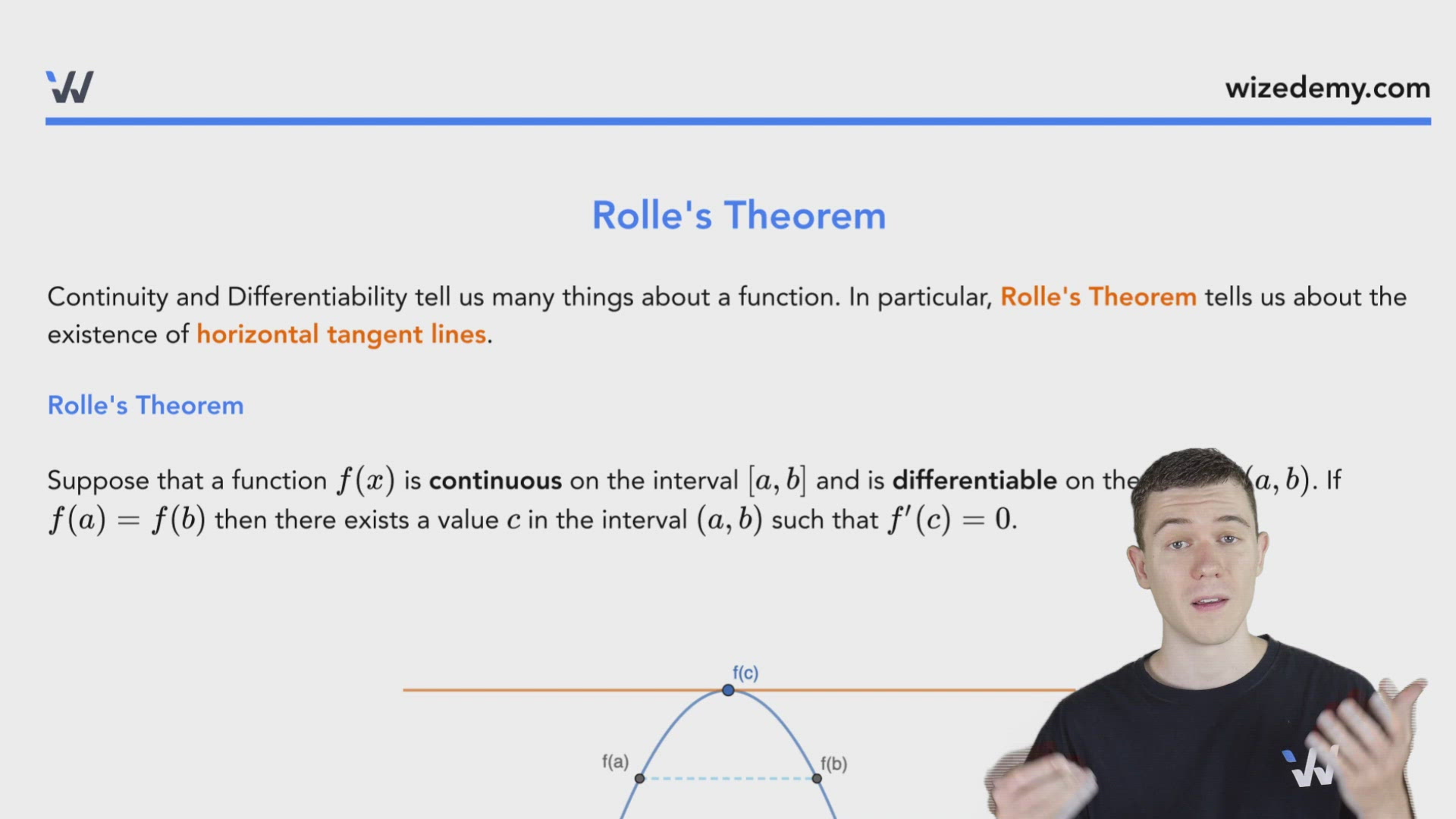
Continuity and Differentiability tell us many things about a function. In particular, Rolle's Theorem tells us about the existence of horizontal tangent lines.
Rolle's Theorem
Suppose that a function is continuous on the interval and is differentiable on the interval . If then there exists a value in the interval such that .

Note: In other words, since is continuous and differentiable, then in between every two points and with the same image, the function must have a maximum or a minimum.
0:00 / 0:00
Example: Rolle's Theorem
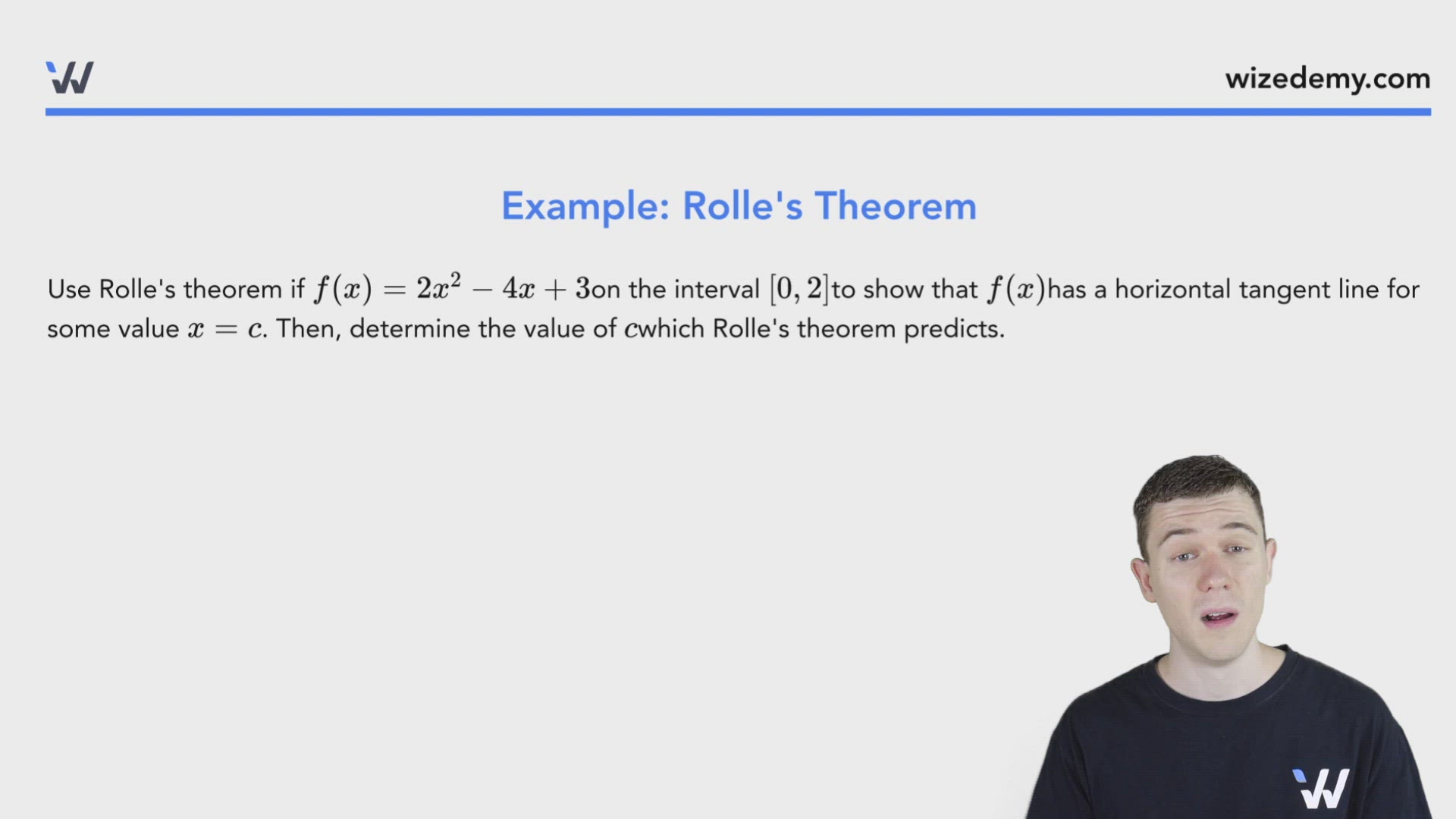
Use Rolle's theorem if on the interval to show that has a horizontal tangent line for some value . Then, determine the value of which Rolle's theorem predicts.
is continuous and differentiable on . Also, , so all of the hypotheses of Rolle's theorem are met with .
So, by Rolle's theorem, there must exist some value such that .
Now, let's find the value of .
, and

Mark Yourself Question
- Grab a piece of paper and try this problem yourself.
- When you're done, check the "I have answered this question" box below.
- View the solution and report whether you got it right or wrong.
The function has no horizontal tangent lines on the interval , even though . Why doesn't this contradict Rolle's Theorem?