Wize University Calculus 1 Textbook > Derivatives
Derivatives as a Rate of Change
Popular Courses
CALCULUS 1000A/B
Western University
Calculus 1
University Study Guides
AP Calculus (AB) Exam Prep Course
AP Exam Prep
MATH 209
Concordia University
MATH 100A
University of British Columbia
MATH 100C
University of British Columbia
MATH 249
University of Calgary
MATH 265
University of Calgary
Calculus 1
General Course
MATH 275
University of Calgary
MATH 140
McGill University
MATH 121
Queen's University
MAT135H1
University of Toronto
MATH*1080
University of Guelph
MATH 134
University of Alberta
Calculus 1
University Study Guides
MATH 154
University of Alberta
MAT 1320
University of Ottawa
MATH 100
University of Alberta
MATH 100B
University of British Columbia

0:00 / 0:00
Derivatives as a Rate of Change
Derivative is a fancy word for rate of change. The derivative is of a function tells us how much the function is changing at any value we wish!
Instantaneous Rate of Change (Slope of the Tangent Line)
The derivative gives the instantaneous rate of change (geometrically the slope of the tangent line) of to the curve at any point where the function is differentiable.

Note: A function is differentiable on an interval only if it is continuous over that interval!
Notation for Derivatives
The derivative of the function is denoted:
If a function is constant, it has no rate of change. Thus the derivative of a constant, , is zero
0:00 / 0:00
Average Rate of Change
The average rate of change of a function from to is defined as
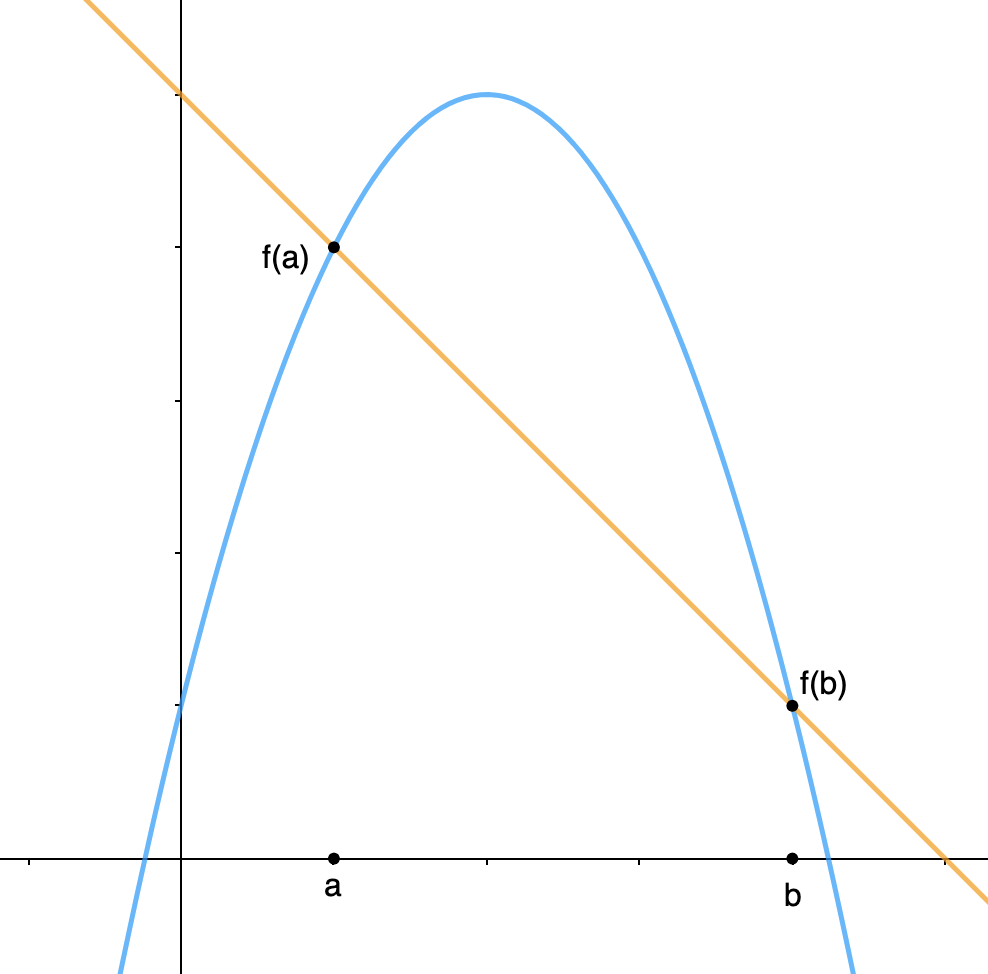
Geometrically, this is the slope of the secant drawn to the graph of over the interval .
0:00 / 0:00
Example: Average Rate of Change
Suppose that a company’s total cost (in dollars) to carry out a production of units of its product is given by . Find the average rate of change of the total cost for the first units produced.
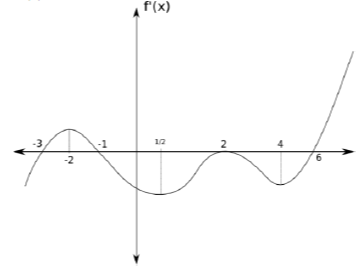
plot for a differentiable function is depicted as below. Find interval(s) for which is increasing.