
Initial Conditions
We don't always get unique answers for . Instead we get . If we are given some initial conditions for the function, we can find this constant by substituting the coordinates and solving for .
Finding f(x) from f'(x)
To recover from , given:
- Antiderive to obtain . (Don't forget )
- Substitute to solve for .
- Rewrite with the value of.
Finding f(x) from f''(x)
To recover from , given two initial conditions, we have to integrate twice:
- Antiderive to obtain . (Don't forget )
- Antiderive to obtain .
- The second time we antiderive we pick up another constant of integration , and we get .
- Substitute the given conditions to find and .
- Rewrite with the values of and .
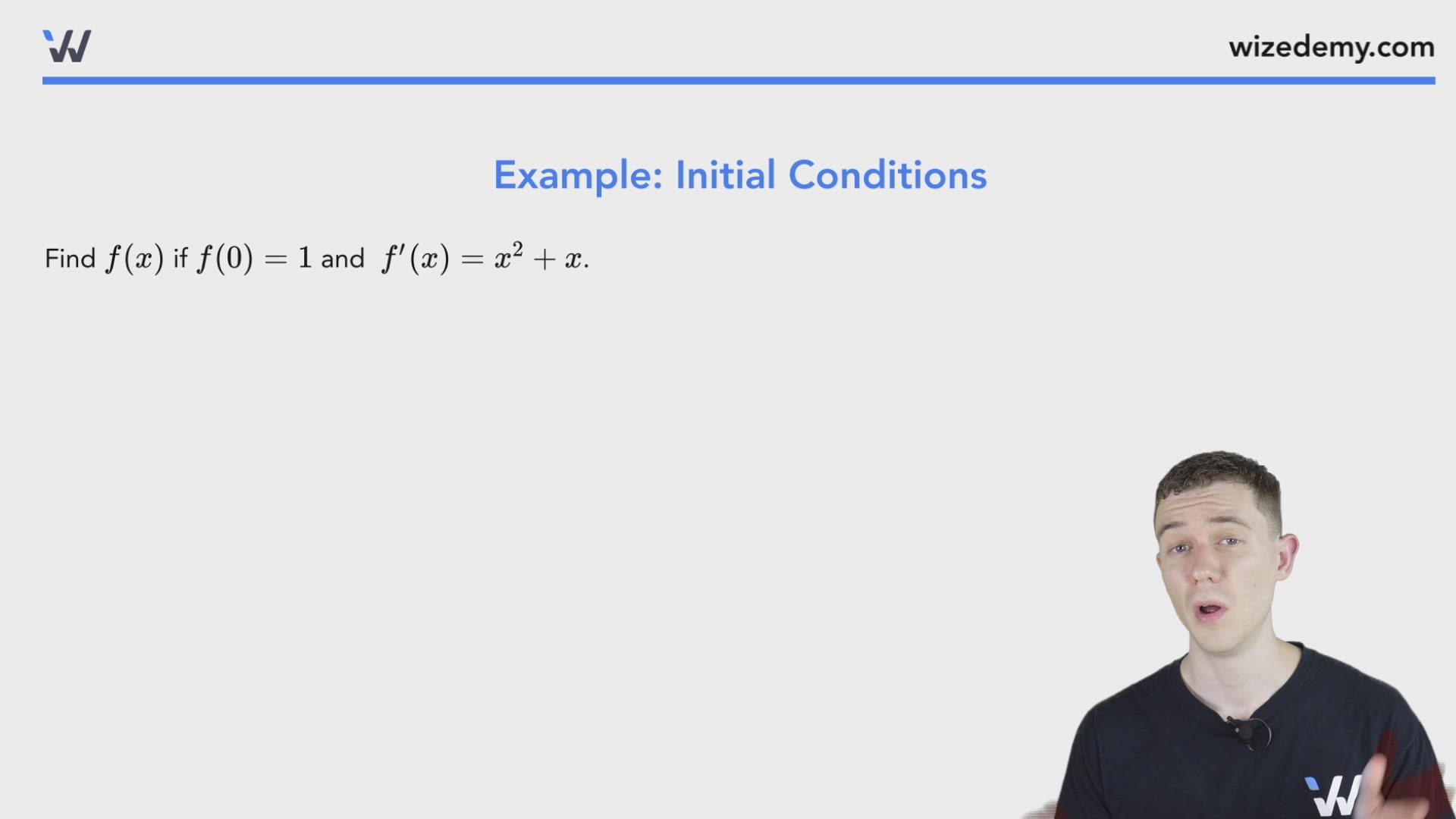
Example: Initial Conditions
Find if and .
Now substitutte the intial condition