Wize University Linear Algebra Textbook > Matrices
Elementary Matrices
Popular Courses
MATH 211
University of Calgary
MATH 1229A/B
Western University
Linear Algebra
University Study Guides
MATH 133
McGill University
MATH 1ZC3
McMaster University
MATH 152
University of British Columbia
MATH 1600A/B
Western University
Linear Algebra
General Course
MAT188H1
University of Toronto
Linear Algebra
University Study Guides
MTH 141
Toronto Metropolitan University
APSC 174
Queen's University
MATH 102
University of Alberta
MATH 115
University of Waterloo
MAT133Y1
University of Toronto
MATH 1B03
McMaster University
MAT223H1
University of Toronto
MATH 123
McGill University
MATH-1270
University of Windsor
MATH 1210
University of Manitoba

0:00 / 0:00
Elementary Matrices
An elementary matrix is a square matrix that is equivalent to the identity matrix after one elementary row operation.
Idea: take the identity matrix and perform one ERO on it. The result is an elementary matrix.
Examples
perform on
perform on
perform on
Elementary Matrices and Matrix Multiplication
When a matrix is left multiplied by an elementary matrix , the result is identical to performing the row operation that created on .
Think of elementary matrices as "encoding" the row operation that created them.
Examples
Let .
Let ( on ). Find .
The row operation that created (swapping rows) is performed on .
Let ( on ). Find .
Let ( on ). Find .
Elementary Matrices and the Matrix Inverse Algorithm
Elementary matrices are the reason the matrix inverse algorithm works.
We can "encode" the sequence of row operations that changes into as a product of elementary matrices.
So applying the same sequence of operations to gives:
Wize Tip
Remember to always multiply each new elementary matrix on the left ( should be closest to ).
Inverse of Elementary Matrices
- Every elementary matrix is invertible; the "opposite" ERO reduces to .
- The inverse of an elementary matrix is an elementary matrix.
Using these facts along with the sequence that produces , we can conclude:
Wize Concept
If is invertible, then it can be written as a product of elementary matrices.
0:00 / 0:00
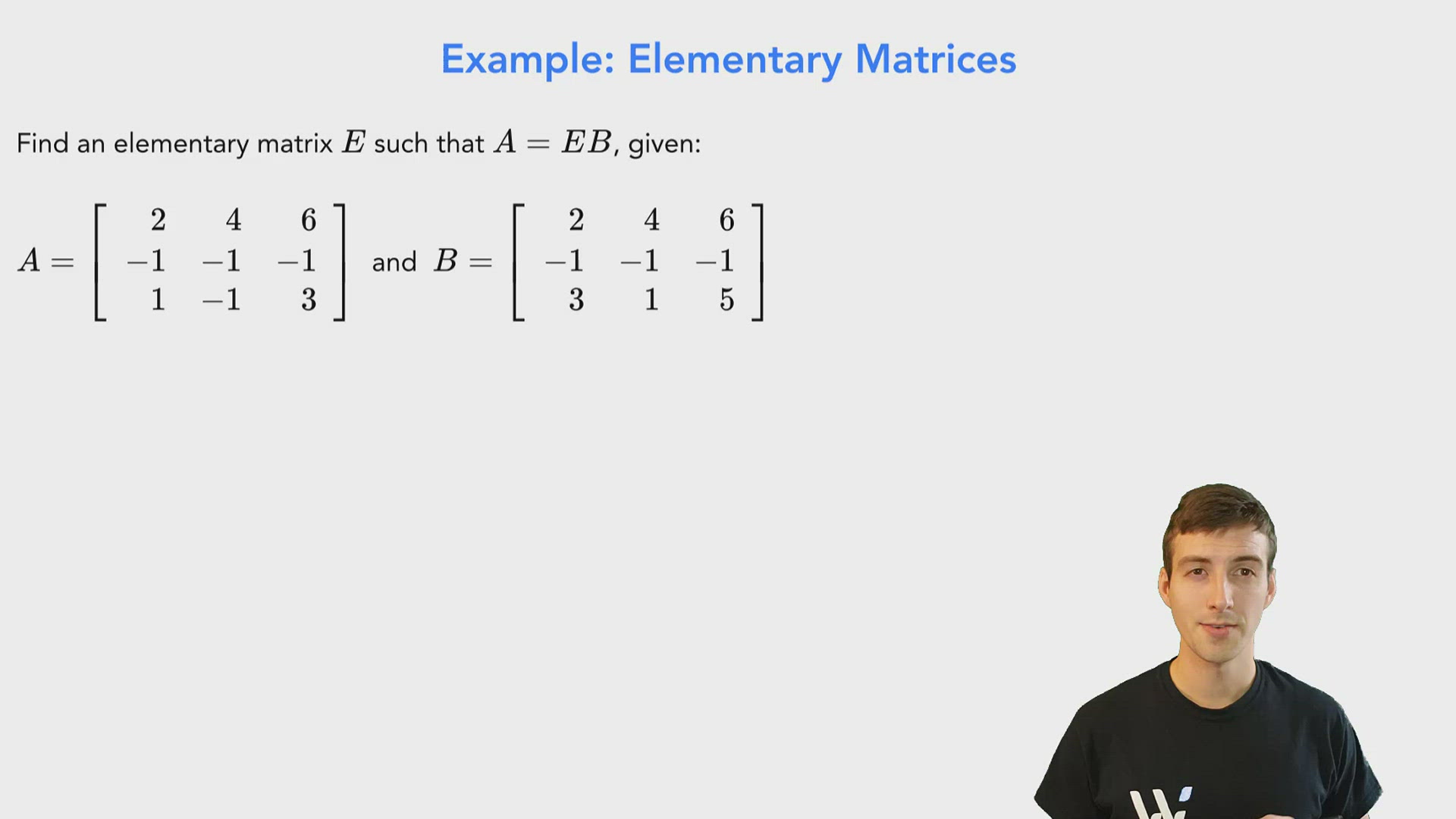
Example: Elementary Matrices
Find an elementary matrix such that , given:
and
Think: what row operation can we perform on to turn it into ?
Notice that rows 1 and 2 don't change; only row 3 is different.
The row operation must be performed on row 3.
Therefore, the rows were not swapped, and we can see that the entries in row 3 were not multiplied by a constant.
We can try , but this does not work out for the second and third entries of the row.
The only other operation that could have been performed is: .
Let's perform this operation on to create the elementary matrix:

0:00 / 0:00
Example: Elementary Matrices and Inverses
Let .
can be reduced to by performing the following EROs (in this order):
Using these row operations, find the elementary matrices and their inverses such that .
So
Finding Inverses of Elementary Matrices
We can find the inverse of an elementary matrix by performing the opposite operation on :
simply swapped rows, so swapping them again "undoes" the operation:
multiplied Row 1 by , so we can undo this by multiplying Row 1 by :
added 4 times Row 2 to Row 1, so we can undo this by subtracting 4 times Row 2 from Row 1:
Exercise: check this yourself!
Find an elementary matrix such that , given:
and
[Enter your answer for by filling in the missing entries in the matrix.]
| 0 | 0 | ||
| 0 | 0 | 1 | 0 |
| 0 | 0 | 0 | 1 |

Mark Yourself Question
- Grab a piece of paper and try this problem yourself.
- When you're done, check the "I have answered this question" box below.
- View the solution and report whether you got it right or wrong.
Let .
A) Using the matrix inverse algorithm, find .
B) Write as a product of elementary matrices.