Wize University Linear Algebra Textbook > Orthogonality
Orthogonal Complement and Orthogonal Projection (COMING SOON)
Popular Courses
Linear Algebra
University Study Guides
MATH 1600A/B
Western University
Linear Algebra
General Course
Linear Algebra
University Study Guides
APSC 174
Queen's University
MATH 115
University of Waterloo
MATH-1270
University of Windsor
MATH 1210
University of Manitoba
MATH 223
McGill University
MATH 1104
Carleton University
MATH 1300
University of Manitoba
MAT 1302
University of Ottawa
MATH 1107
Carleton University
STATS 1LL3
McMaster University
ENGM 1041
Dalhousie University
MATH 114
University of Waterloo
MATH 2114
Virginia Tech
MAT 242
Arizona State University - Tempe
MATH-1260
University of Windsor
MATH 3A
University of California - Irvine
Orthogonal Matrices
Orthogonal Matrix
A matrix is orthogonal if its columns form an orthonormal set.
I.e. Every column is a unit vector and the dot product of any two columns is zero.
An equivalent definition: is an orthogonal matrix if and only if .
Properties
Suppose is square () and . The following are equivalent:
- is an orthogonal matrix
Orthogonal Complement
Let be a subspace of .
The orthogonal complement of , denoted , is the set of vectors that are orthogonal to every vector in .
That is,
Example
Suppose is a plane in with normal vector . What is ?
Then must be in since, by definition, vector is orthogonal to the plane (meaning: orthogonal to every vector that lies in the plane).
Moreover, every scalar multiple of is orthogonal to .
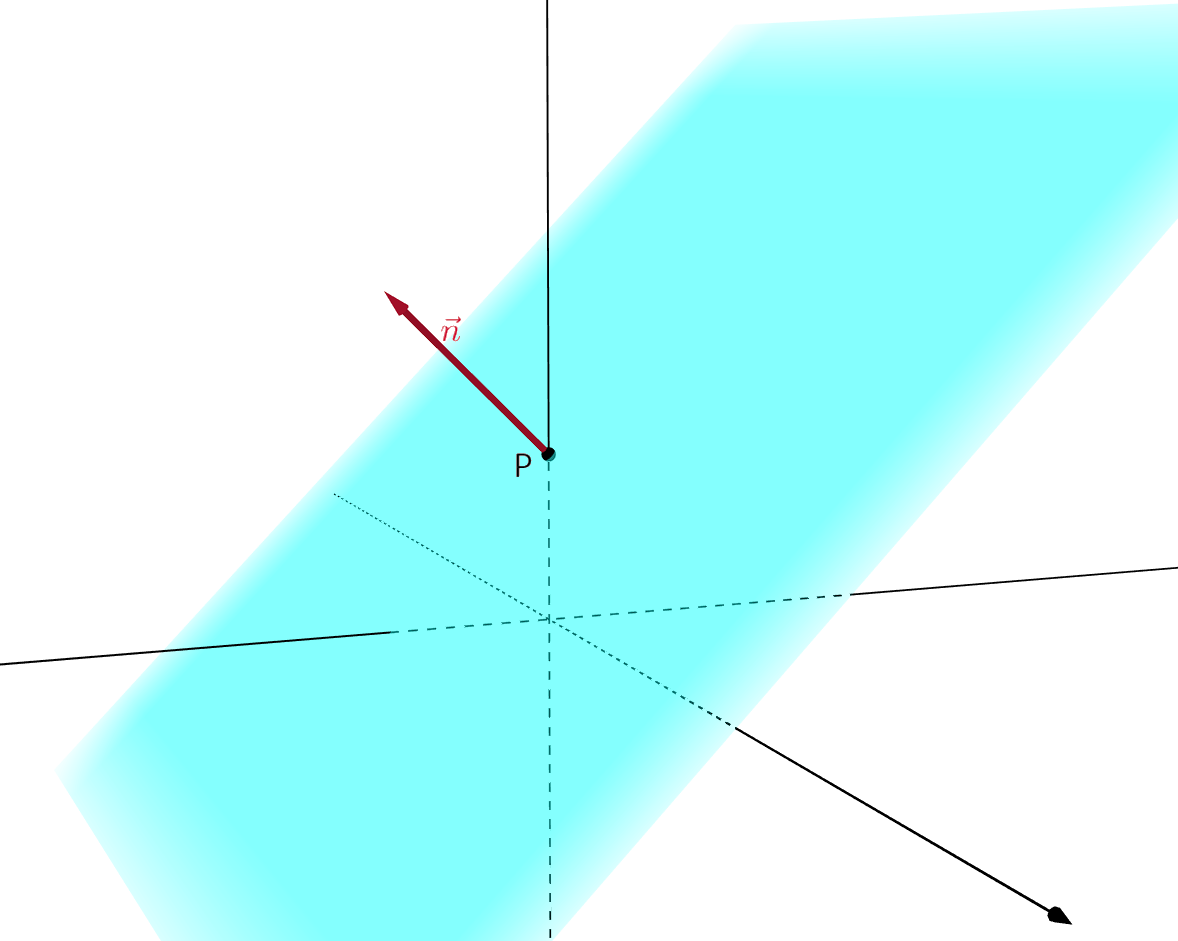
The set of scalar multiples of is a line, call it , and this line is the orthogonal complement of .
Conversely, the orthogonal complement of the line is the plane.
Properties
Given a subspace of :
- is a subspace of
- (no vector except can be in both)
Orthogonal Projection
We have seen projection of one vector onto another. Now we'll see projection onto an entire subspace!
Let be a subspace of with orthogonal basis .
The orthogonal projection of vector onto is the sum of the projections onto each basis vector:
Or, written out in full,
The projection must lie in (it's a linear combination of its basis vectors).
What is the complement of the line formed by this projection vector? The perp!
This is the basis (no pun intended) of the Gram-Schmidt orthogonalization process!
Why is this useful?
The projection of a vector onto a subspace is the best approximation of the vector in the subspace.
It also allows us to decompose a vector into two parts: one part in , and one orthogonal part in .
That is, for every vector in ,