SI Units
Some quantities have a lot of different units you can use. For example, for distance, we could use meters, yards, feet, miles, angstroms, astronomical units, parsecs, light-years...
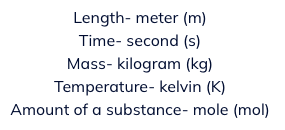
For communication, it helps to have a standard set of units. In chemistry we use base SI units as follows (SI: systeme internationale):
Prefixes
To represent orders of magnitude, we can add prefixes to any unit to scale them to the settings of our measurements.

Unit Analysis
- Unit analysis is a method of checking the dimensional consistency of a equation.
- Two sides of an equation must be equal numerically, but also in dimension.... units can cancel each other out!
- We can often use units to help guide us in answering questions and making sure we are on the right track.
Example: Unit Conversion
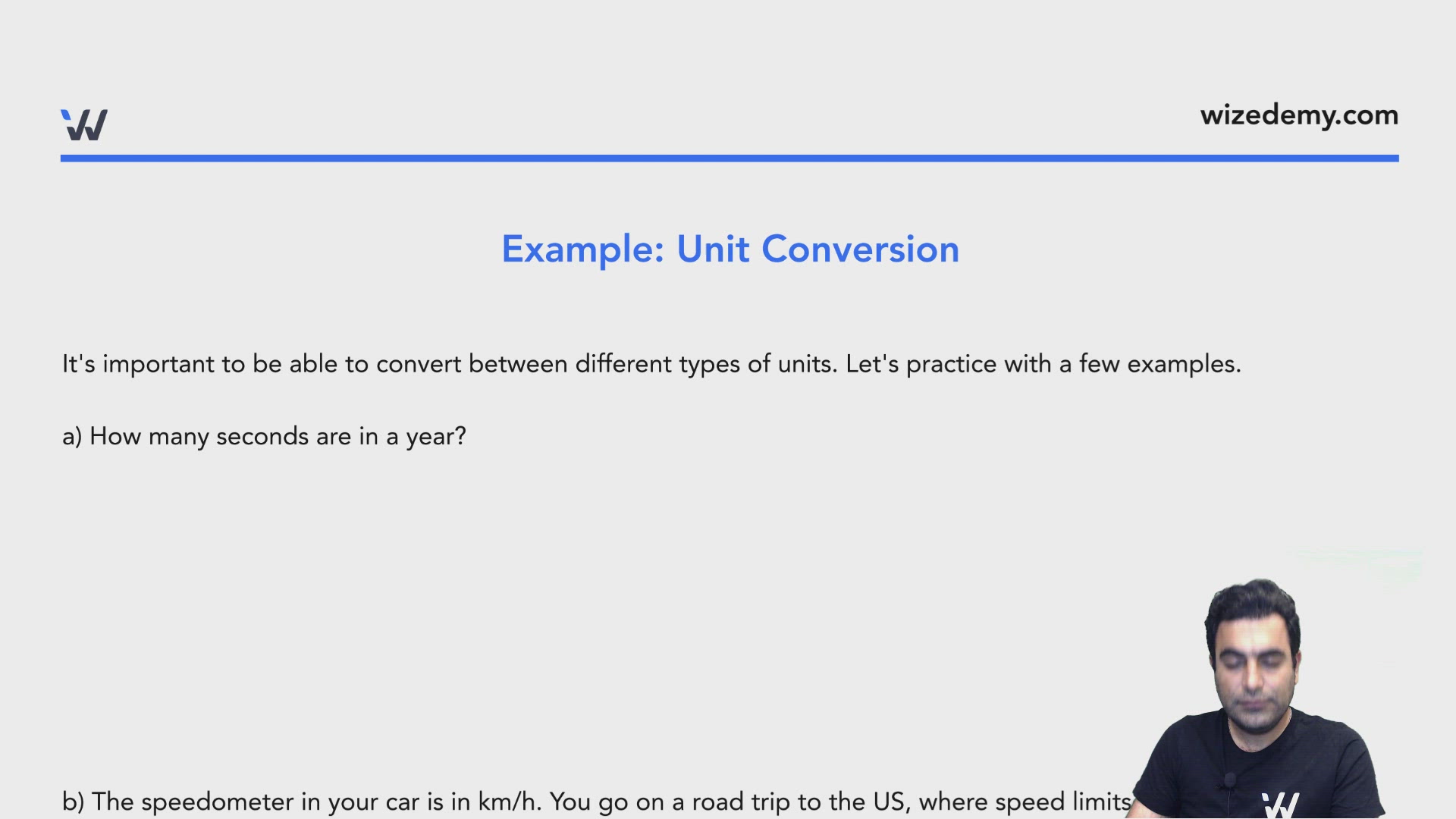
It's important to be able to convert between different types of units. Let's practice with a few examples.
a) How many seconds are in a year?
b) The speedometer in your car is in km/h. You go on a road trip to the US, where speed limits are posted in mph (miles per hour). You're on a highway with a 70 mph speed limit. If you are driving 110 km/h, are you speeding? (1 mile is 1.61 km.)
We need to convert our speed to mph.
This is less than the posted speed limit. We are not going to get a ticket!