Popular Courses
PHYSICS 1201A/B
Western University
Intro to Physics
University Study Guides
PHYSICS 1D03
McMaster University
AP Physics C: Mechanics Exam Prep Course
AP Exam Prep
Physics
General Course
PHYS 211
University of Calgary
PHYSICS 1401A/B
Western University
PCS 211
Toronto Metropolitan University
Intro to Physics
University Study Guides
PHYS*1300
University of Guelph
PHY 1321
University of Ottawa
APSC 111
Queen's University
PHYS 111
University of Waterloo
PCS 120
Toronto Metropolitan University
LE/PHYS 1800 3.00
York University
PHYS-1400
University of Windsor
PHY 1331
University of Ottawa
PHYS 142
McGill University
PHYS 115
University of Waterloo
PHYS 117
University of British Columbia
0:00 / 0:00
Momentum Conservation in the Center of Mass Frame
When looking at more complicated situations it is useful to consider the center of mass of the system.
Wize Concept
No matter how many objects or pieces we have before and after a collision (or explosion), the motion of the center of mass depends only on the net external force acting on the entire system.
- The center of mass behaves as though it were a single particle of combined mass located at an imaginary point, where that net external force would be applied.
- The location of the center of mass is where the mass of the entire system would be concentrated if you wanted to replace all other masses by just one big mass.
Exam Tip
You need to determine whether there is an external force acting on the system, and in which direction.
- If there is no external force, momentum is conserved in that direction. The center of mass will be either at rest or it will move with a constant velocity.
- If there is an external force, there will be an impulse on the center of mass in that direction.
Newton's Second Law applies as usual:
where is the acceleration of the center of mass.
0:00 / 0:00
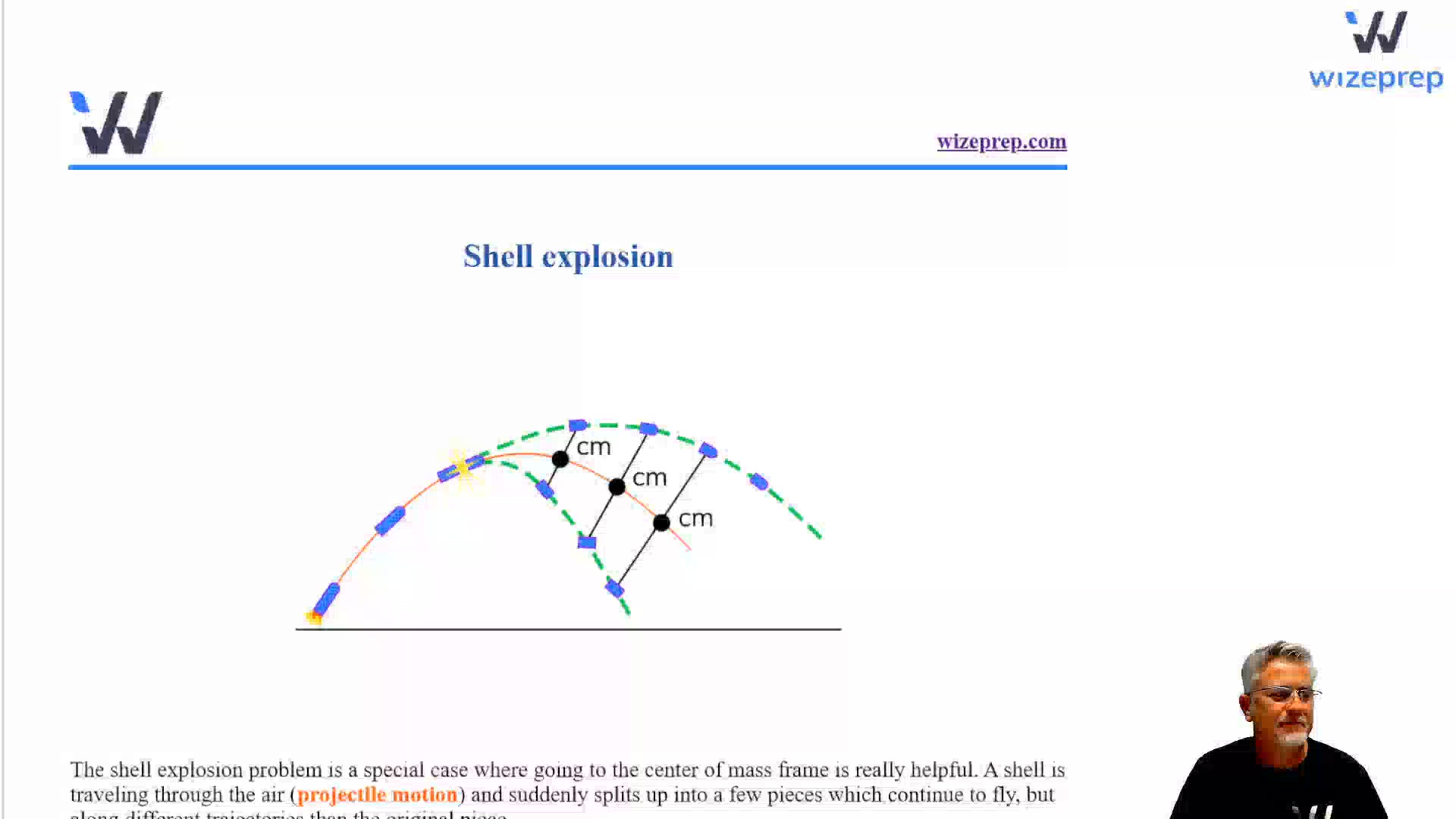
Shell explosion

The shell explosion problem is a special case where going to the center of mass frame is really helpful. A shell is traveling through the air (projectile motion) and suddenly splits up into a few pieces which continue to fly, but along different trajectories than the original piece.
Let's look at the forces that act on the objects in our system:
- In the horizontal direction there is no force at all, which means that the center of mass will move with a constant velocity.
- In the vertical direction there is the force of gravity, which means that we will have an impulse acting on the center of mass.