Wize University Physics Textbook (Master) > Angular / Rotational Motion
Rotation Kinematics
Popular Courses
PHYSICS 1201A/B
Western University
Intro to Physics
University Study Guides
PHYSICS 1D03
McMaster University
AP Physics C: Mechanics Exam Prep Course
AP Exam Prep
Physics
General Course
PHYS 211
University of Calgary
PHYSICS 1401A/B
Western University
PHYSICS 1401A/B
Western University
PHYS 101
McGill University
PCS 211
Toronto Metropolitan University
PHYS 204
Concordia University
PHYS 204
Concordia University
Intro to Physics
University Study Guides
PHYS*1080
University of Guelph
PHY 1321
University of Ottawa
PHYS 131
McGill University
APSC 111
Queen's University
PHYS 111
University of Waterloo
PHYS 110
University of Victoria
LE/PHYS 1800 3.00
York University

0:00 / 0:00
Kinematics Equations for Rotation
The parameters describing the translational motion have an analogue in rotational motion.
Angular velocity is the equivalent of linear velocity, angular acceleration is analogue to linear acceleration, and etc.

Kinematic equations for rotational motions are very similar to kinematic equations for linear motion. For a rotation with a constant angular acceleration:
Watch Out!
Note that for a uniform circular motion, .
Exam Tip
We can combine second and third equations above to find another useful equation which does not depend on angular acceleration:
0:00 / 0:00
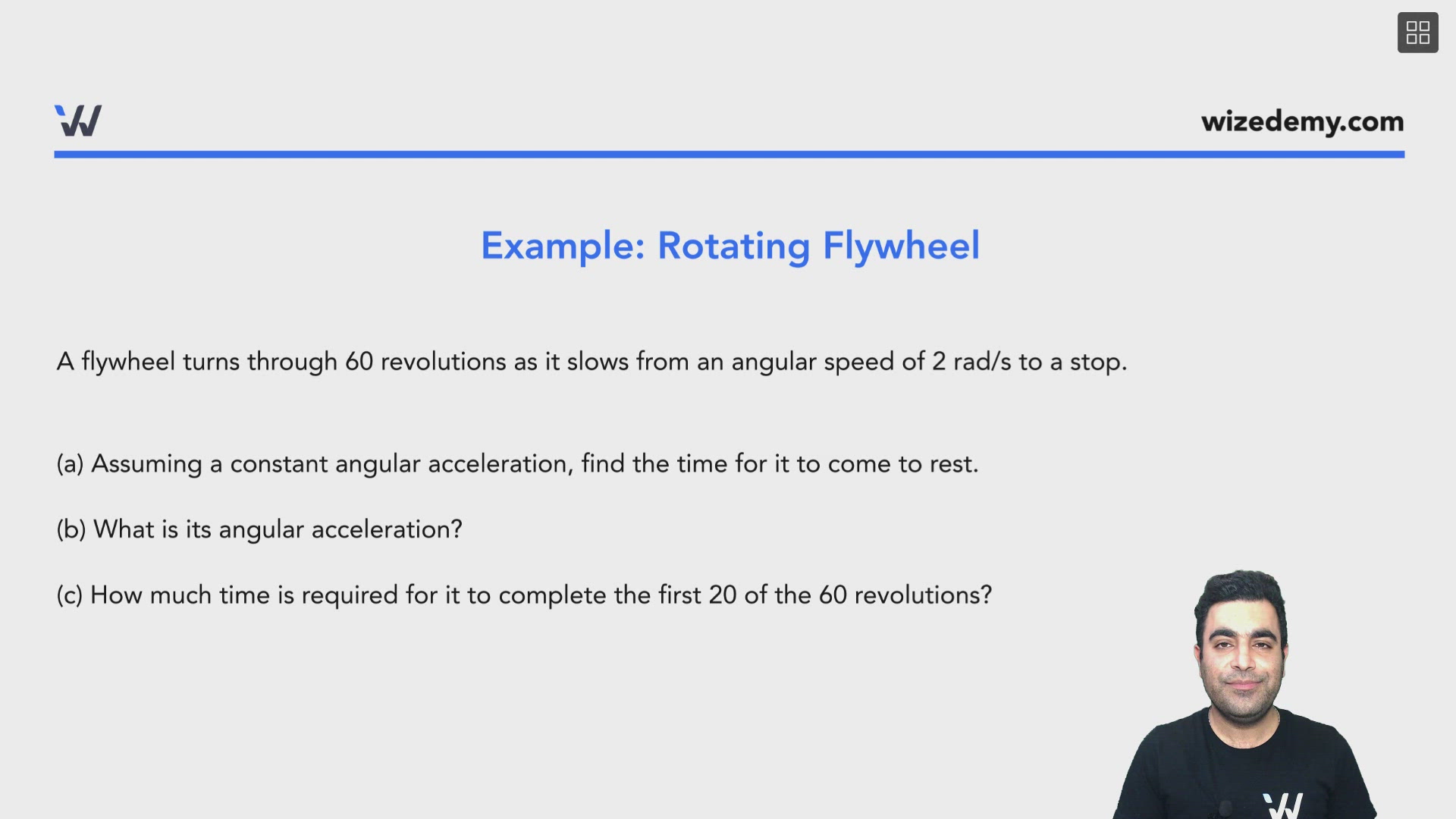
Example: Rotating Flywheel
A flywheel turns through 60 revolutions as it slows from an angular speed of 2 rad/s to a stop.
(a) Assuming a constant angular acceleration, find the time for it to come to rest.
(b) What is its angular acceleration?
(c) How much time is required for it to complete the first 20 of the 60 revolutions?
Solution:
Part a)
As angular acceleration is not given, we use the below formula to find the time for the flywheel to stop:
Note that here the flywheel turns through 60 revolutions before it stops, since each revolution covers . The net change in the angle for this rotation is . From the above equation:
Part b)
Now we can use another kinematic equation for rotation to solve for the angular acceleration:
Note that here the angular acceleration is negative which means that the angular speed is decreasing!
Part c)
We first need to find the angular speed when the flywheel makes 20 revs:
Now we use the formula below to find time:
A 10 kg mass is hanging from a rope wrapped around a cylindrical pulley. The falling mass causes the pulley to rotate. The mass of the pulley is 3 kg. (The moment of inertia of a solid cylinder with radius R and mass of M about its axis of symmetry is )
What is the acceleration of the falling mass? (choices are in )