Wize University Physics Textbook (Master) > Wave Optics
Light Waves at Boundaries
Popular Courses
MCAT
General Course
PHYSICS 1201A/B
Western University
Intro to Physics
University Study Guides
Physics
General Course
PHYSICS 1A03
McMaster University
PHYS 101
McGill University
Intro to Physics
University Study Guides
PHYS 124
University of Alberta
PHY 1122
University of Ottawa
PHYS 142
McGill University
ENGG 212
University of Calgary
PHYS 102B
University of Victoria
PHYS 111
University of Victoria
PHYS 1050
University of Manitoba
PHYS 101
Simon Fraser University
PHYS-1300
University of Windsor
PHY 1121
University of Ottawa
PHYS 121
University of Waterloo
PHYS 206
Concordia University
PHYS 227
University of Calgary
Reflection

- Light will bounce off when it hits a hard reflecting surface (e.g. a mirror), or the boundary between two media (e.g. when it passes from water to air, or from air to water).
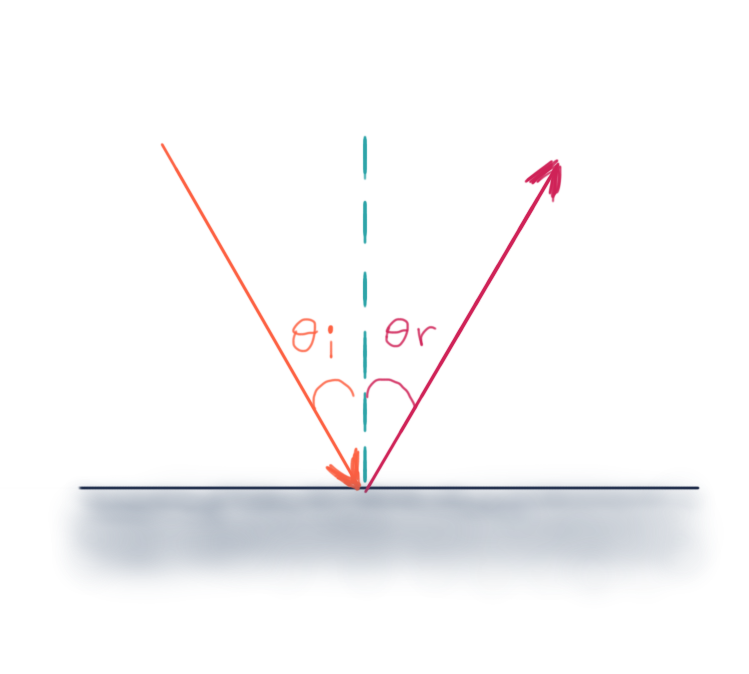
- The angle of incidence is always the same as the angle of reflection :
Exam Tip
The angles are always measured relative to the normal (perpendicular) to the surface, so draw the normal line first, then label the angles relative to it.
NOTE: In this chapter we will not consider refraction. For simplicity, we'll assume that our waves are almost perpendicular so that no refraction occurs, only reflection.
Phase Shift at Reflection Boundaries
Like mechanical waves, light waves may change phase when they get reflected. The phase shift will depend on the boundary conditions.
- Light will have a phase shift of (or ) at boundaries with bigger refractive index
(slower medium / hard reflection / closed boundary / fixed boundary).
- Light will have no phase shift at boundaries with smaller refractive index
(faster medium / soft reflection / open boundary / free boundary).
Exam Tip
There is no phase shift for transmitted waves. The only phase shift will come from the reflected waves.